
 Worksheets
LHS HB Macroevolution
Total questions: 38
Worksheet time: 38mins
Name
Class
Date
1.
T9. Which type of speciation occurred when maggot flies living on harthorns began to feed on apples?
a)
Allopatric
b)
Sympatric
2.
T9. What type of speciation involves geographic isolation?
a)
Allopatric
b)
Sympatric
c)
Both
3.

T9. What type of speciation is this?
a)
Allopatric speciation
b)
Sympatric speciation
c)
Polyploidy
d)
Adaptive radiation
4.
T9. What type of speciation involves reproductive isolation?
a)
Allopatric
b)
Sympatric
c)
Both
5.
T9. Which type of speciation occurred when a few finches were blown from the coast of South America to the Galapagos Islands and then evolved into 14 different finch species?
a)
Allopatric
b)
Sympatric
6.
T9. What type of speciation involves isolation due to behavior such as sexual selection or habitat differentiation?
a)
Allopatric
b)
Sympatric
c)
Both
7.
T10. What are prezygotic isolating mechanisms?
a)
They prevent reproductive attempts and make it unlikely that fertilization will be successful if mating occurs.
b)
When animal genitalia or plant floral structures are incompatible, reproduction can not occur
c)
Courtship patterns used to allow male and female to recognize one another
d)
A biological trait evolves in two unrelated species as a result of exposure to similar environments
8.

T10. What are postzygotic isolating mechanisms?
a)
A diploid cell resulting from the fusion of two haploid gametes
b)
Barriers that prevent the formation of a fertile offspring
c)
They prevent reproductive attempts
d)
The mating between two species
9.

T10. What explains Reproductive isolation?
a)
A biological trait evolves in two unrelated species as a result of exposure to similar environments
b)
Barriers that prevent species from producing a fertile offspring or producing an offspring at all.
c)
Barriers that prevent the formation of a fertile offspring
d)
The mating between two species
10.

T11. Which best defines homologous structures
a)
structures with same function different ancestors
b)
reduced form of a structure indicating shared ancestry
c)
adapting to surrounding
d)
similar structures inherited from a common ancestor
11.

T11. This image shows that
a)
These animals have no simliarities in their structures.
b)
two different species may have evolved from a common ancestor.
c)
These animals are from the same species.
d)
These animals likely evolved from different ancestors due to their differences.
12.
T11. This kind of structure is when the structures have the same function but have a different structure. (bird wings and bat wings)
a)
analogous structure
b)
homologous structure
c)
vestigial structure
13.
T11. This kind of structure are body parts that have no function now and are now the remains from an ancestor.
a)
analogous structure
b)
homologous structure
c)
vestigial structure
14.
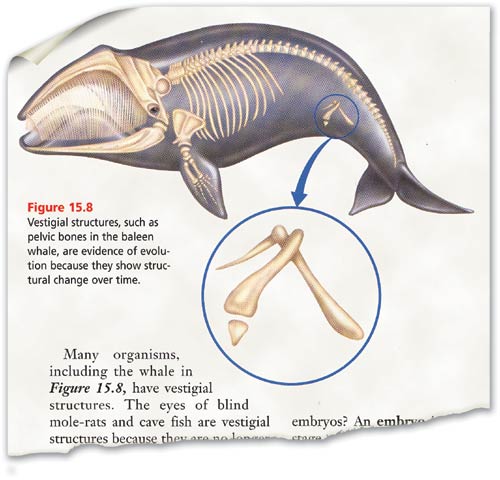
T11. Which of the following is an example of a vestigial structure?
a)
the wings of a red-tailed hawk
b)
the hind limbs of a house cat
c)
the fins of sharks
d)
the tailbone of a human
15.
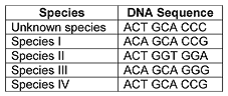
T12. According to this data, the unknown species is most closely related to:
a)
Species I
b)
Species II
c)
Species III
d)
Species IV
16.
T12. When you compare DNA or proteins to support evolution, you are using what kind of evidence?
a)
anatomical evidence
b)
molecular evidence
c)
fossil evidence
17.
T12. There are three species of birds on an island. Bird A has a heavy bill for eating seeds. Bird B has a pointed bill for eating insects. Bird C has a sharp bill for eating both insects and seeds. If all insects on the island suddenly disappeared, which bird or birds would be the LEAST affected?
a)
Bird A
b)
Bird B
c)
Bird C
d)
Bird A and Bird B
18.

T12. Two organisms that are closely related would have
a)
very similar DNA sequence
b)
exactly the same DNA sequences
c)
no proteins in common
d)
completely different DNA sequence
19.
T12. If two organisms have similar traits of DNA they are probably
a)
share a common ancestor
b)
share a common environment
c)
share a common population
d)
speciation
20.
T12. If species A and B have very similar genes and proteins, what is probably TRUE?
a)
species A and B share a relatively recent common ancestor
b)
species A evolved independently of species B for a long period
c)
species A is younger than species B
d)
species A is older than species B
21.

T12. The image shows an example of..
a)
vestigial structure
b)
analogous structure
c)
homologous structure
22.

T13. Which type of evidence is illustrated in this picture
a)
fossil evidence
b)
molecular
c)
anatomical
d)
embryological
23.
T14. Two species are in different environments and look very similar. However, that are not closely related (analogous). Their resemblance is most likely an example of.
a)
sexual selection
b)
temporal isolation
c)
convergent evolution
d)
divergent evolution
24.
T14. Other insects can not, but, a bumble bee has just enough weight to open up the snapdragon flower and pollinate. This adaption is ....
a)
convergent evolution
b)
co-evolution
c)
divergent evolution
d)
speciation
25.
T14. Two species that are closely related become increasingly different through
a)
divergent evolution
b)
competitive relationships
c)
convergent evolution
d)
disruptive selection
26.
T14. Darwin’s finches is an example of this type of evolution.
a)
Divergent
b)
Coevolution
c)
Convergent
d)
Artificial
27.
T14. Some organisms that share a common ancestor have features that have different functions, but similar structures. This process is known as
a)
co-evolution
b)
convergent evolution
c)
divergent evolution
d)
contrasting evolution
28.
T14. Sharks and dolphins both have streamlined bodies that allow them to move through water efficiently, this is an example of which type of evolution?
a)
Divergent
b)
Coevolution
c)
Convergent
d)
Artificial
29.

T14. The forelimbs of penguin, alligator, bat, human are which of the following?
a)
homologous structures
b)
vestigial structures
30.

T15. Which of the three graphs shows stabilizing selection?
a)
A
b)
B
c)
C
31.

T15. What type of selection is shown?
a)
Directional
b)
Stabilizing
c)
Disruptive
32.

T15. What type of selection is depicted in the picture?
a)
stabilizing
b)
directional
c)
disruptive
d)
the answer is not here
33.

T15. Which of the three graphs shows disruptive selection?
a)
A
b)
B
c)
C
34.
T15. If finches with large beaks and finches with small beaks increase in a population while finches with average sized beaks decreases, which pattern of natural selection has occurred?
a)
Directional selection
b)
Disruptive selection
c)
Stabilizing selection
35.
T15. Robins typically lay fours eggs. If more then four eggs are produced then the baby chicks are malnourished while smaller egg numbers result in no viable (able to live) baby chicks. This is an example of
a)
stabalizing
b)
disruptive
c)
direction
d)
none of the above
36.

T16. The hypothesis that evolution of a species occurs gradually over time as a slow and constant process is known as
a)
speciation
b)
punctuated equilibrium
c)
gradualism
d)
microevolution
37.

T16. The hypothesis that evolution of a species occurs in periods of rapid change separated by periods of little or no change is called
a)
divergence
b)
gradualism
c)
punctuated equilibrium
d)
isolation
38.
T16. The model that predicts evolution occurs at a slow, steady rate is called...
a)
gradualism
b)
punctuated equilibrium
c)
adaptive radiation
d)
convergent evolution
100 %

