
NEW
Font size
S
M
L
XL
 Worksheets
Forces, Motion, and Energy
Total questions: 34
Worksheet time: 26mins
Name
Class
Date
1.

Students push four toy cars along a level track using the same force each time. The results are shown below. Which of these is the best prediction?
a)
Toy car 1 will roll the slowest.
b)
Toy car 2 will roll the fastest.
c)
Toy car 3 will roll the longest distance.
d)
Toy car 4 will roll the shortest distance.
2.
A student gave a push to an empty sled along an icy road. The sled traveled 5 meters. The student gave a push to the same sled along the same icy road. After the second push, the sled traveled 7 meters. Which BEST explains why the sled traveled farther after the second time it was pushed?
a)
A heavy object was placed on the sled after the first push.
b)
The sled was pushed with more force during the first push.
c)
The sled was pushed with more force during the second push.
d)
A heavy object was taken off the sled after the second push.
3.
When an object is in motion, it has ___________ energy.
a)
potential
b)
mechanical
c)
kinetic
d)
movement
4.
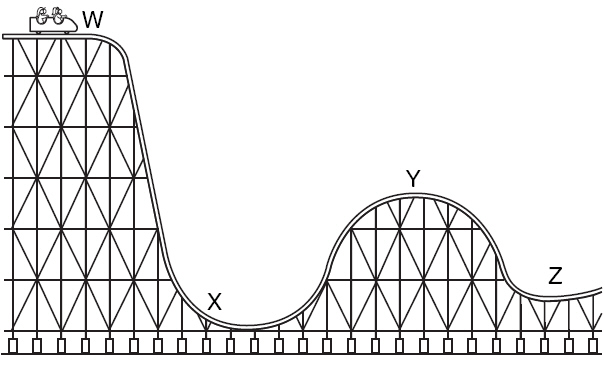
At which point is potential energy greatest?
a)
W
b)
X
c)
Y
d)
Z
5.
Which is the best example that something has kinetic energy?
a)
a. a car parked on a steep hill
b)
b. a tennis ball rolling across the court
c)
c. a picture hanging on the wall
d)
d. a piece of coal before it's burned
6.
Kinetic energy increases as an object moves _________.
a)
slower
b)
faster
c)
at the same speed
d)
through an object
7.

When a pendulum swings, at which point is potential energy at its greatest
a)
1
b)
2
c)
3
d)
4
8.
While a boulder is on the top of a hill it has what type of energy?
a)
Mechanical
b)
Kinetic
c)
Potential
d)
Reactive
9.
What is energy?
a)
rate of work
b)
Motion of an object
c)
ability to do work
d)
force over time
10.

Which of the following is NOT true about Potential Energy?
a)
An object's position affects its potential energy
b)
Potential energy is Stored energy
c)
Potential energy only occurs when an object is in motion
d)
All objects have potential energy
11.

Click to look at the picture.
The picture is demonstrating an example of ______ .
The picture is demonstrating an example of ______ .
a)
gravity
b)
speed
c)
kinetic energy
d)
potential energy
12.
The movement, change in direction, changing speed, or stopping of an object by a push or pull is known as ___ .
a)
kinetic energy
b)
force
c)
friction
d)
potential energy
13.
The law of universal gravitation is credited to whom?
a)
Einstein
b)
Galileo
c)
Darwin
d)
Newton
14.
Two factors effecting the magnitude of the force of gravity between 2 objects are...
a)
mass and distance
b)
mass and matter
c)
distance and weight
d)
weight and mass
15.
A person would weigh less on on the Moon than on the Earth because . . .
a)
Moon has more mass, and therefore more gravity
b)
Moon has less mass, and therefore more gravity
c)
Moon has more mass, and therefore less gravity
d)
Moon has less mass and therefore less gravity
16.
Which is the best example of kinetic energy?
a)
bicycle going downhill
b)
car parked on a curve
c)
water puddle on a sidewalk
d)
ball on a field
17.
A meteor falls through Earth's atmosphere toward the surface of Earth. What causes the meteor to fall toward the surface of Earth?
a)
Gravity from Earth attracts the meteor.
b)
Magnets under the surface of Earth attract the meteor.
c)
Pressure from space pushes the meteor toward Earth.
d)
Radiation from the sun pushes the meteor toward Earth.
18.
Some forces can change the motion of an object without touching the object. Which describes an object moving due to a force that did not touch it?
a)
a raindrop falling through air to the ground
b)
a wind-up toy car moving across the floor
c)
a water bottle top being twisted off the bottle
d)
a soccerball moving upward after being kicked
19.

Which of these is greater at Point 2 than at Point 1?
a)
the potential energy of the sled
b)
the kinetic energy of the sled
c)
the gravity of the sled
d)
the mass of the sled
20.
Potential energy is what type of energy?
a)
energy that is stored
b)
energy that is being used
c)
matter rubbing against matter
d)
the measure of motion
21.
If the skier is at the top of the hill waiting for the whistle to blow for his turn to ski, he has ____________, after the whistle blows and he starts his ski run, he has ___________ .
a)
kinetic energy; potential energy
b)
potential energy; friction
c)
kinetic energy; gravity
d)
potential energy; kinetic energy
22.
The moon orbits the Earth and the Earth orbits the Sun. These orbits are caused by what force?
a)
radiation
b)
gravity
c)
friction
d)
Darth Vader
23.
the force that pulls all objects toward each other
a)
acceleration
b)
friction
c)
velocity
d)
gravity
24.
the resistance that one surface or object encounters when moving over another
a)
reference point
b)
motion
c)
force
d)
friction
25.

Why do air planes and race cars have sleek shapes?
a)
to reduce friction from air resistance
b)
to increase air resistance
c)
to look more appealing than cats
d)
so people will buy them
26.

In the image, what force is acting on arrow A?
a)
friction
b)
gravity
c)
push
d)
Jedi force
27.
How does friction help us move from place to place?
a)
Friction does not help us.
b)
Friction keeps us from slipping and sliding.
c)
Friction only helps cats.
d)
Friction makes us slip and fall.
28.
Which would require the most force to move?
a)
a toy car
b)
a sleeping cat
c)
a science book
d)
a chair with a friend sitting in it
29.
When you type on the keys of your Chromebook you are using a
a)
pull
b)
push
c)
gravity
d)
friction
30.
_____ is the force that slows and stops motion between touching objects.
a)
Friction
b)
Gravity
c)
Pull
d)
Push
31.
What is one way to reduce friction?
a)
Put sandpaper between the surfaces that touch.
b)
Push the surfaces closer together.
c)
Shine a light on the surfaces.
d)
Put a slippery substance between the surfaces.
32.
Why is there less friction between two ice cubes touching than between sandpaper on wood?
a)
They have rough surfaces.
b)
They have loud surfaces.
c)
They have smooth surfaces.
d)
They have bright surfaces.
33.
The tendency of an object to resist a change in motion.
a)
Inertia
b)
Components of Friction
c)
Gravity
d)
Force
34.
The ability to do work.
a)
Energy
b)
Velocity
c)
Power
d)
Effort
Reset

