
 Worksheets
Physics Review
Total questions: 98
Worksheet time: 2hrs 32mins
Name
Class
Date
1.
This part of the experiment serves as a basis of comparison; the one variable being tested has been omitted.
a)
experimental group
b)
control group
c)
data
d)
variables
2.
This variable in an experiment is the one being deliberately changed by the scientist.
a)
dependent variable
b)
independent variable
c)
data
d)
control group
3.
What step does every scientific experiment begin with?
a)
hypothesis
b)
question/problem
c)
procedures
d)
conclusion
4.
An experiment is performed on plants to see how different liquids affect plant growth. Each plant in the experiment is given a different liquid; water, apple juice, or milk. Each plant has the same amount of soil, sunlight, and listens to the same music. In this investigation, the independent variable is ...
a)
The type of plant
b)
The amount of sunlight
c)
The type of music
d)
The type of liquid
5.
The summary at the end of an experiment that explains the results.
a)
conclusion
b)
procedures
c)
materials
d)
responding variable
6.
Observations made during an experiment are called:
a)
data
b)
problems
c)
conclusions
d)
questions
7.
On what axis should the independent variable always be?
a)
X
b)
Y
8.
How many significant figures does the following number have: 0.002040
a)
6
b)
4
c)
3
d)
2
9.
How many significant figures does the following number have: 0.998005
a)
9
b)
10
c)
6
d)
5
10.
How many significant figures does the following number have: 100.00210
a)
7
b)
5
c)
10
d)
8
11.
How many significant figures does the following number have: 100.3
a)
4
b)
3
c)
5
d)
2
12.
Round 1009 to three sig figs
a)
100
b)
101
c)
1010
d)
1000
13.
Round 1047.78 to three sig figs
a)
104
b)
105
c)
1050
d)
1050.00
14.
What is the measurement 1042 Liters rounded to 2 significant figures?
a)
1040 L
b)
1.1 x 10³ L
c)
1.0 x 10³ L
d)
1050 L
15.
What is 98.907 rounded to 1 significant figure?
a)
98.9
b)
90
c)
100
d)
98.91
16.
Calculate 12.47 m ÷ 3.2 s and give your answer with the appropriate number of significant figures.
a)
4 m/s
b)
3.9 m/s
c)
3.90 m/s
d)
3.897 m/s
17.
Calculate 0.020 cm x 50 cm x 11.1 cm and give your answer with the appropriate number of significant figures.
a)
10 cm3
b)
11.1 cm3
c)
11 cm3
d)
11. cm3
18.
How close a measurement is to the true value is called..
a)
Accuracy
b)
Precision
c)
Significant
d)
Estimate
19.
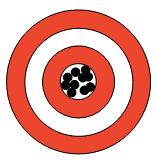
?
a)
High Accuracy & High Precision
b)
High Accuracy & Low Precision
c)
Low Accuracy & High Precision
d)
Low Accuracy & Low Precision
20.

a)
Student A
b)
Student B
c)
Student C
d)
Cannot be determined
21.

a)
Student A
b)
Student B
c)
Student C
d)
Cannot be determined
22.

This bullseye demonstrates...
a)
High Accuracy & High Precision
b)
High Accuracy & Low Precision
c)
Low Accuracy & High Precision
d)
Low Accuracy & Low Precision
23.

The force that acts on an object to stop its motion.
a)
Speed
b)
Friction
24.

Forces that have a net force that is not zero ( object will move).
a)
Balanced force
b)
Unbalanced force
25.
A push or a pull that can move an object is a __________.
a)
gear
b)
lever
c)
force
d)
machine
26.
The force resulting from the pull of the earth on an object.
a)
mass
b)
gravity
c)
acceleration
d)
unbalance
27.

What is the net force?
a)
40 N left
b)
0 N Balalnced
c)
400 N right
d)
40 N right
28.

What is the net force?
a)
400 N Up
b)
400 N Down
c)
- 400 N Down
d)
800 N Down
29.

What is the net force
a)
10 N
b)
0 N
c)
25 N
d)
1 N
30.
Wind blowing at 20 mph.Vector or scalar?
a)
Scalar
b)
Vector
31.
30 m/sec, East. Scalar or Vector
a)
Scalar
b)
Vector
c)
Neither
32.
What is magnitude?
a)
The direction that describes a quantity.
b)
A numerical value
c)
A unit of force
33.
A quantity that has both magnitude and direction is called a scalar quantity.
a)
True
b)
False
34.
Karen runs 3 miles south, then turns around and runs 4 miles north. What is displacement?
a)
5 miles
b)
1 miles
c)
2 miles
d)
3 miles
35.
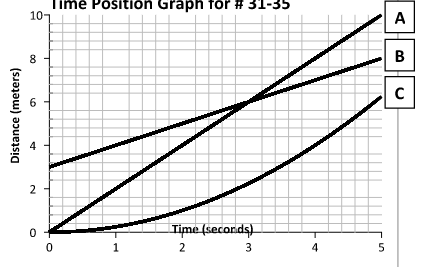
Which runner had a head start?
a)
A
b)
B
c)
C
36.

What is this graph showing?
a)
Constant Speed
b)
Acceleration (speeding up)
c)
Deceleration (slowing down)
d)
No motion
37.

What is happening between 4 and 5 seconds?
a)
The object is slowing down in a negative direction.
b)
The object is slowing down in a positive direction.
c)
The object is slowing down in a negative direction.
d)
The object is speeding up in a negative direction.
38.
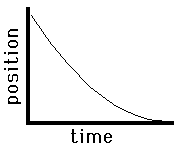
Describe the motion
a)
Slow to fast; Negative direction
b)
Fast to slow; Negative direction
c)
Fast to slow; Positive direction
d)
Slow to fast; Positive direction
39.

In which of the following graphs (click the image) are both runners moving at the same speed (note that graph c is the bottom right graph, and graph d is the bottom left graph)?
a)
Graph A
b)
Graph B
c)
Graph C
d)
Graph D
40.

Which runner won the race?
a)
A
b)
B
c)
C
41.

What does this graph represent?
a)
Constant speed
b)
Acceleration
c)
Not moving
42.
The change in velocity in a given time period is?
a)
Vi
b)
Vf
c)
a
d)
d
43.
When speed and direction remain the same throughout a motion, this is called?
a)
Accelerated motion
b)
Constant motion
c)
Changing motion
d)
Changing velocity
44.
When an object falls in physics world, what happens?
a)
It accelerates at a constant rate until it hits the ground
b)
It accelerates at a non-constant rate until it hits the ground
c)
It accelerates at a constant rate until it reaches terminal velocity
d)
It accelerates at a non-constant rate until it reaches terminal velocity
45.
Which of the following statements applies to the motion of a ball rising and then falling in free fall?
I. The ball has constant acceleration as it moves upward.
II. The ball has constant acceleration at the top of its path.
III. The ball has constant acceleration as it moves downward.
I. The ball has constant acceleration as it moves upward.
II. The ball has constant acceleration at the top of its path.
III. The ball has constant acceleration as it moves downward.
a)
I only
b)
III only
c)
I and III
d)
I, II, and III
46.
What happens when one force PULLS an object toward another?
a)
Friction
b)
Motion
c)
Gravity
d)
Magnetism
47.
What is a force that works AGAINST MOTION?
a)
Force
b)
Motion
c)
Gravity
d)
Friction
48.
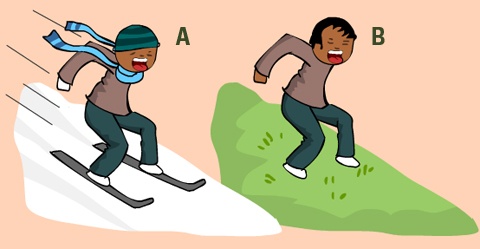
Why is it harder for the boy in Image B to get down the hill?
a)
Motion
b)
Friction
c)
Work
d)
Displacement
49.

In the image, which of the person and their bikes will get down a hill faster?
a)
The boy because he is younger
b)
The woman because she is stronger
c)
The boy because he has a greater mass which applies a greater force
d)
The woman because she has more mass and applies a greater force
50.
Consists of two circular objects; a central shaft and a wheel.
a)
wheel and axle
b)
screw
c)
pulley
51.

A fishing pole is an example of a compound machine. What simple machines are used to make up this compound machine?
a)
lever, wheel and axle, pulley
b)
wheel and axle, inclined plane, pulley
c)
wheel and axle, pulley, inclined plane
52.
If an object is too heavy to move up a ramp, what is the best way to fix the problem?
a)
Increase the slope of the ramp
b)
Increase the elevation of the ramp
c)
Increase the length of the ramp
d)
Increase the friction of the ramp
53.
The tendency of an object to stay in motion or at rest is called
a)
velocity
b)
acceleration
c)
speed
d)
inertia
54.
Which of the following describes energy?
a)
the ability to remain in motion
b)
the ability to do work
c)
the ability to pull objects down
d)
the ability to change states
55.
Which of the following is an example of a simple machine?
a)
bicycle
b)
scissors
c)
ramp
d)
all of these
56.
Which of these is an example of a wheel and axle?
a)
a ceiling fan
b)
a hammer
c)
a pair of scissors
d)
a shovel
57.
A playground seesaw is a type of
a)
pulley
b)
lever
c)
wheel and axle
d)
compound machine
58.
Energy that comes from the tiniest particles of matter is called
a)
chemical energy
b)
thermal energy
c)
nuclear energy
d)
light energy
59.
When a ball rolls down a hill
a)
kinetic energy is created
b)
potential energy is created
c)
thermal energy is created
d)
none of these
60.
Work involves all of these except
a)
force
b)
movement
c)
distance
d)
time
61.

Stored energy that an object has due to its position or chemical composition is...
a)
Potential
b)
Kinetic
c)
Mechanical
62.

What type of energy is in this picture?
a)
Kinetic
b)
Potential
c)
Electromagnetic
63.

What is the law that states that energy cannot be created or destroyed only transform form one energy to another?
a)
Law of Conservation of Energy
b)
Law of Gravity
c)
Law of Inertia
d)
None of these
64.
What is Mechanical Energy?
a)
Energy from a tree
b)
Potential
c)
Thermal Energy
d)
The sum of kinetic and potental energy that causes force to move an object any distance.
65.

At which point is potential energy greatest
a)
W
b)
X
c)
Y
d)
Z
66.
Which of these is an example of a wedge?
a)
skateboard
b)
broom
c)
stairs
d)
butter knife
67.
Which of the following does a simple machine do?
a)
allows the users to apply less force over a longer distance
b)
reduce the amount of force needed to do work
c)
Both of the above
68.
When a roller coaster moves down a ramp
a)
kinetic energy changes to potential energy
b)
electrical energy changes to light energy
c)
potential energy changes to kinetic energy
d)
gravity is not involved
69.
Acceleration is caused by a force acting on a mass.
a)
Newton’s first law of motion
b)
Newton’s second law of motion
c)
Newton’s third law of motion
70.
According to Newton’s first law of motion, a moving object that is not acted on by an unbalanced force will
a)
remain in motion.
b)
eventually come to a stop.
c)
change its momentum.
d)
accelerate.
71.
Forces always act in equal and opposite pairs.
a)
Newton's 1st Law
b)
Newton's 3rd Law
c)
Newton's second law
72.
Which has more Inertia? (and more force to move)
a)
Truck
b)
Ant
73.
Newton's 1st law is often called the _______.
a)
Newton's 2nd law
b)
action-reaction law
c)
law of equality
d)
law of inertia
74.
A person is pushed forward into their seatbelt when a car stops. Which of Newton's laws explains this motion?
a)
1st law
b)
2nd law
c)
2 and 3 law
d)
3rd law
75.
A dropped ball gains speed because
a)
its velocity changes.
b)
a gravitational force acts on it.
c)
of inertia.
d)
its nature is to become closer to Earth.
76.
As soon as a bowling ball rolls off the edge of a table its horizontal component of velocity
a)
decreases.
b)
remains constant.
c)
increases.
77.
A ball rolls off the edge of a table at the same time another ball drops vertically from the same table. The ball to hit the floor first is the
a)
rolling ball.
b)
dropped ball.
c)
both hit at the same time
78.
A horse gallops around a circular arena. The centripetal force on the horse is ___.
a)
directed outward
b)
tension
c)
directed toward the center of the arena
d)
9.8 N
79.
Which of the following is the unit for centripetal force?
a)
J
b)
m/s2
c)
kg⋅m/s
d)
N
80.
Which has greater linear speed, a horse near the outside rail of a merry-go-round or a horse near the inside rail?
a)
the inside horse
b)
the outside horse
c)
Neither
81.
Which object listed below has the greatest momentum?
a)
A 0.05 kg object rolling at 0.2 m/s.
b)
A 0.15 kg object rolling at 2 m/s.
c)
A 0.15 kg object rolling at 1 m/s
d)
A 0.4 kg object rolling at 2 m/s.
82.
The momentum for any object is calculated by
a)
dividing mass by velocity.
b)
multiplying mass by velocity.
c)
multiplying mass by acceleration.
d)
dividing force by acceleration.
83.
A toy car of a mass of 3 kg moves along a frictionless railroad track with a velocity of 4 m/s. What is the momentum of the toy car?
a)
0.75 kg m/s
b)
0.75 N
c)
12 kg m/s
d)
12 N
84.
Which object has the greatest momentum?
a)
An 18-wheeler tractor trailer at rest.
b)
An average mass person walking.
c)
A sports car driving on the highway.
85.
In an elastic collision, the objects stick together after the collision.
a)
True
b)
False
86.
In an inelastic collision, the objects bounce off each other after the collision.
a)
True
b)
False
87.

What kind of energy is represented in this picture?
a)
Thermal
b)
Potential
c)
Nuclear
d)
Mechanical
88.

What kind of energy does this device use?
a)
Chemical
b)
Electrical
c)
Thermal
d)
Chemical
89.
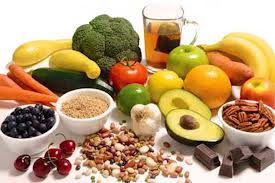
What kind of energy is represented in the picture?
a)
Thermal
b)
Chemical
c)
Sound
d)
Nuclear
90.

A battery converts what type of energy to another?
a)
sound to kinetic
b)
light to heat
c)
mechanical to electrical
d)
chemical to electrical
91.
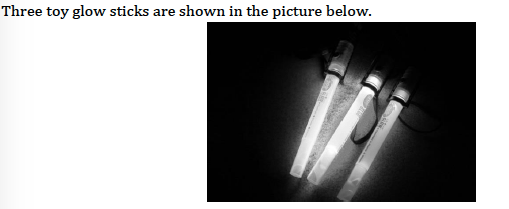
The glow sticks produce light for a short amount of time. The light from the glow stick is a conversion from what to what?
a)
thermal to light
b)
gravitational to potential
c)
radiant to electrical
d)
chemical to light
92.
_________________________ is a measure of the average kinetic energy of the particles in a material.
a)
thermal
b)
friction
c)
temperature
d)
expansion
93.
The liquid in a thermometer ______________ as the temperature increases.
a)
expands
b)
disappears
c)
freezes
d)
explodes
94.
The most common temperature scale used in the United States - where water freezes at 32 degrees and boils at 212 degrees is called the __________________________ scale.
a)
Celsius
b)
Pound
c)
Kelvin
d)
Fahrenheit
95.
The most common temperature scale used in the world where water freezes at 0 degrees and boils at 100 degrees is called the __________________ scale.
a)
Celsius
b)
Fahrenheit
c)
Pound
d)
Kelvin
96.
The most common temperature scale used in the physical sciences where temperatures are 273 degrees more than temperatures on the Celsius scale is called the _______________ scale.
a)
Fahrenheit
b)
Kelvin
c)
Pound
d)
Celsius
97.
Thermal energy always moves from ____________ objects to ______________ objects.
a)
cooler, warmer
b)
warmer, cooler
c)
faster, slower
d)
slower, faster
98.
What happens to particles of a substance as its temperature increases?
a)
the average kinetic energy increases
b)
the average kinetic energy decreases
c)
the average kinetic energy stays the same
d)
nothing happens
100 %

