
 Worksheets
Reproduction and Flower Parts
Total questions: 36
Worksheet time: 23mins
Name
Class
Date
1.

What is #8 pointing to?
a)
petal
b)
stamen
c)
pistil
d)
ovary
2.
What are the small leaves called that protect the bud?
a)
sepal
b)
petal
c)
leaves
d)
seed
3.
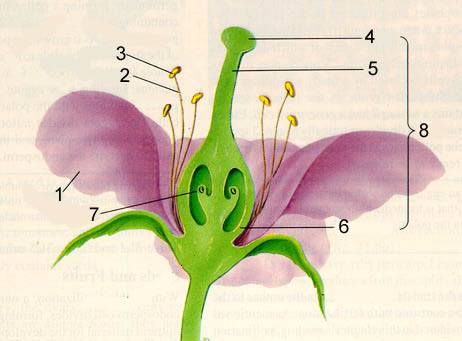
What is #2 pointing to?
a)
anther
b)
filament
c)
ovary
d)
style
4.
Where is pollen made?
a)
ovary
b)
petal
c)
pistil
d)
anther
5.
What is the sticky part of the flower that catches pollen?
a)
style
b)
stigma
c)
ovary
d)
petal
6.

B
a)
Stigma
b)
Ovule
c)
Ovary
d)
Sty
7.

C
a)
Ovary
b)
Ovule
c)
Style
d)
Filament
8.
What is the stamen?
a)
Protection for the flower and support for the petals when in bloom
b)
contains the embryo sac
c)
male part of a flower
d)
connects the stigma to the ovary
9.
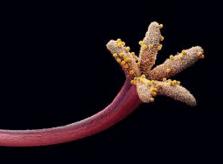
The part of the flower on which the pollen grains land.
a)
pistil
b)
stamen
c)
sepals
d)
stigma
10.
Why are flowers very colorful (and why do they produce odor?)
a)
So people buy them
b)
To make gardens look good
c)
To attract pollinators
d)
To attract sunlight
11.
What part of the flower will turn into a seed?
a)
ovary
b)
anther
c)
ovule
d)
filament
12.
what are the three things a plant needs in order to make there own food
a)
sunlight
b)
water
c)
carbon dioxide
d)
all of them
13.
The filament___________
a)
holds up the anther
b)
protects the petal
c)
is the male part of the flower
d)
catches pollen
14.

How is C adapted to receiving pollen from male flowers?
a)
Part C is sticky.
b)
Part C is colorful.
c)
Part C produces nectar.
d)
Part C produces eggs.
15.

Name part X.
a)
anther
b)
stigma
c)
ovule
d)
ovary
16.
Insects, birds, bats and butterflies can all be called what during the process of pollination?
a)
photographers
b)
photosynthesizers
c)
germinators
d)
pollinators
17.

Small leaf-like structures forming an outer circle at the base of a flower.
a)
petals
b)
sepal
c)
anthers
d)
dicots
18.

The part of a flower that produces the male reproductive cells.
a)
anther
b)
style
c)
stigma
d)
filament
19.
In asexual reproduction, all of the offspring are:
a)
Physically Identical
b)
Genetically Identical
c)
Physically and Genetically Identical
d)
Not Identical
20.
A hydra reproduces when an outgrowth, or bud, forms and continues to develop until if falls off of the parent. This is an example of:
a)
Binary Fission
b)
Sporulation
c)
Budding
d)
Vegetative Propagation
21.

What process is shown in the diagram?
a)
sexual reproduction
b)
asexual reproduction
c)
digestion
d)
excretion
22.

a)
budding
b)
sporulation
c)
vegetative propagation
d)
binary fission
23.

a)
budding
b)
binary fission
c)
sporulation
d)
regeneration
24.
If the environment changes for an Asexual offspring it will?
a)
Explode
b)
Create another offspring
c)
Fall in love
d)
Die
25.
How many parent(s)are needed for asexual?
a)
4
b)
1
c)
9
d)
100
26.
What percentage of chromosomes are handed down by a parent cell in asexual reproduction?
a)
75%
b)
25%
c)
50%
d)
100%
27.

Prokaryotes (bacteria) reproduce asexually via -
a)
spore formation
b)
bud creation
c)
vegetative propagation
d)
binary fission
28.

Why is DNA important?
a)
it is very small and very complicated
b)
it's in everything
c)
it serves as the blueprint for traits of all living things
d)
because we eat it every day for energy
29.
Requires two parents
a)
sexual
b)
asexual
30.

a)
budding
b)
fragmentation
c)
sporulation
d)
binary fission
31.

a)
sporulation
b)
fragmentation
c)
vegetative propagation
d)
binary fission
32.
What are some of the facts about asexual reproduction?
a)
Takes only one mate to reproduce and takes a longer time to reproduce
b)
Takes a shorter amount of time to reproduce and it takes two mates to reproduce
c)
Reproduces diverse offspring and takes a longer time to reproduce
d)
Takes only one mate to reproduce and takes a shorter time to reproduce
33.
If two organisms reproduce sexually, then their offspring will exhibit a genetic makeup that is -
a)
identical to only one parent
b)
identical to all of its siblings
c)
a unique combination of traits
d)
the recessive traits of each parent
34.

When comparing the offspring of sexually and asexually reproducing organisms, we would expect the genetic material (DNA) of the sexually reproducing organism to -
a)
contain fewer mutations
b)
be lesser in quantity
c)
be simpler overall
d)
show more variation
35.
What part of our cells holds our DNA?
a)
cytoplasm
b)
cell membrane
c)
nucleus
d)
ribosomes
36.
Which of the following is NOT an advantage of asexual reproduction?
a)
More efficient.
b)
All organisms can reproduce
c)
No wasted effort finding a mate.
d)
Population has variety to survive in a changing environment.
100 %

