
NEW
Font size
S
M
L
XL
 Worksheets
5th SW Test Review
Total questions: 28
Worksheet time: 53mins
Name
Class
Date
1.

In this tundra food web, if grasses were removed what would happen to the sustainability of the ecosystem?
a)
There would be an overpopulation of arctic hares and lemmings.
b)
Polar bears would move to a new ecosystem.
c)
The ecosystem would collapse, because it lost its main producer.
d)
Wildflowers would die out from the ecosystem.
2.

Which graph shows a situation in which the number of producers in a population depends on the number of prey?
a)
Graph F
b)
Graph G
c)
Graph H
d)
Graph J
3.

What could be one reason for the dramatic change in population from 1700-1900?
a)
Decrease in predators
b)
Decrease in hunting
c)
Increase in food supply
d)
Immigration of predators
4.
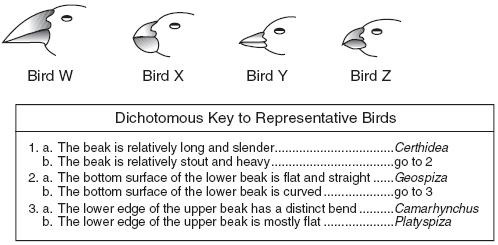
What is the name of bird W?
a)
Certhidea
b)
Geospiza
c)
Camarhynchus
d)
Platyspiza
5.

Which organism is a primary producer?
a)
phytoplankton
b)
krill
c)
copepods
d)
carnivorous plankton
6.
All of the following statements concerning characteristics of predator-prey relationship are correct EXCEPT:
a)
Camouflage is an adaptation that protects prey.
b)
A rise in the population of predators is followed by a decreased in the population of prey.
c)
A rise in the population of prey is often followed by a rise in the population of predators.
d)
The population of predators most often eliminates the population of prey
7.
An insect known as an aphid can be found on many types of plants in Texas. These plants include flowers, vegetables, shrubs, bushes, and trees. Aphids eat the sap from the plants on which they live. Plants need this sap for nourishment. What type of relationship exists between the aphids and plants in an ecosystem?
a)
Producer/Consumer
b)
Prey/Predator
c)
Consumer/Decomposer
d)
Parasite/Host
8.

In the aquatic food web below, which two organisms have a predator-prey relationship?
a)
Shad and sturgeons
b)
Sturgeons and blue crabs
c)
Blue crabs and rangia clams
d)
Copepods and amphipods
9.

Which two types of organisms have a producer-consumer relationship in this African savanna?
a)
Zebras and hyenas
b)
Hyenas and cheetahs
c)
Trees and elephants
d)
Fungi and dung beetles
10.
Which of these human activities is most likely to cause the excessive growth of phytoplankton in the world’s oceans?
a)
The use of chemical fertilizers that are carried by runoff into rivers
b)
The logging of old-growth forests, which results in erosion
c)
The spraying of chemical herbicides that reduce carbon dioxide in the air
d)
The mining of fossil fuels, which requires digging underground tunnels
11.
Which human activity has had a negative impact on ocean systems?
a)
Monitoring
b)
Over-fishing
c)
Creation of artificial reefs
d)
Reduction in coastal developments
12.

Using this dichotomous key, identity the name of the circled fish.
a)
band-tail puffer
b)
spotted goat fish
c)
peacock flounder
d)
trumpet fish
13.
A constant input of energy from the Sun is necessary to maintain any ecosystem. What contributes to the sustainability of an ecosystem?
a)
Small population sizes
b)
Lack of adaptations
c)
Biodiversity
d)
Unstable environment
14.
Plants are known as producers, because they produce or make their own food. How do producers receive the energy for this process?
a)
By consuming soil nutrients
b)
By absorbing sunlight
c)
By releasing water
d)
By producing oxygen
15.
Cattails grow near the edges of lakes, ponds and rivers. Like all other green plants, they turn sunlight into sugar that they use for food. Ducks eat the cattails to get the energy stored in them. The relationship between cattails and ducks is best classified as which of the following?
a)
Freshwater predator/prey
b)
Freshwater producer/consumer
c)
Terrestrial parasite/host
d)
Terrestrial predator/prey
16.
Which of the following describes a predator/prey relationship in a marine environment?
a)
Phytoplankton in the sea make food from sunlight.
b)
Sharks consume smaller fish they catch in the ocean.
c)
Frogs in a pond catch and eat flying insects.
d)
Fish of the same species compete for plants to eat.
17.
Grasshoppers cannot be easily seen on green leaves. How has this adaptation allowed grasshoppers to be successful?
a)
They can be easily seen by predators
b)
They can find food more easily
c)
They are not attacked by predators, and can reproduce
d)
They can find a mate more easily
18.
Which of the following human impacts is NOT harmful to marine environments?
a)
Gas emissions from cars on land
b)
Artificial reefs sunk to the bottom
c)
Over-fishing of Atlantic cod
d)
Fertilizers that enter the ocean through runoff
19.
All food chains and food webs begin with the ____, since this is source of energy for producers.
a)
plants
b)
smallest organisms
c)
Sun
d)
food
20.
Which cell organelle do plants need to carry out the process of photosynthesis?
a)
cell wall
b)
mitochondrion
c)
vacuole
d)
chloroplast
21.
Texas ranchers want to raise cattle that produce tender beef, because customers prefer tender beef over tough beef. How can ranchers use selective breeding to accomplish this?
a)
By decreasing the size of the cattle
b)
By breeding cattle that eat organic grass
c)
By breeding cattle that produce tender meat
d)
By limiting the number of offspring produced
22.
Cells cannot be seen without a microscope. They are the basic unit of life and perform many functions. Which of the following about cells and energy is FALSE?
a)
Animal cells gain energy from eating other organisms.
b)
Plant cells gain energy from the Sun by making glucose through the process of photosynthesis.
c)
Bacteria cells are diverse and gain energy from many different sources.
d)
Some cells do not need energy.
23.
Which of the following is NOT a component of the cell theory?
a)
All cells have similar organelles and perform the same functions.
b)
All cells come from pre-existing cells.
c)
Cells are the most basic unit of life.
d)
All living organisms are made of cells.
24.

If you were to draw an energy pyramid for this food web, how many trophic levels would you need?
a)
3
b)
4
c)
5
d)
9
25.
How might over-fishing and the use of fertilizers negatively impact the ocean?
a)
Algae populations will decrease due to the harmful chemicals.
b)
Artificial reefs will provide new habitats for the fish that remain.
c)
Algae populations will increase and create "dead zones" or areas where oxygen levels are very low.
d)
Marine predators will increase.
26.
Why is biodiversity in an ecosystem essential to the sustainability of the ecosystem?
a)
More genetic variation within a species makes it more likely that some individuals will survive a disease outbreak.
b)
A wide variety of herbivore species that can feed on a wide variety of producers ensures that there is sufficient prey for predators in the ecosystem.
c)
The presence of more species with different adaptations makes it more likely that some organisms will survive a natural disaster.
d)
All of the above indicate why biodiversity is absolutely necessary for the sustainability of the ecosystem.
27.

Clay is conducting an experiment. He placed only a plant in Jar 1. He placed a plant and fish in Jar 2, and he placed just a fish is Jar 3. He put all three jars in direct sunlight. Which of the following is a likely outcome of his experiment?
a)
The plant in Jar 1 died, because it didn't have enough sunlight to absorb for photosynthesis.
b)
The plant and fish in Jar 2 thrived, because both of their needs were being met.
c)
The fish in Jar 3 eventually died, because it did not have enough oxygen without the plant.
d)
Outcomes about Jar 2 and 3 are both likely.
28.
Which of the following would help an organism BEST adapt to cold weather AND decreased food resources?
a)
Huddling together with other organisms
b)
Thicker layer of fat under the skin
c)
Ability to run faster
d)
Fur coat that turns white like the snow
Reset

