
 Worksheets
Characteristics of the Universe #1
Total questions: 31
Worksheet time: 23mins
Name
Class
Date
1.
A supernova is the explosion of a dying:
a)
medium-mass star
b)
high-mass star
c)
protostar
d)
low-mass star
2.

What type of star is the Sun?
a)
Red giant
b)
White dwarf
c)
Red supergiant
d)
Main sequence
3.
The HR diagram classifies stars based on their surface temperature and their:
a)
color
b)
diameter
c)
distance from Earth
d)
absolute brightness
4.
Which one of these is considered evidence in support of the big bang theory?
a)
stars
b)
electromagnetic spectrum
c)
cosmic background radiation
d)
Hubble telescope
5.
What determines if a star becomes a white dwarf, neutron star, or a black hole?
a)
Its age
b)
Its mass
c)
Its brightness
d)
Its temperature
6.
What color are the coolest stars?
a)
blue-white
b)
yellow
c)
orange
d)
red
7.
The Milky Way is what type of galaxy?
a)
Spiral
b)
Elliptical
c)
Irregular
8.
What is a light-year?
a)
distance between two stars
b)
distance light travels in one year
c)
the time it takes light to travel 300,000,000 meters
d)
the time it takes light to travel to Earth from the Sun
9.
Which of the following is part of the EM spectrum?
a)
X-rays
b)
Radio Waves
c)
Visible light
d)
All of the above
10.
Which correctly orders the items from smallest to largest?
a)
Universe, Galaxy, Star Cluster, Star
b)
Star, Star Cluster, Universe, Galaxy
c)
Star, Star Cluster, Galaxy, Universe
d)
Star, Galaxy, Star Cluster, Universe
11.
A black hole could be the result of the death of what type of star?
a)
medium-mass star
b)
high-mass star
c)
protostar
d)
low mass star
12.
What is a major difference in the composition of elliptical and spiral galaxies?
a)
Elliptical galaxies have almost no gas or dust between stars
b)
Elliptical galaxies vary more in shape than spiral galaxies
c)
Spiral galaxies have almost no gas or dust between stars
d)
Spiral galaxies only contain old stars
13.
The HR diagram shows that main-sequence stars
a)
are mostly hot and dim
b)
are mostly cool and bright
c)
increase in brightness as they increase in temperature
d)
decrease in brightness as they increase in temperature
14.
A star is born when
a)
a protostar begins to cool
b)
a nebula expands
c)
helium and oxygen combine
d)
nuclear fusion starts
15.
Depending on its mass, a star may live from about
a)
10 million to 200 billion years
b)
5 million to 100 million years
c)
10 million to 500 billion years
d)
1 million to 10 million years
16.
Where is the Sun found in our GALAXY?
a)
the center
b)
near the center
c)
outside of the galaxy
d)
in one of the arms
17.

What is the theory that states the universe began with a huge explosion?
a)
Apparent Magnitude
b)
Light year
c)
Big Bang Theory
d)
Galaxy
18.

What is the brightness of a star as it appears to an observer on Earth?
a)
Big Bang Theory
b)
Apparent Magnitude
c)
Light year
d)
Spiral Galaxy
19.

What is a small, hot, dim star that is the leftover center of an old star?
a)
Spiral Galaxy
b)
Supernova
c)
White Dwarf
d)
Black Hole
20.
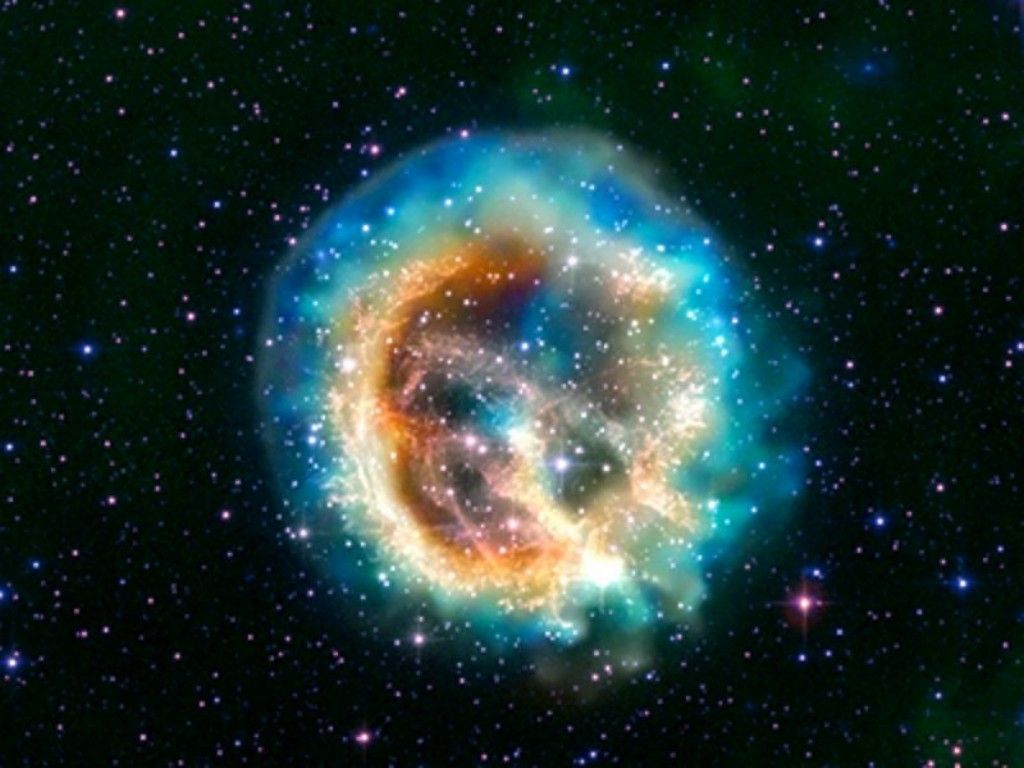
What is gigantic explosion that causes the death of a massive star?
a)
Supernova
b)
Nebula
c)
Red Giant
d)
White Dwarf
21.

What is a large grouping of stars, dust, and gas bound together by gravity?
a)
Nebula
b)
Galaxy
c)
Cosmology
d)
Gravity
22.
What is an object that is so massive and dense that even light can not escape its gravity?
a)
Main-sequence
b)
black hole
c)
Apparent Magnitude
d)
Comet
23.

What is a large cloud of dust and gas where new stars are formed or stars explode?
a)
quasar
b)
black hold
c)
supernova
d)
nebula
24.

Which is the hottest?
a)
a red giant
b)
small, white dwarf
c)
main-sequence yellow star
d)
main-sequence blue star
25.

A student notices that the moon looks larger than the stars. Why?
a)
The moon is reflecting light from the sun
b)
The moon is closer to Earth then the stars
c)
The moon is much larger than the stars
d)
The moon is much larger than Earth
26.
Which shows the correct sequence of a star's life cycle?
a)
main sequence, red giant, white dwarf
b)
main sequence, white dwarf, red giant
27.
The sun appears brighter than other stars because
a)
it is the largest star in the universe
b)
it is the hottest star in the universe
c)
able to radiate more energy than other stars
d)
is closer to Earth than other stars
28.
Which of the following is not a type of galaxy?
a)
Irregular
b)
Triangular
c)
Spiral
d)
Elliptical
29.

The color of a star depends on its
a)
size
b)
temperature
c)
shape
d)
magnitude
30.

What color are the hottest stars?
a)
red
b)
yellow
c)
orange
d)
blue
31.
The majority of stars are in their longest phase, which is called...
a)
white dwarf
b)
H-R Diagram
c)
Red giant
d)
Main-sequence
100 %

