
 Worksheets
Plants AP Bio Vann
Total questions: 51
Worksheet time: 2hrs 41mins
Name
Class
Date
1.
The outside tissue of a plant is called...
a)
Epidermal Tissue
b)
Ground Tissue
c)
Vascular Tissue
d)
Xylem
2.
The tissue that makes up the largest part of most plants and performs photosynthesis is...
a)
Epidermal Tissue
b)
Ground Tissue
c)
Vascular Tissue
d)
Cambium
3.
Tissue that transports material around the plant
a)
Vascular Bundle
b)
Vascular Tissue
c)
Epidermal Tissue
d)
Ground Tissue
4.
This tissue that is responsible for carrying water and nutrients up the plant is...
a)
Phloem
b)
Vascular Bundle
c)
Xylem
d)
Cambium
5.
________ carries nutrients produced in the plant down towards the roots
a)
Xylem
b)
Phloem
c)
Vascular Bundle
d)
Cambium
6.
The layer of cells that makes up the xylem and the phloem are called what?
a)
Epidermal
b)
Vascular
c)
Cambium
d)
Sclerenchyma
7.
The transport system of plants composed of vascular tissues alike the xylem and phloem is called...
a)
Roots
b)
Vascular bundle
c)
Epidermal Tissue
d)
Cambium
8.

Which structure of the plant absorbs water and nutrients from the soil?
a)
stem
b)
leaves
c)
roots
d)
flowers
9.
Xylem and Phloem are both __.
a)
Transpiration
b)
Absorption
c)
Photosynthesis
d)
Vascular tissue
10.
Roots absorb water into the __.
a)
Xylem
b)
Phloem
11.
Moves sugar from leaves to roots
a)
Xylem
b)
Phloem
12.
Which of the following is an example of a non-vascular plant?
a)
grass
b)
corn
c)
trees
d)
moss
13.

What is the source of energy for photosynthesis?
a)
carbohydrates-chemical
b)
sunlight-radiant
c)
heat-thermal
d)
television-electrical
14.
What gas is released by plants during photosynthesis?
a)
sulfur
b)
carbon dioxide
c)
oxygen
d)
hydrogen
15.
What are the reactants (what's needed) for photosynthesis?
a)
glucose and oxygen
b)
light, water, and carbon dioxide
16.
What is the purpose of photosynthesis?
a)
make glucose
b)
make ATP
c)
make light
d)
release carbon dioxide
17.
What type of organism uses photosynthesis?
a)
plants
b)
bacteria
c)
animals
d)
both plants and bacteria
18.

Autotroph or heterotroph?
a)
Autotroph
b)
Heterotroph
19.

Autotroph or heterotroph?
a)
Autotroph
b)
Heterotroph
20.
They enclose the egg cells inside the ovaries.
a)
ovules
b)
anther
c)
seeds
d)
angiosperms
21.
The transfer of pollen, containing the sperm cells, to the female part of the flower.
a)
seed disperal
b)
pollination
c)
germination
d)
fertilization
22.
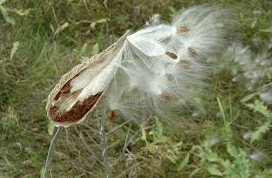
All of the following are examples of seed disbursement except:
a)
wind
b)
volcanic eruptions
c)
physical movement (rolling)
d)
animals feces
23.
The male part of the flower is known as the _____.
a)
stamen
b)
pistil
c)
ovary
d)
petal
24.
The female part of the flower is known as the ____.
a)
stamen
b)
anther
c)
filament
d)
pistil
25.

What is #3 pointing to?
a)
stigma
b)
filament
c)
ovary
d)
anther
26.
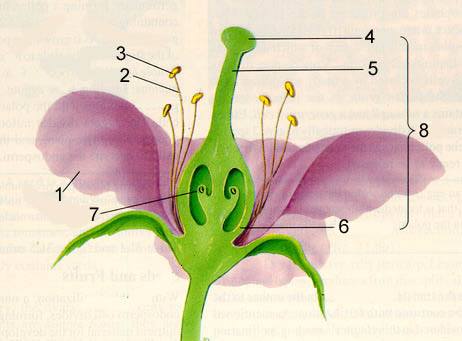
What is #4 pointing to?
a)
anther
b)
style
c)
stigma
d)
ovary
27.
The male part of the flower is known as the _____.
a)
stamen
b)
pistil
c)
ovary
d)
petal
28.
The female part of the flower is known as the ____.
a)
stamen
b)
anther
c)
filament
d)
pistil
29.
What is the main function of leaves?
a)
Leaves provide support for growth and a place to store food.
b)
Leaves provide a place for photosynthesis to occur.
c)
Leaves absorb water and minerals and transport nutrients to the stem.
d)
Leaves create a barrier that prevents water in the plant's tissues from evaporating.
30.
Which structure in the leaf controls the opening and closing of the stoma?
a)
cuticle
b)
epidermis
c)
guard cell
d)
spongy mesophyll
31.

The diagram below shows a cross section of a plant leaf. How does the structure marked X contribute to the survival of the plant?
a)
It allows the intake of gases necessary for photosynthesis.
b)
It allows the intake of minerals necessary for plant growth.
c)
It allows the intake of sunlight necessary for ATP production.
d)
It allows the intake of sugars necessary for plant reproduction.
32.
Which statement describes the role of flowers in plant survival?
a)
Flowers can absorb carbon dioxide for sugar production.
b)
Flowers produce oxygen through cellular respiration.
c)
Flowers contain cells that carry out photosynthesis.
d)
Flowers contain cells that produce gametes.
33.
Seed production, sexual or asexual?
a)
sexual
b)
asexual
c)
neither
d)
both
34.
What does an ovule become when it is pollinated?
a)
a seed
b)
a sprout
c)
a fruit
d)
it stays an ovule
35.
In what stage of the life cycle does pollination occur?
a)
seed production
b)
germination
c)
fertilization
d)
plant development
36.
first stage of plant life cycle (plant is just starting to grow)
a)
seed production
b)
germination
c)
plant development
d)
fertilization
37.
hydrotropism
a)
response to light
b)
response to tough
c)
response to gravity
d)
response to water
38.
gravitropism
a)
response to light
b)
response to tough
c)
response to gravity
d)
response to water
39.
phototropism
a)
response to light
b)
response to tough
c)
response to gravity
d)
response to water
40.
Thigmotropism
a)
response to light
b)
response to tough
c)
response to gravity
d)
response to water
41.
How many flowers are needed for pollination?
a)
1
b)
0
c)
3
d)
2
42.

Small leaf-like structures forming an outer circle at the base of a flower.
a)
petals
b)
sepal
c)
anthers
d)
dicots
43.
The stalks in a flower that produce the male reproductive cells
a)
pistil
b)
stamen
c)
filament
d)
stigma
44.

What is this?
a)
Xylem
b)
Phloem
45.
Water exits the leaf through the __.
a)
Stomata
b)
Flower
c)
Roots
d)
Phloem
46.
Helps fruit ripen
a)
Auxin
b)
Gibberellin
c)
Cytokinins
d)
Ethylene
47.
Breaks seed dormancy and promotes growth (can make fruit bigger)
a)
Auxin
b)
Gibberellin
c)
Cytokinins
d)
Ethylene
48.
Hormone that can keep cut flowers fresh for longer
a)
Auxin
b)
Ethylene
c)
Absisic Acid
d)
Cytokinins
49.
Hormone related to the growth of the plant in response to tropisms
a)
Auxin
b)
Cytokinins
c)
Ethylene
d)
Absisic acid
50.
Changes in an organisms environment that cause a response
a)
Tropism
b)
Hormone
c)
Stimuli
d)
Response
51.
Venus Flytrap flower reacts to a bug.
a)
Nastic Movement
b)
Negative Gravitropism
c)
Thigmotropism
d)
Hydrotropism
100 %

