
NEW
Font size
S
M
L
XL
 Worksheets
Beaks of Finches
Total questions: 25
Worksheet time: 25mins
Name
Class
Date
1.
According to the theory of natural selection, why are some individuals more likely than others to survive and reproduce?
a)
Some individuals pass on to their offspring new characteristics they have acquired during their lifetimes.
b)
Some individuals are better adapted to exist in their environment than others are.
c)
Some individuals do not pass on to their offspring new characteristics they have acquired during their lifetimes.
d)
Some individuals tend to produce fewer offspring than others in the same environment.
2.
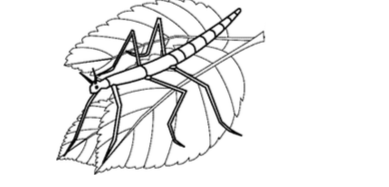
The illustration below shows an insect resting on some green leaves.
The size, shape, and green color of this insect are adaptations that would most likely help the insect to
The size, shape, and green color of this insect are adaptations that would most likely help the insect to
a)
compete successfully with all birds
b)
make its own food
c)
hide from predators
d)
avoid toxic waste materials
3.
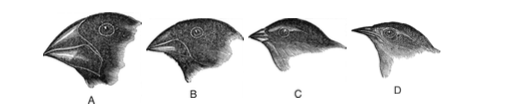
Base your answer(s) to question(s) on the diagram below and on your knowledge of biology. The diagram shows the heads of four different species of Galapagos Islands finches.
The four different types of beaks shown are most likely the result of
The four different types of beaks shown are most likely the result of
a)
gene manipulation
b)
natural selection
c)
unchanging environmental conditions
d)
patterns of behavior learned from parents
4.
Which characteristic is necessary for natural selection to occur in a species?
a)
stability
b)
variation
c)
complex cellular organization
d)
a very low mutation rate
5.
Which two processes result in variations that commonly influence the evolution of sexually reproducing species?
a)
mutation and genetic recombination
b)
mitosis and natural selection
c)
extinction and gene replacement
d)
environmental selection and selective breeding
6.
In members of a bird species living on a remote island, the greatest number of beak variations in the population would most likely be found when
a)
there is a high level of competition for limited resources
b)
homeostasis is limited by a severe climate
c)
they have a large and varied food supply
d)
they are prey for a large number of predators
7.
The different tools used during the beaks of finches lab represented
a)
feeding adaptations in finches
b)
nest construction adaptations
c)
variations in seed size
d)
variations in ecosystems
8.
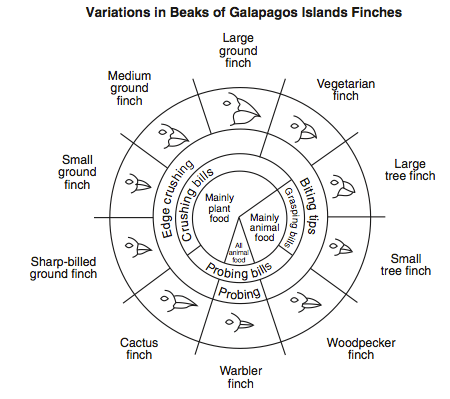
Base your answer(s) to the following question(s) 8. on the diagram below and on your knowledge of
biology.
Several of the Galapagos Islands are inhabited by grasshoppers, beetles, flies, bees, and butterflies. Finches that feed on these consumers would have beaks adapted for
biology.
Several of the Galapagos Islands are inhabited by grasshoppers, beetles, flies, bees, and butterflies. Finches that feed on these consumers would have beaks adapted for
a)
probing, only
b)
probing or grasping
c)
crushing or probing
d)
parrotlike feeding or grasping
9.
"Survival of the Fittest" describes which theory
a)
a) natural selection
b)
b) gravity
c)
c) heredity
d)
d) string theory
10.
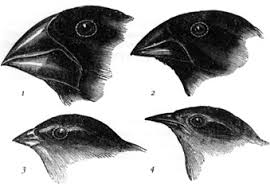
Which process produced the two different types of beaks in the ground finch and the tree finch?
a)
artificial selection
b)
geographical distribution
c)
natural selection
d)
disuse of the beak
11.
What is the advantage of having different shaped beaks?
a)
To look different from other species.
b)
To be able to eat the food readily available in the environment.
c)
To protect itself against predators.
d)
To protect itself against prey.
12.
Why are advantageous traits more likely to be passed onto offspring?
a)
Because they are more likely to survive and reproduce.
b)
Because they come from dominant alleles.
c)
Because they come from recessive alleles.
d)
Because the trait is an acquired phenotype.
13.
Mutations are a change in what?
a)
DNA
b)
tRNA
c)
genotype
d)
phenotype
14.
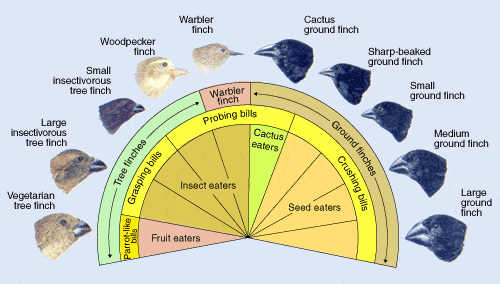
All of these finches have different shaped beaks, they are an adaptation to gain access of
a)
Water
b)
Food
c)
Shelter
15.
How did different beak sizes first arise?
a)
They arose because of their need to be able to eat different food.
b)
The arose by chance (random mutation).
c)
The environment made the change happen.
d)
The finches beaks changed a little at a time each generation.
16.
Individuals in a population have to compete for resources.
a)
Species
b)
Variation
c)
Mutation
d)
Competition
17.
What did the beak type of finches on different islands tell Darwin?
a)
Finch populations evolved over time to favor beaks based on food type
b)
Finch populations had not evolved over time
c)
The finch beaks had no relationship to the available food on the islands
d)
Humans artificially selected finches based on their desired beak type
18.
What do we call traits that increase an individual's chance to survive and reproduce?
a)
Maladaptations
b)
Adaption
c)
Variations
d)
Adaptations
19.

A predator changes its feeding habits to eat at night. What type of rabbit would live on and pass down its traits?
a)
Rabbits that feed during the day
b)
Rabbits that feed during the night
c)
Rabbits that feed in the open field
d)
Rabbits that feed at 12:00 am
20.
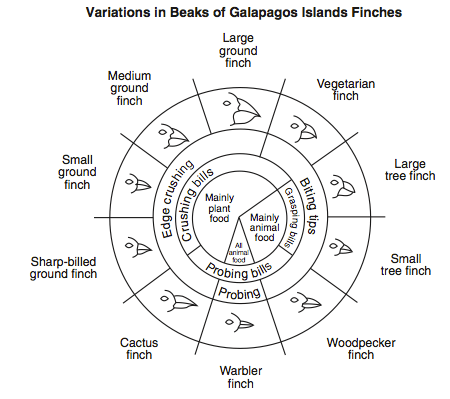
Base your answer(s) to the following question(s) on the diagram below and on your knowledge of biology.
Which two finches would compete the least for food?
Which two finches would compete the least for food?
a)
small ground finch and large ground finch
b)
large ground finch and sharp-billed ground finch
c)
small tree finch and medium ground finch
d)
vegetarian finch and small ground finch
21.
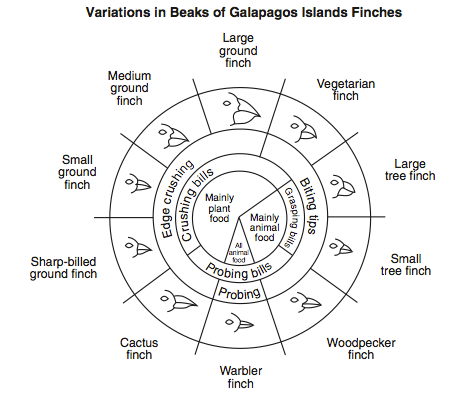
Base your answer(s) to the following question(s) on the diagram below and your knowledge of biology. Which species of finch has an edge-crushing bill that can also probe into plants for food?
a)
cactus finch
b)
sharp-billed ground finch
c)
warbler finch
d)
large ground finch
22.
Which characteristic is necessary for natural selection to occur in a species?
a)
stability
b)
variation
c)
complex cellular organization
d)
a very low mutation rate
23.
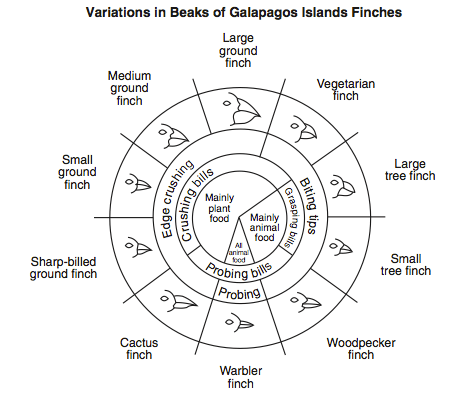
Base your answer to the following question on the finch diversity diagram below and on your knowledge of biology. Warbler finches are classified as
a)
producers
b)
herbivores
c)
carnivores
d)
decomposers
24.
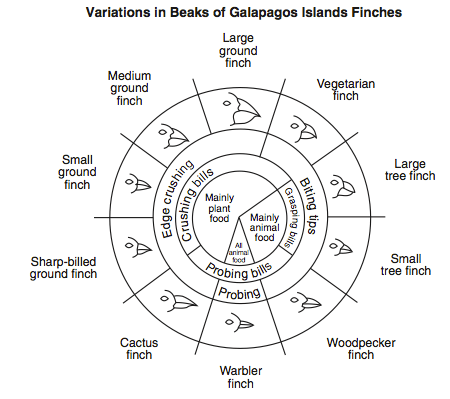
Base your answer(s) to the following question(s) on the information below and on your knowledge of biology. The diagram below represents the relationship between beak structure and food in several species of finches in the Galapagos Islands.
Which factor most directly influenced the evolution of the diverse types of beaks of these finches?
Which factor most directly influenced the evolution of the diverse types of beaks of these finches?
a)
predation by humans
b)
available food sources
c)
oceanic storms
d)
lack of available niches
25.
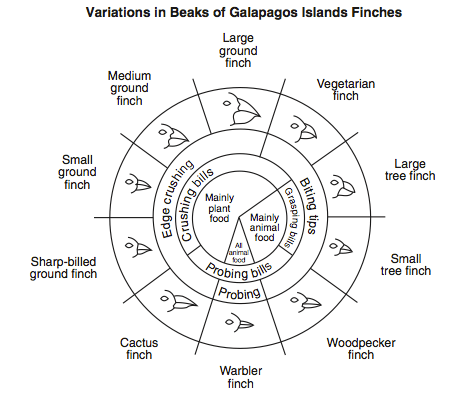
Base your answer(s) to the following question(s) on the diagram below that shows variations in the beaks of finches in the Galapagos Islands and on your knowledge of biology.
The diversity of species seen on the Galapagos Islands is mostly due to
The diversity of species seen on the Galapagos Islands is mostly due to
a)
gene manipulation by scientists
b)
gene changes resulting from mitotic cell division
c)
natural selection
d)
selective breeding
Reset

