
 Worksheets
Nuclear Physics and Relativity
Total questions: 41
Worksheet time: 53mins
Name
Class
Date
1.

What type of particle is being illustrated in following picture?
a)
gamma ray
b)
alpha particle
c)
beta particle
d)
nucleus
2.
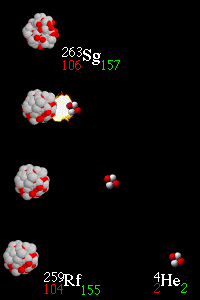
What type of decay is being illustrated in following picture?
a)
beta decay
b)
alpha decay
c)
gamma ray
d)
nucleus
3.
Which one is NOT considered to be nuclear radiation?
a)
alpha particles
b)
beta particles
c)
quarks
4.

What element makes up an alpha particle?
a)
oxygen
b)
helium
c)
hydrogen
d)
electron
5.

What makes up a beta particle?
a)
electron
b)
proton
c)
helium nucleus
d)
light
6.

The time required for one half of a sample of a radioisotope to decay is called:
a)
half-time
b)
half-life
7.

What are the following equations illustrating?
a)
beta decay
b)
gamma decay
c)
alpha decay
8.
Which of the following includes all of the subatomic particles found inside the nucleus of an atom?
a)
Electrons and protons
b)
Electrons, protons, and neutrons
c)
Neutrons and electrons
d)
Protons and neutrons
9.
An atom has an atomic number of 30 and a mass number of 65. How many neutrons are in the atom?
a)
30
b)
65
c)
35
d)
95
10.
The __________________ is the sum of the protons and the neutrons in an atom.
a)
Atomic Number
b)
Mass Number
c)
Protons
d)
Neutrons
11.
A particle that moves around the nucleus is a(n) .
a)
proton
b)
ion
c)
neutron
d)
electron
12.

What is the Atomic Number?
a)
7
b)
6.941
c)
3
d)
6
13.
The atomic number of an element is the total number of _________.
a)
neutrons
b)
protons and neutrons
c)
electrons
d)
protons
14.
Isotopes of the same element have different ____________.
a)
numbers of protons
b)
numbers of electrons
c)
symbols
d)
numbers of neutrons
15.
Which of the following is a positively charged subatomic particle found in the nucleus of an atom?
a)
Electron
b)
Proton
c)
Neutron
d)
Quark
16.
Which of the following is a subatomic particle with no charge that is found in the nucleus of an atom?
a)
Electron
b)
Proton
c)
Neutron
d)
Quark
17.
An atom has an atomic number of 15 and a mass number of 31. How many protons are there in the atom?
a)
15
b)
31
c)
16
d)
47
18.
During ______________, the atoms of one element break down to form atoms of another element.
a)
radioactive decay
b)
potassium decay
19.
A beta particle consists of fast moving electron & has a(n) __________ charge.
a)
Positive
b)
Neutral
c)
Negative
20.
In the equation, 146C --> 147N + 0-1B, the _______ decay of radioactive carbon-14 results in the creation of a new nitrogen-14 atom.
a)
Radioactive
b)
Beta
c)
Alpha
21.
How is the alpha particle written in a nuclear equation?
a)
42He
b)
24He
22.
High-energy radiation that possesses no mass & is denoted by the symbol λ is called ____________.
a)
Gamma Ray
b)
Gamma Pay
23.
What is the most penetrating radiation?
a)
gamma
b)
alpha
c)
beta
d)
positron
24.
Radiation can cause what?
a)
Superpowers
b)
Cancer
c)
Headaches
d)
The flu
25.
What is emitted during Alpha Radiation?
a)
A helium nuclei.
b)
A helium atom
c)
Gamma Rays.
d)
Positrons
26.
Alpha makes the atomic number decrease by how many?
a)
1
b)
2
c)
3
d)
5
27.

a)
42He
b)
0-1 e
c)
00Y
d)
178O
28.

a)
42He
b)
0-1 e
c)
00Y
d)
178O
29.

a)
42He
b)
0-1 e
c)
00Y
d)
178O
30.

a)
42He
b)
0-1 e
c)
00Y
d)
178O
31.
Type of radiation that requires thick layers of concrete or lead in order to be stopped
a)
Gamma
b)
They are equal
c)
Beta
d)
Alpha
32.
Type of radiation that can be stopped by a piece of paper
a)
Alpha particle
b)
Beta particle
c)
gamma ray
33.
When nuclei decay, an element stays the same.
a)
True
b)
False
34.
When nuclei decay, massive amounts of __________ is released.
a)
energy
b)
jello
c)
protons
d)
neutrons
35.
Nuclear fission is when scientists put atoms together.
a)
True
b)
False
36.

Which type of nuclear radiation is being emitted here?
a)
alpha
b)
beta
c)
gamma
d)
none
37.

Which type of nuclear radiation is being emitted here?
a)
Alpha
b)
beta
c)
gamma
d)
none
38.
If we start off with element 5024X after an alpha decay we get another element Y that looks like
a)
5022Y
b)
4622Y
c)
4820Y
d)
5426Y
39.

If we start off with element 5024X after an beta decay we get another element Y that looks like
a)
5023Y
b)
4622Y
c)
5025Y
d)
50 24Y
40.
Type of radiation that can be stopped by your skin, and your clothes. (passes through paper)
a)
Alpha
b)
Beta
c)
Gamma
d)
Isotope
41.
Gamma rays have a _____ charge
a)
0
b)
+1
c)
-1
d)
+2
100 %

