wayground logo

Free Printable Worksheets

NEW

Font size

S
M
L
XL
Worksheets

Atomic theory and Atomic structure test

Total questions: 42

Worksheet time: 38mins

Name
Class
Date
1.
subatomic particles found on the outermost shell & responsible for the atom's reactivity
a)
neutrons
b)
valence electrons
c)
isotopes
d)
ions
2.
Subatomic particles with a positive charge
a)
neutrons
b)
atomic mass
c)
protons
d)
isotopes
3.
Measure mainly of the nuclear particles: protons + neutrons
a)
Subatomic Particles
b)
Atomic Number
c)
Atomic Mass
d)
Gluons
4.
Subatomic particles that are neutral in charge
a)
Neutrons
b)
Protons
c)
Nucleus 
d)
Electrons
5.
Atoms of the same element with a different number of neutrons
a)
Ion
b)
Gluons
c)
Isotope
d)
Quarks
6.
Discovered the electron within the atom
a)
Thomson
b)
Chadwick 
c)
Schrodinger & Heisenberg
d)
Dalton
7.
an element will always have the same number of 
a)
neutrons
b)
protons
c)
isotopes
d)
atoms
8.
An atom has 10 protons and a mass of 18. It has __ neutrons
a)
10
b)
18
c)
28
d)
8
9.

The number 16 for the atomic element sulfur is the

a)

ionic number

b)

isotope

c)

atomic mass

d)

atomic number

10.

The name of this particle means indivisible and it is the building block of matter

a)

molecule

b)

compound

c)

atom

d)

isotope

11.

In what part of an atom can the protons and neutrons be found?

a)

nucleus

b)

neutrine

c)

electron cloud

d)

proton cloud

12.

What is the atomic number?

a)

the number of protons in the nucleus

b)

the number of protons and neutrons in the nucleus

c)

the number of neutrons in the nucleus

d)

the number of protons in the energy levels

13.
In order for an atom to be neutral what has to be true?
a)
The atom has more protons than neutrons
b)
The atom has more neutrons than protons
c)
The atom has the same number of protons and neutrons
d)
The atom has the same number of protons and electrons
14.
How is the number of neutrons in the nucleus of an atom calculated?
a)
Add the number of e- and p+ together
b)
Subtract the number of e- from p+
c)
Subtract the number of p+ from the mass number
d)
Add the mass number to the number of e-
15.
Which subatomic particles contribute the most to the mass of an atom?
a)
Protons, Neutrons, Electrons
b)
Protons only
c)
Protons and Electrons
d)
Protons and Neutrons
16.
What did Thomson discover?
a)
electron
b)
proton
c)
neutron
d)
electron cloud
17.
A family on a periodic table are ________ , while a period on the periodic table are the ________
a)
rows, columns (groups)
b)
columns (groups), rows
18.
What period is Silicon found in?
a)
1
b)
2
c)
3
d)
4
19.
Protons and Electrons balance the charge of an atom.
a)
True
b)
False
20.
How many electron shells/levels does this atom have?
a)
1
b)
2
c)
3
d)
4
21.

What are valence electrons?

a)

The total number of electrons in an atom

b)

The number of electrons in the outermost shell

c)

The number of electrons in the second shell

d)

The number of protons in the outermost shell

22.

How many valence electrons should Magnesium have in its Lewis dot model?

a)

1

b)

2

c)

3

d)

4

23.
How many valence electrons are found in atoms of group 14?
a)
4
b)
3
c)
14
d)
16
24.

All atoms are most stable with (or would "prefer") how many electrons in their valence shell?

a)

1

b)

2

c)

8

d)

18

25.

This could be the dot diagram of

a)

Mg

b)

Cl

c)

C

d)

O

26.

This is a correct dot diagram for nitrogen (N)

a)

true

b)

false

27.
Which of the following best describes an electron?
a)
It has no charge and about the same mass as a proton
b)
It has a negative charge and much less mass than a proton
c)
It has a positive charge and much more mass than a neutron
d)
It has a negative charge and about the same mass as a neutron
28.
What is the name of this element?
a)
Helium
b)
Hydrogen
c)
Argon
d)
Silver
29.
What is the name of this element?
a)
Lithium
b)
Boron
c)
Carbon
d)
Neon
30.
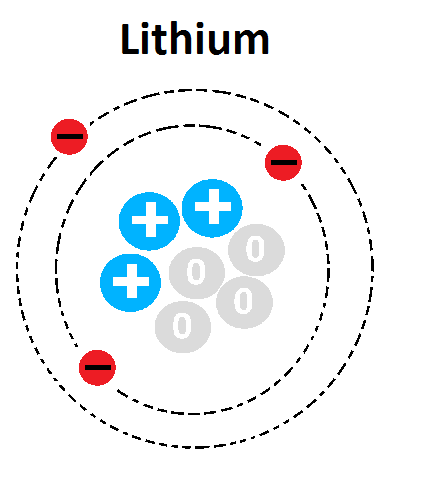
What is the mass number of this atom?
a)
1
b)
3
c)
4
d)
7
31.

The innermost energy level has a maximum of how many electrons?

a)

1

b)

2

c)

6

d)

8

32.
The period for Bromine is ___________.
a)
3
b)
2
c)
4
33.

According to the model Bohr created, electrons orbit the nucleus in defined locations known as

a)

carapaces

b)

integuments

c)

cartridges

d)

shells

34.

They can jump from level to level and between levels

a)

True

b)

False

35.
The majority of an atom's mass exists where?
a)
In the nucleus
b)
In the electron cloud
c)
In the space between the nucleus and the electrons
d)
In the neutrons
36.

Which model belongs to Rutherford?

a)
b)
c)
d)
37.

Which model belongs to Bohr?

a)
b)
c)
d)
38.

Which is the model created by Dalton?

a)
b)
c)
d)
39.

Which is the correct order of the atomic model?

a)

Rutherford, Dalton, Bohr, Thomson, Schrodinger

b)

Dalton, Rutherford, Thomson, Bohr, Schrodinger

c)

Schrodinger, Rutherford, Thomson, Dalton, Bohr

d)

Dalton, Thomson, Rutherford, Bohr, Schrodinger

40.

Chlorine has an atomic number of 17 and a total of 20 neutrons. The mass number is ...

a)

17

b)

37

c)

20

d)

35

41.

Lithium has 3 protons and a mass number of 8. How many neutrons does it have?

a)

5

b)

3

c)

8

d)

11

42.

An isotope has

a)

same number of protons different number of neutrons

b)

same number of neutrons different number of protons

c)

same number of protons different number of electons

d)

same number of electrons different number of protons