
 Worksheets
WE LOVE PHYSICS OLE OLE RAYA
Total questions: 40
Worksheet time: 20mins
A wire has a certain electrical resistance. The diameter and length of the wire may be changed. Which pair of changes must cause the resistance of the wire to increase?
A decrease diameter
decrease length
B decrease diameter
increase length
C increase diameter
decrease length
D increase diameter
increase length
Which statement describes the nature and a property of all β-particles?
A electrons can travel through a vacuum
B electrons stopped by a thin sheet of paper
C helium nuclei can travel through a vacuum
D helium nuclei stopped by a thin sheet of paper
The diagram shows a battery connected to two resistors. Four students separately measure the electromotive force (e.m.f.) of the battery, the current in the resistors, and the potential difference (p.d.) across resistor R. Which row shows values with their correct units?
A emf = 3.0 A
current = 0.30 V
p.d. = 1.5 A
B emf = 3.0 A
current = 0.30 A
p.d. = 1.5 V
C emf = 3.0 V
current = 0.30 V
p.d. = 1.5 A
D emf = 3.0 V
current = 0.30 A
p.d. = 1.5 V
A student uses a length of wire as a resistor. He makes a second resistor from the same material. To be certain of making a second resistor of higher resistance, he should use a piece of wire that is
A longer and thicker.
B longer and thinner.
C shorter and thicker.
D shorter and thinner.
What is the unit of electromotive force (e.m.f.)?
A ampere
B newton
C ohm
D volt
A teacher wishes to show the production of electrostatic charges. She holds a rod and rubs it with a cotton cloth. A copper rod, a glass rod, a plastic rod and a steel rod are available. Which two rods would both be suitable to use?
A a copper rod and a glass rod
B a glass rod and a plastic rod
C a plastic rod and a copper rod
D a plastic rod and a steel rod
Which group contains only good electrical conductors?
A air, carbon (graphite), plastic
B air, gold, mercury
C carbon (graphite), copper, mercury
D copper, gold, plastic
Two similar balloons hang side by side, on insulating threads, a short distance apart. They are both rubbed with the same dry cloth and become charged. Which diagram shows how the balloons hang after charging?

A

B

C

D
A negatively charged rod is held close to one side of a metal sphere. The other side of the sphere is earthed. Which diagram shows the distribution of charge on the metal sphere?

A

B

C

D
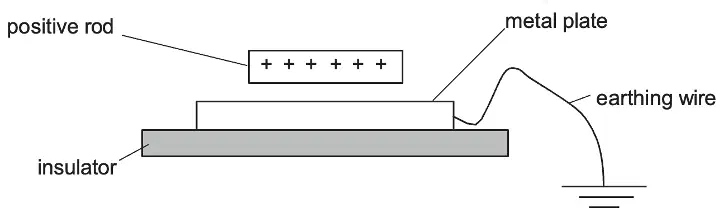
A positively charged plastic rod is placed just above a thick metal plate. The metal plate rests on an insulator and is connected to the earth by a wire. A student disconnects the earthing wire and then removes the positively charged rod. The experiment is repeated. This time the student removes the positively charged rod and then removes the earthing wire. Which statement is correct?
A When the earthing wire is disconnected first, the metal plate becomes positively charged.
B When the earthing wire is disconnected first, the metal plate becomes negatively charged.
C When the plastic rod is removed first, the metal plate becomes positively charged.
D When the plastic rod is removed first, the metal plate becomes negatively charged.
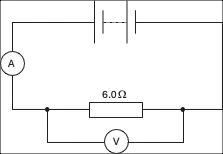
In the circuit shown, the ammeter reads 2.0 A and the voltmeter reads 12V. How much energy is transferred by the resistor in 10 seconds?
A 2.4 J
B 14.4 J
C 240 J
D 1440 J
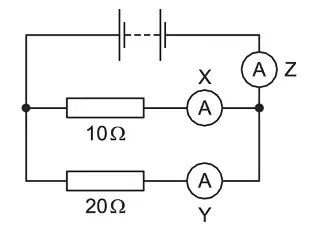
The circuit shown contains three ammeters X, Y and Z. Which ammeter has the largest reading?
A X
B Y
C Z
D They all have the same reading.
Two meters are connected in a circuit to measure the current in a component and the potential difference across the component. Which meters are used and how are they connected to the component?
A an ammeter in parallel for current, a voltmeter in series for potential difference
B an ammeter in series for current, a voltmeter in parallel for potential difference
C a voltmeter in parallel for current, an ammeter in series for potential difference
D a voltmeter in series for current, an ammeter in parallel for potential difference
Why are lamps in a house lighting circuit connected in parallel rather than in series?
A If one lamp stops working, the remaining lamps become brighter.
B Less current is taken from the power supply.
C The lamps can be turned off independently using switches.
D When more lamps are added, their brightness decreases.
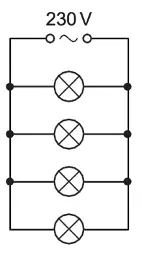
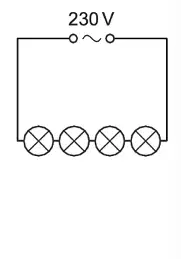
Four lamps are each labelled 240 V. In which circuit do all four lamps have normal brightness?
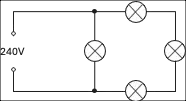
A

B

C
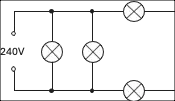
D

The diagram shows a 3.0 Ω resistor and a 6.0 Ω resistor connected in parallel. What is the total resistance of this arrangement?
A less than 3.0 Ω
B 3.0 Ω
C 4.5 Ω
D more than 6.0 Ω
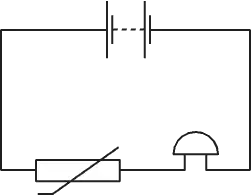
A student sets up this circuit. What is the purpose of the circuit?
A to allow a lamp to be made dimmer or brighter as required
B to amplify the sound of a voice
C to light a lamp in the dark
D to sound a bell when the temperature rises
What is the circuit symbol for a variable resistor?

A

B

C

D
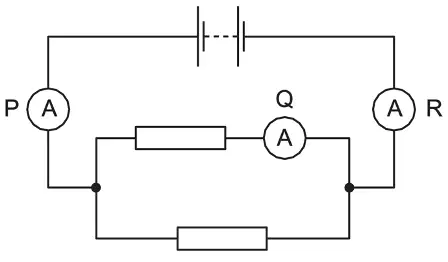
The diagram shows a circuit containing three ammeters P, Q and R.
Which statement about the readings on the ammeters is correct?
A The reading on P is equal to the reading on Q.
B The reading on P is equal to the reading on R.
C The reading on Q is greater than the reading on P.
D The reading on Q is greater than the reading on R.
In which circuit are the lamps connected so that they operate at normal brightness?
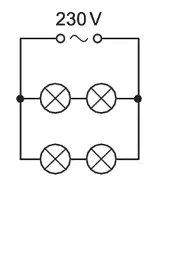

What happens to the brightness of the lamp and what happens to the voltmeter reading?
lamp becomes brighter, decreases voltmeter reading
lamp becomes brighter , increases voltmeter reading
lamp does not change , decreases voltmeter reading
lamp does not change, increases voltmeter reading
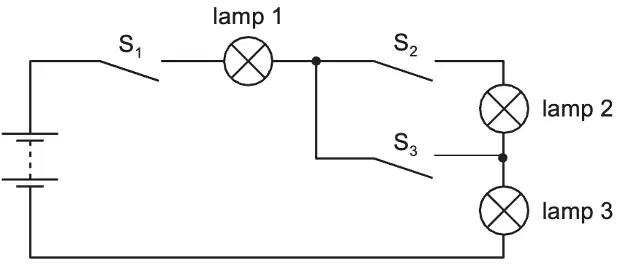
Which switch or switches is/are closed?
S1 only
S1 and S2
S1 and S3
S2 and S3

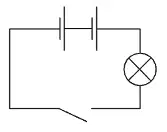
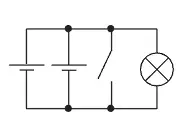
The diagram shows a torch containing two cells, a switch and a lamp.
Which is the circuit diagram for the torch?



Between which two points must a voltmeter be connected to find the potential difference across the bell?
L and M
M and N
N and O
O and P

The circuit shows a battery and four lamps. All the lamps are lit.
One lamp fails and all the lamps go out. Which lamp failed?
Which lamp failed?
A
B
C
D

A circuit contains the component shown by the following symbol.
Which change would the component detect?
light level.
potential difference.
radioactivity.
temperature.

The circuit diagram shows a cell connected to three identical lamps X, Y and Z. All the lamps are lit.
What happens to lamp Z?
It goes out completely.
It becomes dimmer but stays lit.
It stays the same brightness.
It becomes brighter.
A thermistor is used in a circuit to control a piece of equipment automatically. What might this circuit be used for?
lighting an electric lamp as it becomes darker
ringing an alarm bell if a locked door is opened
switching on a water heater at a pre-determined time
turning on an air conditioner when the temperature rises
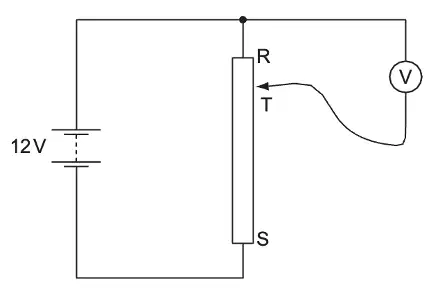
A student connects a variable potential divider (potentiometer) circuit.
What happens to the reading on the voltmeter as the sliding terminal T is moved from R to S?
It decreases from 12 V to 0 V.
It increases from 0 V to 12 V.
It remains at 0 V.
It remains at 12 V.
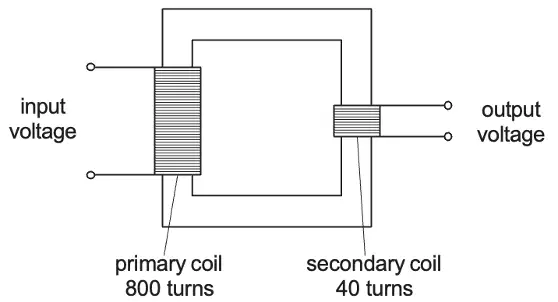
The diagram shows a transformer.
The input voltage is 240 V. What is the output voltage?
6.0 V
12 V
20 V
40 V
A coil carries a current in a magnetic field. The coil experiences a turning effect.
Which device uses this effect?
a d.c. motor
an electromagnet
a relay
a transformer

A magnet is suspended from a spring so that it can move freely inside a stationary coil. The coil is connected to a sensitive centre-zero galvanometer.
What does the galvanometer show?
a constantly changing reading
a steady reading to the left
a steady reading to the right
a steady reading of zero
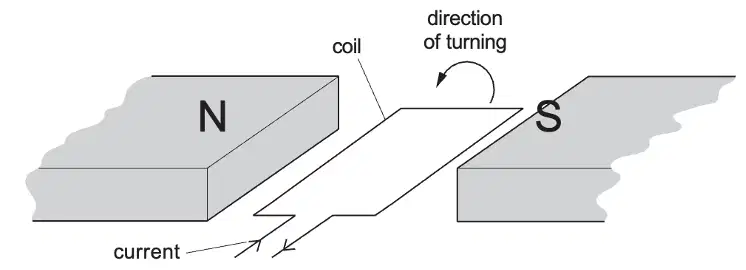
The diagram shows a flat, rectangular coil placed between the poles of a magnet.
There is a current in the coil that makes it turn in the direction shown in the diagram.
Which change would make the coil turn in the opposite direction?
decreasing the current in the coil
increasing the number of turns on the coil
reversing both the direction of the current in the coil and the poles of the magnet
reversing only the direction of the current in the coil
A step-up transformer is used before electricity is transmitted by overhead cables. Which statement explains why the step-up transformer is used?
It increases the current to increase the speed at which the electricity travels.
It increases the current to reduce energy loss in the cables.
It increases the voltage to increase the speed at which the electricity travels.
It increases the voltage to reduce energy loss in the cables.
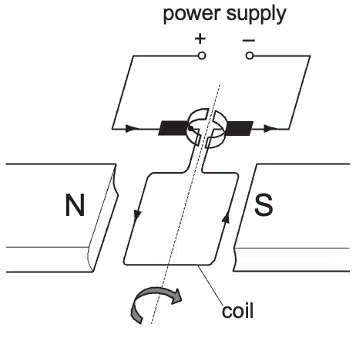
A current-carrying coil in a magnetic field experiences a turning effect.
How can the turning effect be increased?
Increase the number of turns on the coil.
Reduce the size of the current.
Reverse the direction of the magnetic field.
Use thinner wire for the coil.
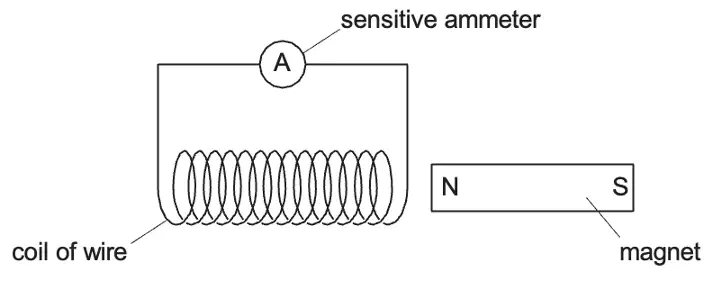
A student investigates electromagnetic induction. She has a bar magnet and a coil of wire that is connected to a sensitive ammeter.
Which movement does not cause a reading on the ammeter?
moving the coil to the right
moving both the magnet and the coil to the left at the same speed
moving both the magnet and the coil towards each other at the same speed
moving the magnet to the left
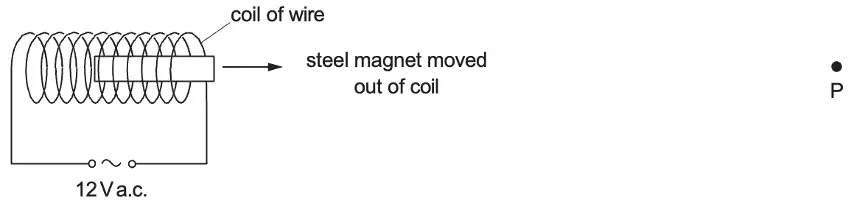
A steel magnet is placed inside a coil of wire. There is a large alternating current in the coil. The magnet is slowly moved out of the coil to position P.
How has the steel changed, if at all, when it reaches position P?
It has become a stronger magnet.
It has become demagnetised.
The poles have changed ends.
There has been no change.

A metal wire is placed between the poles of a magnet.
The wire can be moved in each of three directions OP, QR and ST.
In which direction or directions must the wire be moved to induce an e.m.f. across the ends of the wire?
OP only
OP or ST
QR
ST only
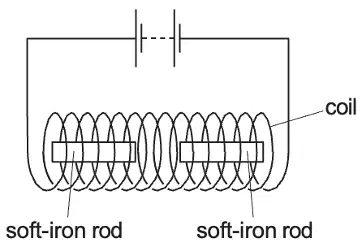
Two soft-iron rods are placed end to end inside a coil which is connected to a battery.
The connections from the battery to the coil are now reversed. What happens to the soft-iron rods in each case?
battery connections as shown: rods attract
battery connections reversed: rods attract
battery connections as shown: rods attract
battery connections reversed: rods repel
battery connections as shown: rods repel
battery connections reversed: rods attract
battery connections as shown: rods repel
battery connections reversed: rods repel
Which diagram shows a movement that will not produce the changing magnetic field needed to induce an e.m.f. in the coil?





