
Font size
S
M
L
XL
 Worksheets
OHIO AIR Test Review
Total questions: 231
Worksheet time: 4hrs 31mins
Name
Class
Date
1.
Osmosis is the diffusion of _____ across a selectively permeable membrane.
a)
food
b)
air
c)
water
d)
oxygen
2.
During diffusion
a)
substances (things) moves from high to low concentration
b)
water moves when energy is used
c)
large or oddly shaped molecules move across a cell membrane
d)
water moves from high to low concentration
3.

Which way will the water molecules move during osmosis?
a)
Out of the cell, so the cell shrinks.
b)
Out of the cell, so the cell swells.
c)
Into the cell, so the cell shrinks.
d)
Into the cell, so the cell swells.
4.
The movement of molecules against a concentration gradient
a)
simple diffusion
b)
facilitated diffusion
c)
active transport
d)
osmosis
5.

_______ regulates what enters and leaves a cell.
a)
Cell Membrane
b)
Nucleus
c)
Mitochondria
d)
Cytoplasm
6.
What does selectively-permeable mean?
a)
The cell controls what passes in and out of the cell
b)
Nothing gets through
c)
The cell lets only large substances through
7.

The picture is an example of _________________.
a)
isotonic
b)
diffusion
c)
osmosis
d)
active transport
8.
Passive transport requires no
a)
concentration gradients
b)
osmosis
c)
motion
d)
energy
9.

The picture below is an example of _________________.
a)
osmosis
b)
isotonic
c)
diffusion
d)
active transport
10.
In a plant cell, a stiff wall surrounds the membrane, giving the cell a rigid, boxlike shape.
a)
cell membrane
b)
cell
c)
ribosome
d)
cell wall
11.
The basic unit of structure and function in a living things.
a)
chloroplast
b)
nucleus
c)
cell
d)
cell membrane
12.
A gel-like fluid in which many different organelles are found.
a)
cell membrane
b)
nucleus
c)
organelle
d)
cytoplasm
13.
Most of the cell's energy is produced within these rod-shaped organelles. This organelle is considered the "powerhouse" of the cell.
a)
ribosomes
b)
mitochondria
c)
vacuole
d)
endoplasmic reticulum
14.
Directs all the cell's activities.
a)
mitochondria
b)
chloroplasts
c)
vacuole
d)
nucleus
15.
A tiny cell structure that carries out a specific function within a cell.
a)
organelle
b)
cell
c)
nucleus
d)
ribosomes
16.
These small structures function as factories to produce proteins.
a)
mitochondria
b)
golgi body
c)
endoplasmic reticulum
d)
ribosomes
17.
This sac with the cytoplasm stores water, food, waste, products and other materials.
a)
vacoule
b)
organelle
c)
cytoplasm
d)
cell membrane
18.

Name structure #1.
a)
nucleus
b)
golgi body
c)
ribosome
d)
cytoplasm
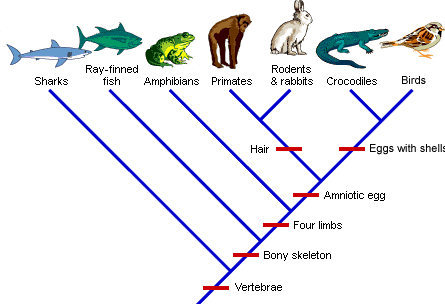
19.

Name structure #5.
a)
rough ER
b)
nucleus
c)
vesicle
d)
cytoplasm
20.

Name structure #9.
a)
rough ER
b)
mitochondria
c)
smooth ER
d)
cell wall
21.

How many chromosomes do humans have?
a)
46
b)
21
c)
10
22.

Structure (b) is a ____.
a)
chromosome
b)
chromatid
c)
centromere
23.

Structure (a) is a ____.
a)
chromosome
b)
chromatid
c)
centromere
24.

Structure (c) is a ____.
a)
chromosome
b)
chromatid
c)
centromere
25.

The stages of mitosis in order
a)
Metaphase, Anaphase, Prophase, Telophase
b)
Prophase, Anaphase, Metaphase, Telophase
c)
Prophase, Metaphase, Anaphase, Telophase
d)
Anaphase, Prophase, Telophase, Metaphase
26.

This picture shows which process?
a)
mitosis
b)
meiosis
c)
the cell cycle
27.
How does a bacteria reproduce?
a)
Mitosis
b)
Cytokenesis
c)
Binary Fusion
d)
Binary Fission
28.

Which part of the cell cycle is the longest?
a)
Interphase
b)
Mitosis
c)
Cytokenesis
29.
G1 & G2 = Growth
What is the S phase?
What is the S phase?
a)
making centrioles
b)
making spindle fibers
c)
doubling the DNA
d)
cutting the DNA in half
30.

It has two homologues, is 2n and the chromosomes are found in pairs
a)
Haploid
b)
Diploid
31.

When an area of a chromatid is exchanged with the matching area on a chromatid of its homologous chromosome, _________________ occurs
a)
crossing over
b)
mutagenesis
c)
hybridization
d)
fertilization
32.
A cat has a total of 38 chromosomes in its body cells. How many in its gametes?
a)
38
b)
19
c)
76
d)
10
33.
The process of crossing over occurs in what phase of meiosis?
a)
anaphase 1
b)
prophase 1
c)
prophase 2
d)
telophase 1
34.
The purpose of meiosis is to form ________ cells.
a)
body
b)
sex
c)
somatic
d)
brain
35.
type of reproduction of meiosis
a)
sexual
b)
asexual
36.
products of meiosis are genetically
a)
different
b)
identical
37.
Most of the cells in the human body are produced by
a)
mitosis
b)
meiosis
38.
Human eggs and sperm are _____, and each has ____ chromosomes.
a)
diploid, 23
b)
diploid, 46
c)
haploid, 23
d)
haploid, 46
39.
What are chromosomes?
a)
different versions of genes
b)
condensed DNA
c)
uncoiled DNA
40.
Crossing over is important because....
a)
It prevents mutations from entering the gametes.
b)
It allows for even distribution of chromosomes in the gametes.
c)
It allows for more genetic diversity of gametes.
d)
It allows for genetic uniformity of gametes.
41.
This produces cells for growth and repair.
a)
mitosis
b)
meiosis
42.
Diploid Cells are represented by
a)
2n
b)
n
c)
4n
d)
1/2 n
43.
A male shark has 40 chromosomes in each of its sex cells. How many would be present in its body cells?
a)
20
b)
40
c)
80
d)
160
44.
With mitosis you get ___, _________ cells, but with meiosis, you get ___, ____________.
a)
4, different, 2, identical
b)
4, identical, 2, different
c)
2, different, 4, identical
d)
2, identical, 4, different
45.
Chromosomes that have the same sequence of genes, that have the same structure, and that pair during meiosis
a)
homologous chromosomes
b)
tetrads
c)
synapsis
d)
crossing over
46.
Male gamete
a)
ovum
b)
polar body
c)
sperm
d)
oocyte
47.
A mature egg cell
a)
sperm
b)
ovum
c)
polar body
d)
male gamete
48.
The union of male and female gametes to form a zygote
a)
sperm
b)
egg
c)
fertilization
d)
tetrads
49.
The production, growth, and maturation of an egg or ovum
a)
spermatogenesis
b)
oogenesis
c)
fertilization
d)
conception
50.
The process by which male gametes form
a)
oogenesis
b)
spermatogenesis
c)
fertilization
d)
crossing over
51.

A is:
B is:
C is:
B is:
C is:
a)
A: chromatid
B: centromere
C: chromosome
B: centromere
C: chromosome
b)
A: chromosome
B: chromatid
C: centromere
B: chromatid
C: centromere
c)
A: chromosome
B: centromere
C: chromatid
B: centromere
C: chromatid
d)
A: centromere
B: chromosome
C: chromatid
B: chromosome
C: chromatid
52.

A grapical display that shows an individual's chromosomes arranged in homologous pairs and in order of diminishing size
a)
pictograph
b)
genetic recombination
c)
karyotype
d)
diploid
53.
The result of meiosis is:
a)
two diploid cells
b)
two haploid cells
c)
four diploid cells
d)
four haploid cells
54.
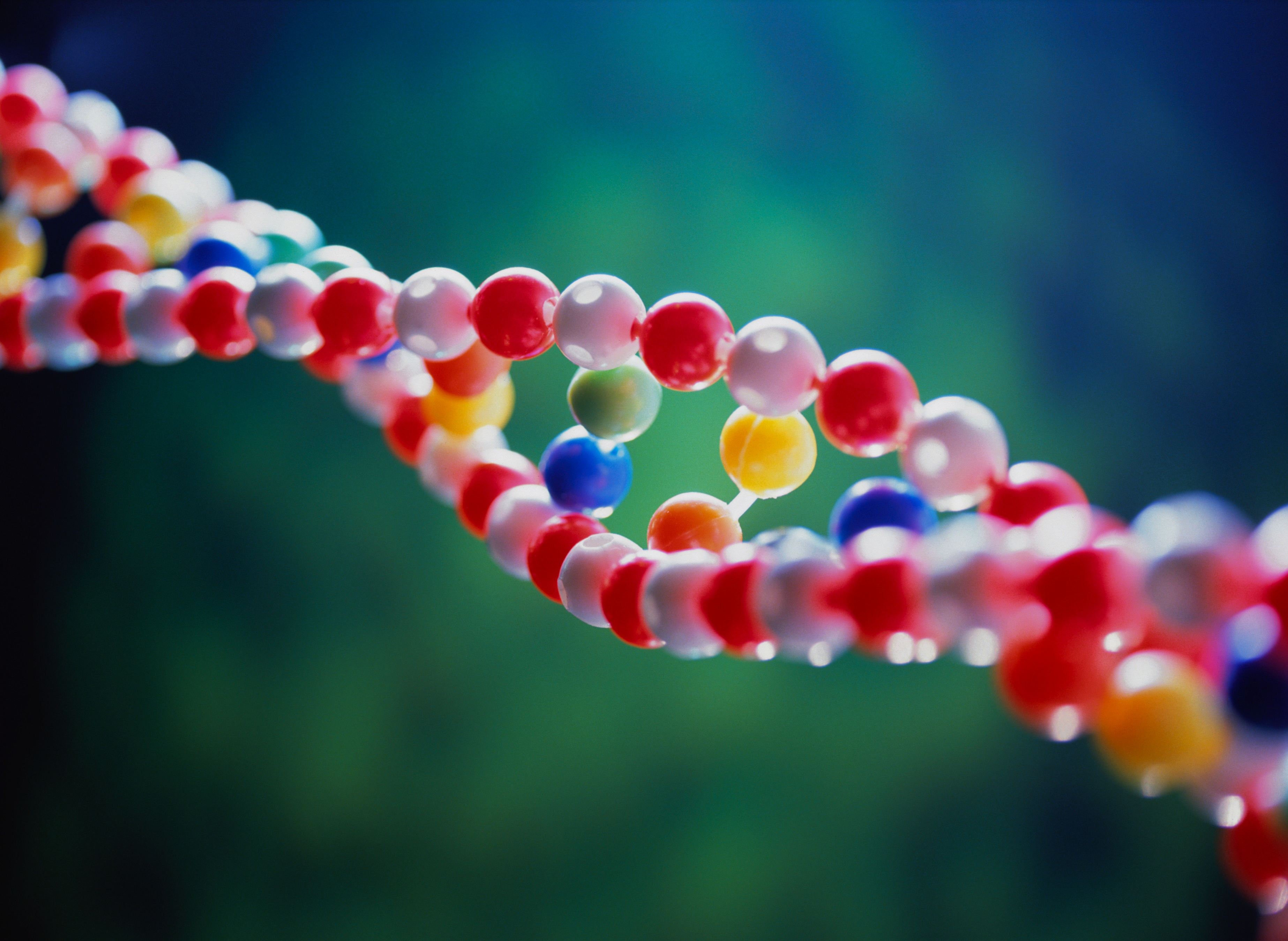
Why is DNA important?
a)
it is very small and very complicated
b)
it's in everything
c)
it serves as the blueprint for traits of all living things
d)
because we eat it every day for energy
55.
What are the 4 nitrogen bases?
a)
adenine, thymine, cytoplasm, and guanine
b)
adenine, thymine cytosine, and guanine
c)
adenine, thymine, cytosine, and gylcerol
d)
adenine, thymine, cytosine, and glucose
56.
Which 2 molecules forms the sides (backbone) of the DNA ladder?
a)
deoxyribose and adenine
b)
deoxyribose and a hydrogen bond
c)
sugar and the nucleus
d)
deoxyribose (sugar) and phosphate
57.
Which sequence of DNA bases would pair with this partial strand
ATG TGA CAG
ATG TGA CAG
a)
ATG TGA CAG
b)
TAC ACT GTC
c)
GTA AGT GAC
d)
CAT TCA CTG
58.
The name of the 5 carbon sugar that makes up DNA is _____
a)
phosphate
b)
deoxyribose
c)
ribose
d)
polymerase
59.
How many different types of nitrogen bases are there in DNA?
a)
1
b)
2
c)
3
d)
4
60.
What is the end result of replication?
a)
Two new identical strands of DNA
b)
One parent strand and one daughter strand of DNA
c)
Two new and different strands of DNA
d)
One new strand of DNA
61.
What are the three parts of a nucleotide?
a)
Polymer, Monomer, Diomer
b)
Phosphorous, Monosaccharide, Sulfur Base
c)
Phosholipid, fatty acid chain, gylercin.
d)
Phosphate group, sugar, nitrogen base
62.

Which of the following best describes a DNA molecule?
a)
double helix
b)
contains ribose
c)
made of amino acids
d)
contains Uracil
63.
Adenine bonds with ______________.
a)
Guanine
b)
Thymine
c)
Cytosine
d)
Adenine
64.
Guanine bonds with ______________.
a)
Adenine
b)
Guanine
c)
Cytosine
d)
Thymine
65.
A process in which DNA has the unique ability to make an exact copy of itself.
a)
Replication
b)
Translation
c)
Transcription
66.
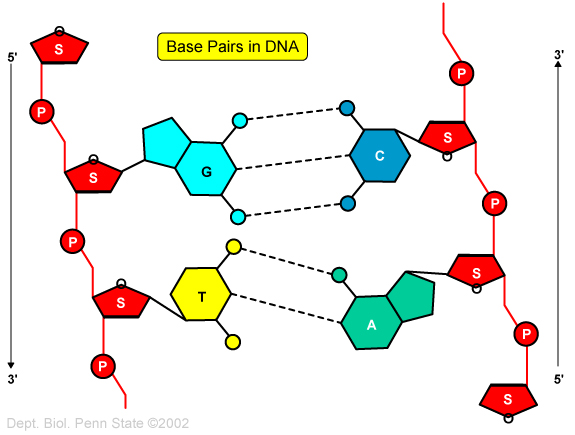
Nitrogenous bases are joined by which type of bond?
a)
polar bonds
b)
ionic bonds
c)
covalent bonds
d)
hydrogen bonds
67.
In what phase of the cell cycle does DNA replication take place?
a)
G1
b)
S
c)
G2
d)
M
68.
tRNA is involved in
a)
carrying amino acids
b)
carrying ribosomes
c)
carrying glucose
d)
carrying lipids
69.

What is occurring in this picture?
a)
Translation
b)
DNA Replication
c)
Polymerase is unzipping the DNA
d)
Transcription
70.

Which amino acid is made from the RNA codon GUA?
a)
Phenylalanine
b)
Leucine
c)
Serine
d)
Valine
71.

Which amino acid is made from the RNA codon ACC?
a)
Tyrosine
b)
Isoleucine
c)
Threonine
d)
Valine
72.
Which represents the bases of mRNA?
a)
A U C G
b)
A T U G
c)
A T C G
d)
U T C G
73.
A segment of the DNA from a chimpanzee has the sequence: TAC GAA GCA. Which mRNA would be transcribed from this segment of DNA?
a)
GCA TCC TAC
b)
AUG CUU CGU
c)
ATG CTT CGT
d)
GCA UCC UAC
74.
Which of the following is the sugar found in RNA?
a)
Ribose
b)
Maltose
c)
Deoxyribose
d)
Amylose
75.
Which of the following is a correct difference between RNA and DNA?
a)
RNA is single stranded and DNA is double stranded
b)
RNA is double stranded and DNA is single stranded
c)
DNA uses Uracil and RNA uses Thymine
d)
RNA has deoxyribose and DNA has ribose
76.
Which statement is TRUE regarding DNA and RNA?
a)
DNA's sugar is ribose; RNA's sugar is deoxyribose
b)
DNA is single stranded; RNA is double stranded
c)
DNA contains thymine; RNA contains uracil
d)
DNA is in cytoplasm; RNA is in nucleus
77.

Which amino acid is made from the RNA codon UUA?
a)
Phenylalanine
b)
Leucine
c)
Serine
d)
Tyrosine
78.
What type of macro-molecules are DNA and RNA?
a)
Protein
b)
Carbohydrate
c)
Nucleic Acid
d)
Lipid
79.
In eukaryotes, DNA is located in the
a)
cytoplasm
b)
nucleus
c)
cell membrane
d)
ribosome
80.
Which of the following would copmlete the mRNA strand for CAG (DNA)
a)
CAG
b)
AUG
c)
GUC
d)
UAC
81.
An RNA molecule is
a)
double helix
b)
always double stranded
c)
usually double stranded
d)
single stranded
82.
An mRNA molecule is produced in the step of protein synthesis:
a)
replication
b)
transcription
c)
duplication
d)
translation
83.
In mRNA, each codon specifies a particular
a)
nucleotide
b)
amino acid
c)
purine
d)
pyrimidine
84.
If an mRNA codon is AGU, which of the following would be the appropriate tRNA anticodon?
a)
TCA
b)
UGA
c)
AGU
d)
UCA
85.
Which of the following is the complementary mRNA strand for this strand of DNA? ATT-GCG-AGT
a)
UAA-CGC-TCA
b)
UAA-GCG-UCA
c)
UAA-CGC-AGT
d)
UAA-CGC-UCA
86.
How many bases are in one codon?
a)
1
b)
2
c)
3
d)
4
87.

Using the codon identify the amino acid sequence:
AUG-GGC-ACC-UCA-UGA
AUG-GGC-ACC-UCA-UGA
a)
MET-GLU-VAL-TYR-STOP
b)
MET-GLY-THR-SER-STOP
c)
MET-SER-THR-GLY-STOP
d)
MET-LYS-ASN-STOP
88.
Using the codon identify the amino acid sequence:
AUG-CCA-GUA-GGG-UAA
AUG-CCA-GUA-GGG-UAA
a)
MET-HIS-ALA-GLY-STOP
b)
MET-PRO-GLY-VAL-STOP
c)
MET-PRO-VAL-GLY-STOP
d)
MET-THR-SER-ASP-STOP
89.

The genotypic ratio here is
a)
25% blue eye 75 % brown eye
b)
BB = 25% Bb = 50% bb = 25%
c)
BB= 50 % bb = 50%
d)
All brown eye
90.

What is the genotypic ratio here
a)
TT = 25% Tt= 50% tt=25%
b)
all tall
c)
TT= 75% tt = 25%
d)
Tt = 100%
91.

To express the recessive trait you must be
a)
homozygous dominant
b)
heterozygous
c)
alleleerific
d)
homozygous recessive
92.
What are the two genotypes that show the DOMINANT Phenotype
a)
GG, gg
b)
GG, Gg
c)
Gg, gg
93.
Heredity is the passing of traits from _____________________ to _____________________
a)
predators to prey
b)
water to rain
c)
parents to offspring
d)
fungi to protists
94.
The different forms of a gene are known as _____________.
a)
Codons
b)
Proteins
c)
Alleles
d)
Nucleotides
95.
How many alleles do you get from each parent?
a)
1
b)
2
c)
23
d)
46
96.
Which of Mendel's laws states that alleles are separated during meiosis?
a)
Law of Dominance
b)
Law of Segregation
c)
Law of Independent Assortment
d)
Law of Meiosis
97.
Which of Mendel's laws states that alleles are distributed to gametes independent of one another?
a)
Law of Dominance
b)
Law of Segregation
c)
Law of Independent Assortment
d)
Law of Meiosis
98.
According to the Law of Segregation, alleles are separated during the process of _____________.
a)
Mitosis
b)
Meiosis
c)
Osmosis
d)
Translation
99.
Which of the following is an example of a GENOTYPE?
a)
25%
b)
Blue
c)
1:2:1
d)
Bb
100.
Which of the following is an example of a PHENOTYPE?
a)
25%
b)
Blue
c)
1:2:1
d)
Bb
101.
Which of the following is an example of a homozygous dominant genotype?
a)
RR
b)
Rr
c)
rr
102.
Which of the following is an example of a homozygous recessive genotype?
a)
RR
b)
Rr
c)
rr
103.
Which of the following is an example of a heterozygous genotype?
a)
RR
b)
Rr
c)
rr
104.
What is another name for heterozygous?
a)
Hybrid
b)
Purebred
c)
Codominant
d)
Mixed Breed
105.

Both parents in this Punnet square
a)
are homozygous dominant
b)
are homozygous recessive
c)
are heterozygous
d)
have blue eyes
106.
Who is considered the "Father of Genetics?"
a)
James Watson
b)
Francis Crick
c)
Gregor Mendel
d)
Albert Einstein
107.
True or False: Genetics is the scientific study of heredity.
a)
True
b)
False
108.
A __________ is a segment of DNA that codes for a particular protein, which leads to a particular trait.
a)
Gene
b)
Allele
c)
Codon
d)
Nucleotide
109.
True or False: A phenotype describes the physical expression (characteristics) of a gene. In other words, how something looks.
a)
True
b)
False
110.

What is the FUNCTION of a punnett square?
a)
Identifies the location of a gene.
b)
Determines the DNA sequence of an organism.
c)
Predicts the possible results of a genetic cross.
d)
Tests for the presence of dominant alleles.
111.

A calico cat shows both the traits for orange fur and black fur. What kind of allele expression is this?
a)
Incomplete Dominance
b)
Co dominance
c)
Independent assortment
d)
Recessive inheritance
112.
A breed of chicken shows codominance for feather color. One allele codes for black feathers, another codes for white feathers. The feathers of heterozygous chickens of this breed will be:
a)
all black
b)
all white
c)
all gray
d)
speckled black and white
113.

This type of inheritance pattern is a MIXTURE of both traits.
a)
incomplete dominance
b)
co-dominance
c)
complete dominance
d)
recessive pattern
114.

This type of inheritance pattern shows BOTH traits in possible offspring
a)
complete dominance
b)
incomplete dominance
c)
co-dominance
d)
dominant pattern
115.

What genotype is missing from this Punnett Square?
a)
RrYy
b)
RRYY
c)
rryy
d)
RrYY
116.

Based off this punnett square, what fraction of the offspring will have wrinkled, yellow seeds?
a)
9/16
b)
3/16
c)
1/16
d)
16/16
117.

This image is an example of a _____________ cross.
a)
Monohybrid
b)
Dihybrid
c)
Purebred
d)
Heterozygous
118.
In a dihybrid cross, _________ pairs of contrasting traits are being crossed.
a)
one
b)
two
c)
three
d)
four
119.
In a ____________ cross, one pair of contrasting traits are being crossed.
a)
monohybrid
b)
dihybrid
c)
trihybrid
d)
quadhybrid
120.
Which of the following is a phenotype?
a)
Aa
b)
red hair
c)
heterozygous
d)
DNA
121.

T - tall and t = short
In the punnett square below, what belongs in the missing square
In the punnett square below, what belongs in the missing square
a)
tt
b)
Tt
c)
Bb
d)
TT
122.
The first set of offspring after the p-generation is known as the;
a)
P2 generation
b)
F1 generation
c)
F2 generation
d)
p-generation
123.

What is the genotype(s) of the F1 offspring that has the dominant trait?
a)
BB
b)
bb
c)
Bb
d)
BB and bb
124.

In the following dihybrid cross, a short tail (S) is dominant to a long tail (s) and brown fur (B) is dominant to white fur (b). What is the fraction of cats that have a short tail and white fur?
a)
4/16
b)
12/16
c)
3/16
d)
1/16
125.
Mendel crossed what organism in his investigations?
a)
Peas
b)
Flies
c)
Pigs
d)
Humans
126.
Brown (B) is dominant over white (b). Which genotype is a purebred for brown fur?
a)
BB
b)
Bb
c)
bb
d)
All of the above
127.
Which of the following genotypes is homozygous recessive?
a)
RR
b)
Rr
c)
rr
d)
None of the Above
128.
Dominant alleles are-
a)
capital
b)
lowercase
c)
both
d)
neither
129.
Recessive alleles are-
a)
capital
b)
lowercase
c)
both
d)
neither
130.

If green is dominant over purple, then what is the genotype for this individual?
a)
Purple
b)
Green
c)
GG
d)
gg
131.
Which of the following is a heterozygous genotype?
a)
BB
b)
TT
c)
Uu
d)
jj
132.

Each box of the Punnett square represents what percent?
a)
10
b)
15
c)
25
d)
20
133.
the passing of traits from parent to offspring
a)
Genetics
b)
Heredity
c)
Genetic Combinations
d)
Meiosis
134.
Both alleles for a characteristic are the same
a)
Hybrid
b)
Heterozygous
c)
Homozygous
d)
Phenotype
135.

This is an example of a ______________.
a)
phenotype
b)
genotype
c)
xenotype
d)
base pairs
136.

The genetic make up of this flower is ________.
a)
homozygous recessive
b)
heterozygous
c)
homozygous dominant
d)
white
137.
T - tall and t = short
In the punnett square below, what belongs in the missing square
In the punnett square below, what belongs in the missing square
a)
tt
b)
Tt
c)
Bb
d)
TT
138.

Which individual in the first generation is a carrier?
a)
The male
b)
The female
c)
individual 1
d)
None of the above
139.

How many generations are shown in this pedigree?
a)
1
b)
2
c)
3
d)
4
140.

How many boys did the mother and father from the first generation have?
a)
2
b)
4
c)
5
d)
6
141.

a)
Not affected male
b)
Not affected female
c)
Affected male
d)
Affected female
142.

Does this pedigree show a dominant or recessive trait?
a)
Dominant
b)
Recessive
143.

a)
Not Affected Male
b)
Not Affected Female
c)
Affected Male
d)
Affected Female
144.

a)
Not affected Female
b)
Not affected Male
c)
Affected Male
d)
Affected Female
145.
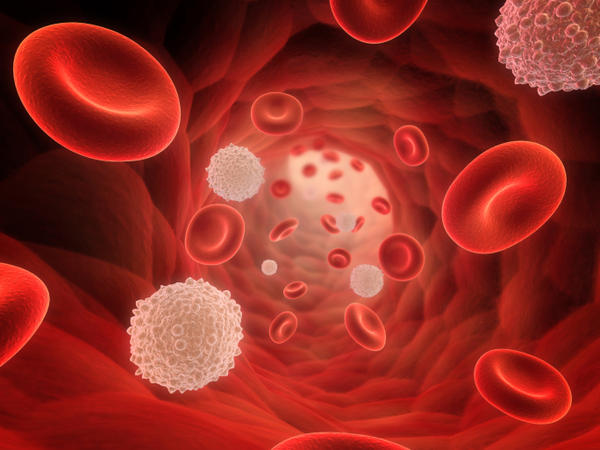
Mike has type O blood. Mike can donate blood to someone who is type A.
a)
True
b)
False
146.
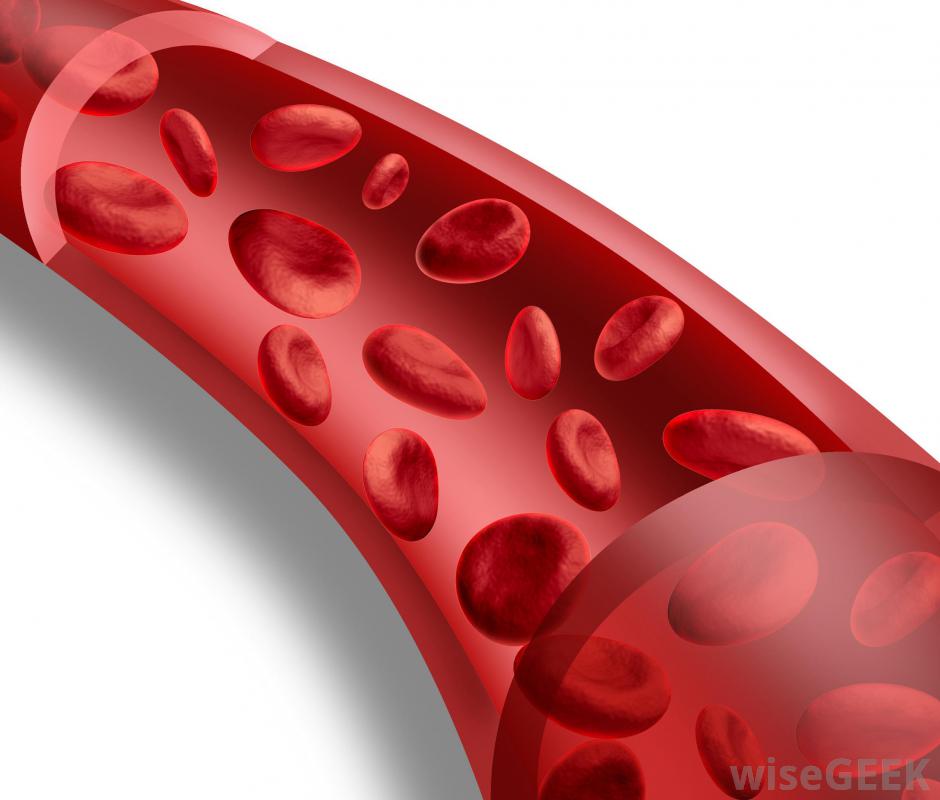
Mike has type O blood. Mike can receive blood from someone who has Type A or Type B.
a)
True
b)
False
147.

Jim has type AB blood. His dad could be type O.
a)
True
b)
False
148.
Universal blood donors have type ______ blood.
a)
A
b)
AB
c)
B
d)
O
149.

What percentage of the female offspring will be a carrier for this recessive disease?
a)
0%
b)
50%
c)
100%
d)
25%
150.

What percentage of the offspring will have this recessive disease?
a)
0%
b)
25%
c)
50%
d)
75%
151.
If a trait shows up more commonly in men than women it is probably
a)
not inherited
b)
on the x chromosome and dominant
c)
on the x chromosome and recessive
d)
on a normal body chromosome
152.
I have 1 X chromosome and 1 Y chromosome. What am I?
a)
Male
b)
Female
153.
I have 2 X chromosomes. What am I?
a)
Male
b)
Female
154.
What does a vertical line coming down from a square and circle that are connected by horizontal line indicate?
a)
They are cousins
b)
The children
c)
Aunts and Uncles
155.
What do we use pedigrees for?
a)
To look at families
b)
To make determinations about the offspring
c)
To track traits in families
d)
Nothing
156.

What type of heredity is shown in the pedigree?
a)
Sex-Linked Dominant
b)
Sex-Linked Recessive
c)
Autosomal Dominant
d)
Autosomal Recessive
157.

What type of heredity is shown in the pedigree?
a)
Sex-Linked Dominant
b)
Sex-Linked Recessive
c)
Autosomal Dominant
d)
Autosomal Recessive
158.

This is an example of ___________?
a)
Incomplete dominance
b)
Co-Dominance
159.

This is an example of ___________.
a)
Incomplete Dominance
b)
Codominance
160.

This shows...
a)
Incomplete dominance
b)
Codominance
c)
Sex linked traits
d)
Dominant inheritance
161.

B = brown fur b = white fur
In the punnett square, what is the probability for white fur?
In the punnett square, what is the probability for white fur?
a)
0%
b)
25%
c)
50%
d)
75%
162.
Each step in a food chain or a food web is called a
a)
Step level
b)
Pyramid level
c)
Trophic Level
d)
Heat Level
163.
What are the products of cellular respiration?
a)
glucose, carbon dioxide, and ATP energy
b)
glucose and carbon dioxide
c)
carbon dioxide and water
d)
carbon dioxide, water, and ATP energy
164.
Where does cellular respiration take place?
a)
nucleus
b)
chloroplast
c)
mitochondria
d)
vesicle
165.
Cells use the energy stored in food to make
a)
ADP
b)
ATP
c)
Glucose
d)
Water
166.
The main source of energy for all life comes from ____.
a)
the Earth
b)
the moon
c)
the sun
d)
the food we eat/make
167.
Another name for sugar is
a)
ATP
b)
Cellular
c)
Glucoes
d)
Fall Out Boy
168.
Cellular Respiration's goal is to?
a)
make water
b)
make ATP
c)
make glucose
d)
make oxygen
169.
What is a producer?
a)
an organism that gets energy from eating other organisms
b)
an organisms that uses sunlight to make its own food
c)
an organism that gets energy from eating dead organisms, non-living material or waste
170.
An organism that gets energy from eating other organisms is a ______________
a)
producer
b)
consumer
c)
decomposer
171.
A connection of food chains with many food energy paths in an ecosystem is a ____________
a)
ecosystem
b)
food web
c)
environment
172.
What is a herbivore?
a)
an animal that gets energy from eating other animals
b)
an organism that gets energy from eating only plants
c)
an animal that gets energy by eating both plants and other animals
173.

Which of the following is a herbivore?
a)
cricket
b)
frog
c)
hawk
d)
shrew
174.
What is needed for cellular respiration to occur?
a)
oxygen and water
b)
oxygen and glucose
c)
glucose and carbon dioxide
d)
water and carbon dioxide
175.

The rabbit in this food web would be considered a:
a)
Decomposer
b)
Producer
c)
Secondary Consumer
d)
Primary Consumer
176.

Which food chain correctly identifies the flow of energy?
a)
Polar Bear--->Caribou--->Grasses--->Sun
b)
Lichen--->Lemming--->Artic Fox--->Polar Bear
177.
Carbon is....
a)
the least common element in all living things.
b)
found only in the atmosphere and rocks.
c)
the most common element in all living things.
d)
is found mostly in dead things.
178.
Which of the following is an example of a decomposer?
a)
Owl
b)
Fish
c)
Tree
d)
Mushroom
179.

When a population grows past the ecosystem's carrying capacity, what happens to the population?
a)
Continues to grow
b)
The population starts to die off to return to carrying capcity
c)
The population will go extinct due to lack of resources
d)
The population grows then finds a new carrying capacity
180.
If there is more food than usual in an ecosystem, then...
a)
Populations will stay the same
b)
Populations will decrease
c)
Populations will increase
181.
Space, food, water, weather conditions, disease, and climate/weather conditions can be examples of what?
a)
biotic factors
b)
limiting factors
c)
abiotic factors
d)
death rate
182.

If the sun provides all energy in the Energy Pyramid, and the energy decreases by a division of 10 as you travel up the pyramid, how much energy does the Tertiary Consumer have?
a)
100%
b)
10,000%
c)
10%
d)
.1%
183.

If the grasshopper were to be removed completely from the food web, what organism would be most effected?
a)
The squirrel
b)
The shrew
c)
The deer
d)
The rabbit
184.

Which organisms from the Food Web is consuming the Insects?
a)
Lynx, Hare
b)
Shrew, Red fox
c)
Lynx, Red Fox
d)
Hawk, Shrew
185.

Which organism receives the least amount of energy from the producer?
a)
Owl
b)
Grasshopper
c)
Lilypad
d)
Mouse
186.

What does a food web represent?
a)
All connections of energy flow throughout all organisms in a ecosystem.
b)
The specific ways that mutualism is carried out.
c)
A single pathway or energy flow between organisms.
d)
How carnivores get their food.
187.
What does a Primary Consumer eat?
a)
Tertiary Consumers
b)
Secondary Consumers
c)
Producers
188.
In a food web, arrows point at:
a)
who gets energy.
b)
who gets eaten.
189.
_____________ are an example of decomposers.
a)
fish
b)
bacteria
c)
plants
d)
seaweed
190.
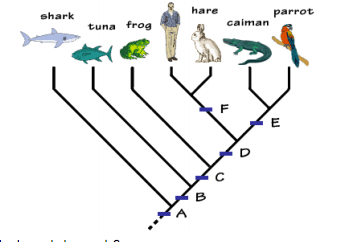
On the cladogram, which organism is the closest relative of the human?
a)
Frog
b)
Hare
c)
Caiman
d)
Parrot
191.
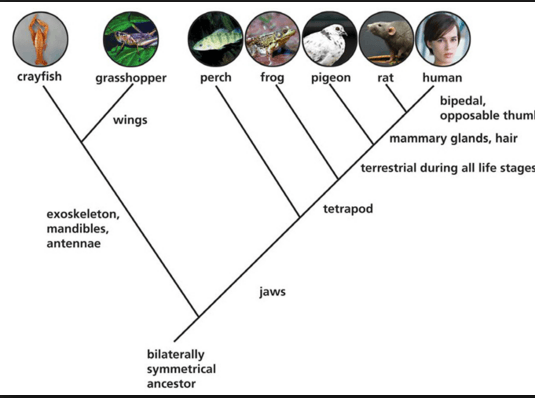
Which trait do only humans have, according to the cladogram?
a)
jaws
b)
mammary glands & hair
c)
terrestrial during all life stages
d)
bipedal & opposable thumbs
192.
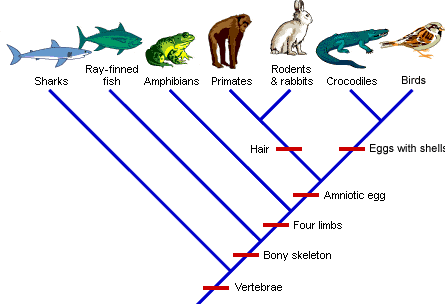
According to this cladogram, birds are LEAST related to:
a)
Amphibians
b)
Sharks
c)
Ray Finned Fish
d)
Crocodiles
193.
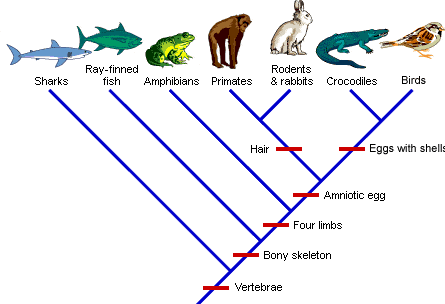
Which two orgainsms have hair?
a)
Sharks & Ray Finned Fish
b)
Primates & Rodents
c)
Birds & Crocodiles
d)
Rabbits & Birds
194.
According to this cladogram, sharks are MOST closely related to which organism?
a)
Amphibians
b)
Ray finned fish
c)
Crocodiles
d)
Birds
195.
Cladograms are constructed by grouping organisms together based on their____________ characteristics.
a)
shared
b)
different
c)
similar
d)
opposite
196.

A common ancestor for both A and E could be at position __.
a)
1
b)
2
c)
3
d)
4
197.

A dichotomous key for trees is provided. Hikers found a tree that has large brown cones and single sharp needles. What species of tree have the hikers found?
a)
Juniper
b)
Pine
c)
Spruce
d)
Fir
198.
You look at two species and see very similar DNA. What does this likely tell you?
a)
These are the same animal.
b)
These animals have a common ancestor.
c)
These animals are not likely related.
d)
These animals are likely becoming one species.
199.
Most plants appear green because chlorophyll
a)
absorbs green light.
b)
absorbs violet light.
c)
reflects green light.
d)
does not absorb violet light.
200.
The reactants of photosynthesis are
a)
sugar and water.
b)
sugar and oxygen.
c)
carbon dioxide and water.
d)
carbon dioxide and oxygen.
201.
What are the products of photosynthesis?
a)
Carbon dioxide and water
b)
Carbon dioxide and oxygen
c)
Glucose and oxygen
d)
Glucose and water
202.
What pigment absorbs sunlight for photosynthesis?
a)
chloroplast
b)
thylakoid
c)
grana
d)
chlorophyll
203.

Autotroph or heterotroph?
a)
Autotroph
b)
Heterotroph
204.

Autotroph or heterotroph?
a)
Autotroph
b)
Heterotroph
205.
Which gas is removed from the atmosphere during photosynthesis?
a)
hydrogen
b)
oxygen
c)
nitrogen
d)
carbon dioxide
206.
Most plants appear green because chlorophyll
a)
absorbs green light.
b)
absorbs violet light.
c)
does not absorb green light.
d)
does not absorb violet light.
207.
Which of the following best describes photosynthesis?
a)
Photosynthesis converts radiant energy into chemical energy.
b)
Photosynthesis produces carbohydrates.
c)
Plants need sunlight, carbon dioxide, water, nutrients, and chlorophyll to complete photosynthesis.
d)
Plants use chlorophyll, water, and carbon dioxide to make sugar.
208.
In which eukaryotic organelles does photosynthesis occur?
a)
mitochondria
b)
stomata
c)
xylem
d)
chloroplast
209.
Who is the father of evolution?
a)
Darwin
b)
Mendel
c)
Newton
d)
Einstein
210.
What is another name for natural selection?
a)
survival of the smartest
b)
survival of the fastest
c)
survival of the biggest
d)
survival of the fittest
211.

Structures with the same parts have different functions; suggests that organisms share a common ancestry
a)
vestigial structures
b)
homologous structures
c)
adaptive radiation
d)
fossil
212.
Where the better adapted organisms survive to pass traits along to offspring.
a)
Evolution
b)
Natural Selection
c)
Extinction
d)
Artifical Selection
213.

When an organism is completely wiped out of existence, we call it?
a)
extinction
b)
adaptation
c)
evolution
d)
inbreeding
214.
What are the evidences for Evolution?
a)
Fossil Records
b)
Embryology
c)
Similar body structure
d)
All the above
215.
Which organisms are most likely to survive?
a)
the best adapted
b)
the fastest
c)
the strongest
d)
the most domesticated (tamed)
216.

Two organisms that are closely related would have
a)
very similar DNA sequence
b)
exactly the same DNA sequences
c)
no proteins in common
d)
completely different DNA sequence
217.

Genetic variation can arise from a random change in the DNA of a gene. The change is called a(n)
a)
mutation
b)
gene flow
c)
gene pool
d)
allele
218.

Which of the following is a term for a group of similar organisms that can reproduce fertile offspring?
a)
individual
b)
population
c)
species
d)
fossil
219.
A remnant or trace of an organism from the past is called a _______.
a)
Ancestor
b)
Skeleton
c)
Fossil
d)
Imprints
220.
A scientist is examining a newly discovered species of bird to determine which type it is most closely related to. The best method to determine relatedness is
a)
comparative embryology
b)
the fossil record
c)
comparative anatomy
d)
DNA analysis
221.

Which layer is the oldest
a)
B
b)
A
c)
E
d)
C
222.
The study of the distribution of species in different places and times. (Where did a species live and when?)
a)
Common Ancestry
b)
Biogeography
c)
Stasis
d)
Sequential
223.
A scientist is examining a newly discovered species of bird to determine which type it is most closely related to. The best method to determine relatedness is
a)
comparative embryology
b)
the fossil record
c)
comparative anatomy
d)
DNA analysis
224.
Mutations are important because they bring about
a)
death of the organism in which they develop
b)
genetic variation needed for a population to evolve
c)
benefits for the individual, not for the population
d)
Hardey-Weinberg equilibrium within a population
225.

Which two species are most related?
a)
B&C
b)
A&B
c)
A&C
d)
C&B
226.

All rabbits living in a particular area would be an example of a(n)
a)
population
b)
species
c)
fossil
d)
individual organism
227.

Some organisms that share a common ancestor have features that have different functions, but similar structures. These are known as
a)
vestigial structures
b)
analogous structures
c)
homologous structures
d)
fossil structures
228.

two species are in different environments and look very similar. However, that are not closely related (analogous). Their resemblance is most likely an example of.
a)
sexual selection
b)
temporal isolation
c)
convergent evolution
d)
divergent evolution
229.

Other insects can not, but a bumble bee has just enough weight to open up the snapdragon flower and pollinate. This adaption is ....
a)
convergent evolution
b)
co-evolution
c)
divergent evolution
d)
speciation
230.
What is the process in which humans breed organisms for certain traits?
a)
natural selection
b)
inheritance
c)
artificial selection
d)
descent withOUT modification
231.
asexual reproduction produces offspring with
a)
half of a single parent's genes
b)
the same genes as the parent
c)
a mix of genes from two parents
d)
lots of genetic variation
Reset

