
 Worksheets
Atmospere
Total questions: 68
Worksheet time: 1hrs 19mins
Name
Class
Date
1.
0-17 km above Earth's surface, site of weather, organisms, contains most atmospheric water vapor. (temperature decreases with increasing altitude, pressure decreases)
a)
mesosphere
b)
stratusphere
c)
ionosphere
d)
troposphere
2.
2nd layer of atmosphere; extends from 10 to 30 miles up; location of ozone layer; absorbs 95% of Ultraviolet radiation; temperature increases with altitude increase.
a)
stratosphere
b)
mesosphere
c)
ionosphere
d)
trophosphere
3.
(50-80 km) The layer of the atmosphere above the stratosphere in which temperature decreases as altitude increases. Protects the Earth's surface because most meteoroids burn in the mesosphere producing meteor trails of hot glowing gases. (Meso = middle)
a)
mesosphere
b)
ionosphere
c)
hemisphere
d)
trosposphere
4.
Process by which, in a fluid being heated, the warmer part of the that substance will rise and the cooler portions will sink.
a)
convection
b)
conduction
c)
radiation
d)
caramelisation
5.
Natural situation in which heat is retained in Earth's atmosphere by carbon dioxide, methane, water vapor, and other gases
a)
greenhouse effect
b)
ionosphere
c)
ozone
d)
organic gasses
6.
an atmospheric phenomenon consisting of bands of light caused by charged solar particles following the earth's magnetic lines of force
a)
fluorescence
b)
aurora borealis
c)
excited state
d)
boraxo phenomenon
7.
Temperature to which the air needs to be cooled to reach saturation
a)
humidity
b)
relative humidity
c)
dew point
8.
Which will heat and cool faster?
a)
land
b)
water
c)
neither, they will heat and cool at the same rate
9.
The layers of the atmosphere in order from the ground up
a)
stratosphere, troposphere, mesosphere and thermosphere
b)
troposphere, mesosphere, thermosphere and stratosphere
c)
thermosphere, mesosphere, stratosphere and troposphere
d)
troposphere, stratosphere, mesosphere and thermosphere
10.
What is the hottest layer in the atmosphere?
a)
Ionosphere
b)
Stratosphere
c)
Thermosphere
d)
Mesosphere
11.
Layer of the Earth's atmosphere that contains the ozone layer?
a)
thermosphere
b)
mesosphere
c)
stratosphere
d)
troposphere
12.
Before condensation can occur, the air must be ____________________________.
a)
Humid
b)
Cold
c)
Hot
d)
Saturated
13.
Atmospheric conditions, along with short-term changes, of a particular place at a particular time
a)
weather
b)
climate
c)
air pressure
d)
precipitation
14.

The layer of the atmosphere where weather occurs is the _.
a)
thermosphere
b)
stratosphere
c)
mesosphere
d)
troposphere
15.
______ is the average pattern for weather over a long period of time.
a)
climate
b)
weather
c)
forecast
d)
sunlight
16.
What percent of solar radiation is absorbed by the land and sea?
a)
20%
b)
25%
c)
30%
d)
50%
17.
Which gas makes up the largest component of Earth's atmosphere?
a)
oxygen
b)
nitrogen
c)
argon
d)
carbon dioxide
18.
The most abundant element in the earth's atmosphere is...
a)
oxygen
b)
argon
c)
hydrogen
d)
nitrogen
19.
The vertical movement of air due to the uneven heating is called
a)
convection
b)
reflection
c)
conduction
d)
refraction
20.
In the Northern Hemisphere, the general direction of the flow of the jet stream is toward the
a)
north
b)
south
c)
east
d)
west
21.

Which diagram shows the formation of a land breeze?
a)
diagram Y
b)
diagram X
c)
neither
d)
both
22.
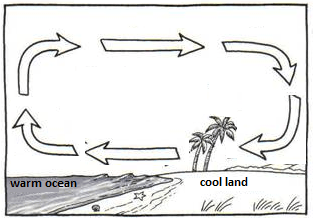
What kind of breeze is this and when would it form?
a)
Land breeze - daytime
b)
Land breeze - nighttime
c)
Sea breeze - daytime
d)
Sea breeze - nighttime
23.
The main factor that causes any wind to blow is ...
a)
a. Uneven heating of the Earth's atmosphere.
b)
b. Differences in air pressure and humidity.
c)
c. Warm air from the poles meeting the cold ait from the equator.
d)
d. The even heating of the Earth's atmosphere.
24.
Warm air _________ and cool air ___________.
a)
rises/sinks
b)
sinks/rises
25.
What causes wind to blow?
a)
Differences in longitude
b)
Shock waves from clouds
c)
Differences in air temperature and pressure
d)
The rotation of the earth
26.
If you wanted to visit an area with very little wind, where might you go?
a)
The doldrums around the equator
b)
the jet streams in the northern and southern hemisphere
c)
the North or South Pole
d)
the area around the Mediterranean Sea
27.
Trade winds move towards the ____.
a)
Polar regions
b)
Western Hemisphere
c)
Humid subtropical climates
d)
Equator
28.
Low pressure zones near the equator are known as ____.
a)
Westerlies
b)
Easterlies
c)
Jet Streams
d)
Doldrums
29.
Winds that blow from the west are called ____.
a)
Easterlies
b)
Polars
c)
Westerlies
d)
Temperates
30.
What winds blow from west to east in the temperate zone and move weather patterns across the United States?
a)
prevailing westerlies
b)
polar easterlies
c)
trade winds
d)
jet streams
31.
What are cold winds that blow from east to west in the polar regions?
a)
polar easterlies
b)
trade winds
c)
prevailing westerlies
d)
jet streams
32.
Global winds over the United States blow in which direction?
a)
east to west
b)
north to south
c)
south to west
d)
west to east
33.
What atmospheric layer contains most of the mass of Earth's atmosphere?
a)
thermosphere
b)
troposphere
c)
stratosphere
d)
mesosphere
34.
Satellites orbit this layer of the atmosphere.
a)
Stratosphere
b)
Exosphere
c)
Thermosphere
d)
Troposphere
35.
Which has the SHORTEST wavelength and, therefore, the highest frequency/most energy
a)
Radio waves
b)
Ultraviolet Rays
c)
Gamma Rays
d)
X-rays
36.
Which list correctly matches each instrument with the weather variable it measures?
a)
wind vane—wind speed
thermometer—temperature
precipitation gauge—relative humidity
thermometer—temperature
precipitation gauge—relative humidity
b)
wind vane—wind direction
thermometer—dewpoint
psychrometer—air pressure
thermometer—dewpoint
psychrometer—air pressure
c)
barometer—relative humidity
anemometer—cloud cover
precipitation gauge—probability of precipitation
anemometer—cloud cover
precipitation gauge—probability of precipitation
d)
barometer—air pressure
anemometer—wind speed
psychrometer—relative humidity
anemometer—wind speed
psychrometer—relative humidity
37.
Air pressure is usually highest when the air is
a)
cool and humid
b)
cool and dry
c)
warm and humid
d)
warm and dry
38.
A low-pressure system in the Northern Hemisphere has a surface air-circulation pattern that is
a)
clockwise and away from the center
b)
clockwise and toward the center
c)
counterclockwise and away from the center
d)
counterclockwise and toward the center
39.
In which direction do the surface winds blow around a high-pressure system in the Northern Hemisphere?
a)
clockwise and inward
b)
clockwise and outward
c)
counterclockwise and inward
d)
counterclockwise and outward
40.
Clouds most likely form as a result of
a)
moist air rising, compressing, and warming
b)
moist air rising, expanding, and cooling
c)
dry air rising, compressing, and warming
d)
dry air rising, expanding, and cooling
41.
A unit of atmospheric pressure
a)
millibar
b)
isobar
c)
thermometer
d)
barometer
42.
An instrument that measures atmospheric pressure
a)
isotherm
b)
barometer
c)
isobar
d)
millibar
43.
An instrument which uses a wet and a dry bulb thermometer is called a
a)
psychrometer
b)
anemometer
c)
barometer
d)
thermometer
44.
AIr pressure is expressed in units of measure called
a)
isobars
b)
millibars
c)
inches
d)
degrees
45.
Clouds form through
a)
precipitation
b)
condensation
c)
evaporation
d)
infiltration
46.
_____________ is the temperature to which air must be cooled to reach saturation.
a)
Humid point
b)
Temperature index
c)
Relative Humidity
d)
Dew Point
47.
Warm saturated air contains _______ water vapor than cold saturated air.
a)
more
b)
less
48.

White, thin, feathery clouds, usually made of ice crystals are...
a)
Stratus
b)
Cumulus
c)
Cirrus
49.
Which term describes a circulation of air or water that is caused by uneven heating?
a)
convection current
b)
conduction current
c)
radiation current
d)
emission current
50.
____________ air rises because it is ____________dense.
a)
Cool, Less
b)
Warm, Less
c)
Cold, More
d)
Warm, More
51.
When water is cooled to its dew point, it forms a cloud on the ground called _____.
a)
cumulus
b)
precipitation
c)
fog
d)
condensation
52.
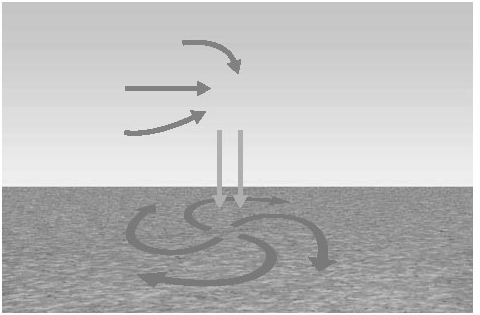
Which type of pressure system is pictured?
a)
high
b)
low
c)
medium
d)
none
53.
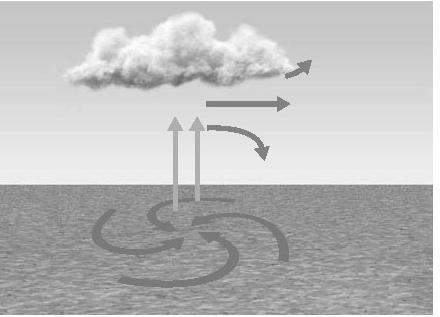
Which type of pressure system is pictured?
a)
high
b)
low
c)
medium
d)
none
54.
When air contains as much moisture as possible at a specific temperature, it is:
a)
at its dew point
b)
saturated
c)
at its dew point AND saturated
d)
none of the rest
55.
The temperature at which air is saturated and condensation forms is the:
a)
dew point
b)
rain point
c)
wind point
d)
relative humidity
56.
Which cloud would be found in the middle of the atmosphere?
a)
altostratus
b)
cirrostratus
c)
stratus
d)
cirrocumulus
57.

If you were at an altitude of about 50 Km, what temperature would you experience.
a)
-80
b)
-40
c)
0
d)
40
58.
Which of the following is an example of a cloud of vertical development?
a)
nimbostratus cloud
b)
cumulonimbus cloud
c)
cirrus cloud
d)
stratus cloud
59.
Lvl 2: Precipitation that falls to the planet as balls of ice. They can be small and large.
a)
Rain
b)
Sleet
c)
Hail
d)
Snow
60.
Water droplets condense around _____________ to form a cloud.
a)
dust
b)
water
c)
cloud particles
d)
precipitation
61.
What is the definition of sublimation?
a)
a chemical process where a solid turns into a gas without going through a liquid stage
b)
the process of a liquid changing into a gas
62.
What is an example of sublimation?
a)
Ice cream melting
b)
Dry ice
63.
This type of fog is found on the sides of mountains.
a)
radiation fog
b)
steam fog
c)
dew
d)
upslope fog
64.

How does the temperature on the windward side of the mountain compare to the temperature on the leeward side?
a)
Temperature on the leeward side is cooler
b)
Temperature on the leeward side is the same as the windward side
c)
Temperature on the windward side is cooler
d)
Temperature on the windward side is warmer
65.
The _______ of a mountain range is the side that receives a lot of precipitation.
a)
dry side
b)
leeward/dry side
c)
windward/wet side
d)
cloudy side
66.
The dry area on the leeward side of the mountain is called the
a)
peak
b)
rainforest
c)
rain shadow
d)
windward side
67.
Which side of mountain tends to be dry?
a)
Front
b)
Leeward
c)
Equatorial
d)
Windward
68.
Deserts often form on which side of the mountain?
a)
The valley side
b)
The leeward side
c)
The northwest side
d)
The windward side
100 %

