
 Worksheets
PUNNETT SQUARES
Total questions: 30
Worksheet time: 44mins
Name
Class
Date
1.
Aa, DD, bB, yy are all examples of
a)
genotypes
b)
phenotypes
2.
AA and Aa always show up as
a)
dominant
b)
recessive
3.
Which of the following genotypes is homozygous dominant?
a)
A
b)
Aa
c)
AA
d)
aa
4.
Which of the following genotypes is heterozygous?
a)
Bb
b)
BB
c)
bb
d)
B
5.
In a flowering plant species, red flower color (R) is dominant over white flower color (r). What is the genotype of any red-flowering plant resulting from this species?
a)
rr
b)
R
c)
RR
d)
RR or Rr
6.
B = brown eyes
b = blue eyes
What is true about these two brothers that have brown eyes?
One has genotype BB the other Bb.
b = blue eyes
What is true about these two brothers that have brown eyes?
One has genotype BB the other Bb.
a)
they have same phenotype and genotype
b)
they have different genotypes and phenotypes
c)
they have same phenotype but different genotypes
d)
they have same genotype but different phenotypes
7.
W=white hair
w= non-white hair
If you cross a horse with WW and a horse with ww what fraction of the offspring would be expected to have white hair?
w= non-white hair
If you cross a horse with WW and a horse with ww what fraction of the offspring would be expected to have white hair?
a)
none
b)
3/4
c)
1/2
d)
all
8.

What are the possible genotypes for this cross?
a)
TT = 25% Tt= 50% tt=25%
b)
all tall
c)
TT= 75% tt = 25%
d)
Tt = 100%
9.

T - tall and t = short
In the punnett square below, what belongs in the missing square
In the punnett square below, what belongs in the missing square
a)
tt
b)
Tt
c)
Bb
d)
TT
10.
How many alleles (letters) do each person carry for a trait?
a)
1
b)
2
c)
3
d)
4
11.
G = green, g = yellow
The genotype for a yellow plant is...
The genotype for a yellow plant is...
a)
GG
b)
Gg
c)
gg
d)
all of the choices result in yellow
12.

What chance does the offspring have of showing a recessive trait?
a)
50%
b)
75%
c)
100%
d)
25%
13.
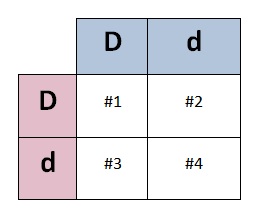
What is the allele combination for square 1?
a)
Dd
b)
DD
c)
dd
d)
D
14.
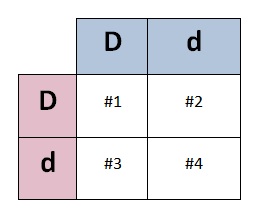
What is the possibility of this offspring having a dominate trait?
a)
50%
b)
75%
c)
25%
d)
0%
15.
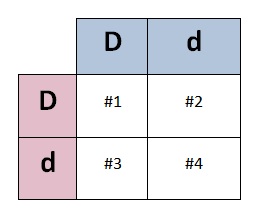
What is the chance of this offspring having a recessive trait?
a)
25%
b)
100%
c)
50%
d)
0%
16.

What is the missing allele?
a)
a
b)
A
c)
AA
d)
aa
17.

What is the genotype for the black chickens?
a)
BB
b)
Bb
c)
bB
d)
bb
18.

What is the phenotype for Bb?
a)
Black chicken
b)
Blue Chicken
c)
Dominant
d)
Red spot
19.

If two black chickens (genotype bb) mated, would there be a chance of having Blue (Bb, BB) chickens?
a)
No chance
b)
50% chance
c)
25% chance
d)
100% chance
20.

What chance does the offspring have of showing a dominant trait?
a)
100%
b)
75%
c)
50%
d)
0%
21.

How many females are in this pedigree?
a)
3
b)
4
c)
6
d)
7
22.

How many of the males in this pedigree show the trait being studied?
a)
2
b)
3
c)
4
d)
6
23.
When 2 pea plants heterozygous for height (Tt) are crossed, what is the ratio of the resulting genotypes (TT:Tt:tt)?
a)
1:2:1
b)
2:1:1
c)
0:3:1
d)
0:2:2
24.

T - tall and t = short
In the punnett square below, what belongs in the missing square
In the punnett square below, what belongs in the missing square
a)
tt
b)
Tt
c)
Bb
d)
TT
25.
In plants, tall (T) is dominant to short (t). Perform the following cross: Tt x Tt. What is the probability of producing a short plant?
a)
0%
b)
25%
c)
50%
d)
75%
26.

B = brown fur b = white fur
In the punnett square, what is the probability for white fur?
In the punnett square, what is the probability for white fur?
a)
0%
b)
25%
c)
50%
d)
75%
27.
Two brown eyed parents (Bb) have a baby. What is the chance the baby is blue eyed?
a)
0 %
b)
25%
c)
50%
d)
75%
28.

Which individual in the first generation is a carrier?
a)
The male
b)
The female
c)
individual 1
d)
None of the above
29.

How many kids did the mother and father from the first generation have?
a)
2
b)
4
c)
5
d)
6
30.

How many boys did the mother and father from the first generation have?
a)
2
b)
4
c)
5
d)
6
100 %

