
 Worksheets
8th grade staar review physics
Total questions: 84
Worksheet time: 2hrs 53mins
Name
Class
Date
1.
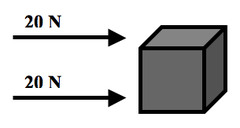
What is the net force?
a)
40 N left
b)
0 N Balalnced
c)
400 N right
d)
40 N right
2.

What is the net force?
a)
10 N
b)
0 N
c)
25 N
d)
1 N
3.
What is velocity?
a)
the quickness of an object
b)
the location of an object
c)
acceleration
d)
speed with the specific direction
4.

Calculate the Net Force.
a)
40N, Left
b)
40N, Right
c)
0N, Balanced
d)
75N, Right
5.
In a normal environment, why does a bowling ball and feather hit the ground at different times when dropped from the same height?
a)
They don't; they hit the ground at the same time.
b)
One is more dense than the other.
c)
One is heavier than the other.
d)
Air resistance
6.

What is the net force?
a)
400 N Up
b)
400 N Down
c)
- 400 N Down
d)
800 N Down
7.
The tendency of an object at rest to stay at rest unless it is acted upon by a force is called ___________________
a)
inertia
b)
motion
c)
gravity
d)
lubricant
8.
When forces are _________ the object DOES NOT move.
a)
unbalanced
b)
balanced
c)
heavy
d)
light
9.
When forces are ___________ the object will move.
a)
unbalanced
b)
balanced
c)
light
d)
gravity
10.
Which of Newtons laws explains why football teams have big, large, fast athletes.
a)
Frist and second
b)
second law
c)
first law
d)
Third law
11.
Which law explains why when you put a book on a table the table pushes on the book
a)
3rd law
b)
4th law
c)
1st law
d)
2nd law
12.

When Ronda Rousey got kicked in the face, What is the interaction pair?
a)
The foot and the face
b)
Ronda Rousey and media criticism
c)
The foot and the air flow
d)
Ronda Rousey and the floor
13.
A bus hits a bug and the bug splatters on the windshield, which force is greater?
a)
The Bus
b)
The Bug
c)
They're the same
d)
Gravity acting on the bus
14.
When you hold an apple above your head, how many force pairs act on the apple?
a)
1
b)
2
c)
3
d)
4
15.
Newton's third law states that any action will have a(n) _______ and ______ reaction
a)
Equal and similar
b)
Equal and opposite
c)
Equal and different
d)
Greater and opposite
16.
A book rests on a table. The force of gravity pulls down on the book with a force of 20 newtons. What prevents the books from accelerating downward at 9.8 m/sec2
a)
The table presses back up on the book with an equal and opposite force of 20 newtons.
b)
The table presses back up on the book with a force greater than 20 newtons.
c)
The table and the book together are accelerating downwards at 9.8 m/sec2
d)
The inertia of the book holds it up
17.

This equation goes with which law?
a)
Newton's first law of motion
b)
Newton's second law of motion
c)
Newton's third law of motion
d)
None of these
18.
You hit a wall with a stick. The equal but opposite reaction is _____
a)
the wall pushes against you
b)
the stick pushes against you
c)
you push against the stick
d)
the wall pushes against the stick
19.
A 20 kg bike accelerates at 10 m/s2. How much force was applied?
a)
25
b)
200 N
c)
20 N
d)
10 N
20.

When a cannon fires a cannonball we observe Newton's third law. Which force is the reaction force?
a)
The cannon moving forward
b)
The cannonball moving forward
c)
The cannon moving backward
d)
The cannonball moving backward
21.

Which car is accelerating?
a)
A car that is not moving
b)
A ar that rounds a curve at a constant speed
c)
A car traveling at a constant speed
d)
A car that has a set speed of 60mph
22.

How fast is the car traveling at 30 seconds?
a)
5m/s
b)
10m/s
c)
20m/s
d)
30m/s
23.

Pushing a child on a swing is easier than pushing an adult on the same swing.
a)
1st Law
b)
2nd Law
24.
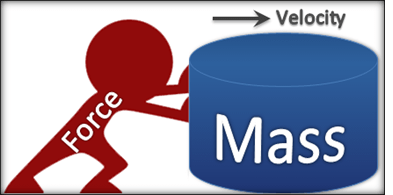
a)
1st
b)
2nd
c)
3rd
25.
What law is best described by inertia?
a)
1st
b)
2nd
c)
3rd
26.

a)
1st
b)
2nd
c)
3rd
27.
Object at rest stays at rest.
a)
1st
b)
2nd
c)
3rd
28.
Acceleration is due to a force put on an objects mass.
a)
1st
b)
2nd
c)
3rd
29.
Action/Reaction
a)
1st
b)
2nd
c)
3rd
30.
Force exerted between the surfaces of two objects.
a)
Friction
b)
Inertia
c)
Force
d)
Gravity
31.
How does friction affect the speed of a moving object?
a)
Friction speeds up the motion of the objects
b)
Friction slows down the motion of objects
32.
A student applies 2 Newtons of force to a toy car causing it to accelerate at a rate of 10 m/s2. What is the mass of the toy car in kg?
a)
2 kg
b)
.2 kg
c)
.02 kg
33.
What is speed?
a)
Speed is the time traveled in a certain distance
b)
Speed is the distance an object travels in a given amount of time
c)
Speed is the total distance and direction
34.
Which of the following is an example of velocity?
a)
15 m/s downhill
b)
15 mph
c)
A flock of geese flying at 55 mph
d)
A rollercoaster slowing down as it travels uphill
35.
Which of the following is an example of acceleration?
a)
A rollercoaster slows down as it travels uphill
b)
A cyclist travels 40 kilometers in 2 hours
c)
A flock of geese flies north at 55 mph
d)
An athlete can run about 12.5 km/hr
36.
Inertia is the tendency of an object:
a)
To keep moving
b)
To stay at rest
c)
To resist a change in motion
37.
Which of the following formulas are incorrect?
a)
F=MxA
b)
M= F/A
c)
A= F/M
d)
M= A/F
38.
Work=
a)
Friction X Distance
b)
Joules X Friction
c)
Distance/Force
d)
Force X Distance
39.
Work is measured in
a)
Jewels
b)
Joules
c)
Newtons
40.
A man pushes against a beach ball with 20 Newtons of force. The ball does not move. How much work is he doing?
a)
0 Joules
b)
20 Joules
c)
0 Newtons
d)
20 Newtons
41.

At which point does the water in the waterfall have the greatest gravitational potential energy?
a)
Point 1
b)
Point 2
c)
Point 3
d)
Point 4
42.

As the rollercoaster moves from point Z to point Y, the potential energy _________ as the kinetic energy __________.
a)
Increases; increases
b)
Decreases; decreases
c)
Increases; decreases
d)
Decreases; increases
43.
As the rollercoaster moves from point Y to point X, the potential energy _________ as the kinetic energy __________.
a)
Increases; increases
b)
Decreases; decreases
c)
Increases; decreases
d)
Decreases; increases
44.
At which of the 4 points does the cart have the least potential energy?
a)
W
b)
X
c)
Y
d)
Z
45.

A diagram of a pendulum is shown to the left. The pendulum is released from Position 1. At which two positions will the pendulum’s potential energy equal its kinetic energy?
a)
1 and 2
b)
2 and 4
c)
3 and 4
d)
4 and 5
46.

In the graph to the right, how many kilometers has the object moved after 10 minutes?
a)
1 km
b)
1.5 km
c)
2 km
47.
In the graph to the right, how many kilometers has the object moved after 20 minutes?
a)
1 km
b)
1.5 km
c)
2 km
48.
In the graph to the right, how many minutes did it take for the object to move 3.5 kilometers?
a)
10 minutes
b)
20 minutes
c)
30 minute
d)
40 minutes
49.

The graph below shows the speed of a car traveling north over a 16 second time period. Based on the information in the graph, it can be concluded that in the first 8 seconds, the car is
a)
changing its direction
b)
accelerating at a constant rate
c)
climbing a steep incline
d)
experiencing less and less friction
50.
_________ states that energy cannot be created or destroyed, but only transformed into different forms
a)
Law of Conservation of Mass
b)
Law of Conservation of Energy
51.
What type of energy is being converted when a glow stick cracks?
a)
Chemical to light
b)
Light to mechanical
c)
Light to chemical
d)
Chemical to electrical
52.
What type of energy is being converted when a plant goes through photosynthesis?
a)
Chemical to light
b)
Light to mechanical
c)
Light to chemical
d)
Chemical to electrical
53.
In science, if we are measuring time, what unit would we use?
a)
Hours
b)
Minutes
c)
Seconds
d)
Hourglass
54.
What is plotted on the x-axis?
a)
Independent Variable
b)
Dependent Variable
c)
Whichever you want
55.

What is the formula to calculate speed?
a)
S = t/d
b)
S = d/t
c)
S = d x t
d)
S = t x d
56.

A runner races in the 100 meter dash. It takes her 10 seconds to finish. What is her average speed?
a)
10 m/s
b)
1000 m/s
c)
100 seconds
d)
10 seconds
57.

What does this graph represent?
a)
Constant Speed
b)
Acceleration
c)
Not moving
58.

What is happening at D?
a)
Stationary
b)
Accelerating
c)
Fast steady speed; moving away from the starting position
d)
Slower steady speed; moving away from the starting position
59.

What is happening at E?
a)
Stationary
b)
Accelerating
c)
Fast steady speed; moving away from the starting position
d)
Steady speed; returning to start position
60.

What is happening at A?
a)
Stationary
b)
Accelerating
c)
Slower steady speed; moving away from the starting position
d)
Steady speed; returning to start position
61.
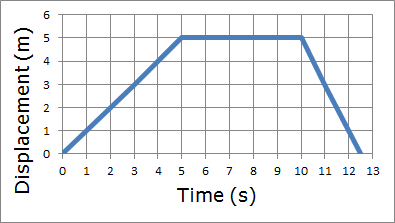
According to the graph how far does the person travel in the first 5 seconds?
a)
2 m
b)
10 m
c)
0 m
d)
5 m
62.

What is the person doing from 5 seconds to 10 seconds?
a)
Walking
b)
Running
c)
Standing Still
d)
Walking Fast
63.

How far is the person from the starting point after 3 seconds?
a)
0 m
b)
2 m
c)
3 m
d)
6 m
64.

What is the average speed of the person during the first 5 seconds?
a)
0 m/s
b)
1 m/s
c)
3 m/s
d)
6 m/s
65.

What is happening in this graph from point B to C?
a)
The object is going down a hill.
b)
The object is returning to its starting location.
c)
The object is slowing down.
d)
The object is staying still.
66.

What is happening in this graph from point A to B?
a)
The object is accelerating.
b)
The object is not moving.
c)
The object is decelerating.
d)
The object is moving at a constant speed.
67.
This variable in an experiment is the one being deliberately changed by the scientist.
a)
dependent variable
b)
independent variable
c)
data
d)
control group
68.
A factor in an experiment that stays the same.
a)
control group
b)
constant
c)
dependent variable
d)
experimental group
69.
An educated guess that has not been tested.
a)
law
b)
theory
c)
hypothesis
d)
fact
70.
Three baseball players investigate to see who can throw a baseball the farthest. They mark off an area on the playground for their investigation. Which should they keep constant?
a)
height of the players
b)
color of the balls thrown
c)
order in which the players throw
d)
spot from which the players throw
71.
Dory set up an experiment to see how the mass of a ball affects the distance it rolls off a ramp. What is the dependent variable?
(Hint: The DV is the variable being counted or measured.)
(Hint: The DV is the variable being counted or measured.)
a)
distance traveled by the ball
b)
height of the ramp
c)
mass of the ball
d)
ball type
72.
If you were testing how well different dish soaps cleaned grease, the independent (experimental) variable would be the:
a)
dishes type
b)
amount of water
c)
dish soap type
d)
grease type
73.
Which piece of lab equipment would be used to find the volume of a small circular rock?
a)
Graduated Cylinder
b)
Metric Ruler
c)
Triple Beam Balance
d)
Beaker
74.
Which piece of lab equipment would you use to find the mass of a rock?
a)
Graduated Cylinder
b)
Metric Ruler
c)
Triple Beam Balance
d)
Beaker
75.
What would the INDEPENDENT variable be in an experiment testing which types of paper airplane fly the farthest?
a)
the paper used
b)
the type of paper airplane
c)
the distance of each plane's flight
d)
how hard the plane is thrown
76.

Describe the correlation in the graph shown.
a)
Strong Negative
b)
Strong Positive
c)
Weak Negative
d)
No Correlation
77.

Describe the correlation in the graph shown.
a)
Strong Negative
b)
Strong Positive
c)
Weak Negative
d)
No Correlation
78.

Describe the correlation in the graph shown.
a)
Strong Negative
b)
Strong Positive
c)
No Correlation
d)
Weak Positive
79.
Which would be a qualitative observation?
a)
The color of milk
b)
The number of eggs used
c)
The temperature at which the egg boiled
d)
The time it took the egg to cook
80.
Mr. S set up an experiment to see how the mass of a ball affects the distance it rolls off a ramp. What is the controlled variable?
a)
Distance traveled by the ball
b)
Height of the ramp
c)
Mass of the ball
81.
Mr. S set up an experiment to see how the mass of a ball affects the distance it rolls off a ramp. What is the dependent variable?
a)
Distance traveled by the ball
b)
Height of the ramp
c)
Mass of the ball
82.
Mr. S set up an experiment to see how the mass of a ball affects the distance it rolls off a ramp. Identify the independent variable.
a)
Distance traveled by the ball
b)
Height of the ramp
c)
Mass of the ball
83.
Mr. S normally uses praise as a reward to train his dog. He wants to know the best way to train his dog, so he sets up an experiment to find out if there is a better way to get his dog to respond to commands. What is his independent variable?
a)
Type of reward
b)
Praise
c)
Type of dog
d)
Amount of time the dog follows commands
84.
Mr. S normally uses praise as a reward to train his dog. He wants to know the best way to train his dog, so he sets up an experiment to find out if there is a better way to get his dog to respond to commands. What is his dependent variable?
a)
Type of reward
b)
Praise
c)
Type of dog
d)
Amount of time the dog follows commands
100 %

