
NEW
Font size
S
M
L
XL
 Worksheets
SOL Practice
Total questions: 42
Worksheet time: 30mins
Name
Class
Date
1.
Newton's second law of motion is represented by -
a)
Force = Mass x Acceleration
b)
Work = Force x Distance
c)
Density = Mass/Volume
d)
Speed = Distance/Time
2.

What tells you on the periodic table how many energy orbitals or shells an atom has?
a)
Period
b)
Group
c)
Family
d)
Atomic Number
3.
Which instrument will help you get the volume of a substance?
a)
A graduated cylinder
b)
A triple beam balance
c)
A spring scale
d)
A ruler
4.
Which represents a chemical change?
a)
A campfire
b)
boiling water
c)
a phase change
d)
ripping paper
5.
The space an object takes up and is measured by taking the length times width times height or the displacement of water is called the -
a)
weight
b)
mass
c)
volume
d)
leng
6.
If the frequency of a sound wave is increased, then what will also increase?
a)
Pitch
b)
Amplitude
c)
Wave
d)
Sound
7.
the electric company reads the meter outside of your house. What unit is used to measure electrical energy?
a)
killowatts per hour
b)
Newton-meter
c)
millivolt
d)
ohm-meter
8.

What is happening between the points 4 and 5?
a)
melting
b)
boiling
c)
vaporization
d)
freezing
9.
What is made up of more than one different elements?
a)
element
b)
mixture
c)
compound
d)
solution
10.
What cannot be broken down to any simpler piece of matter and still be the same type of matter?
a)
element
b)
mixture
c)
compound
d)
soluti
11.
You learned about different energy transformations. What is the most common energy used in your house?
a)
nuclear
b)
mechanical
c)
chemical
d)
electrical
12.
There are three forms of heat transfer. Which one travels from the Sun to the Earth?
a)
Conduction
b)
Convection
c)
Radiation
d)
Heat doesn't travel from the Sun
13.
When pulling socks from the dryer, they are often stuck together. You can hear them crackle as you pull them apart. This type of electricity is -
a)
Magnetism
b)
Static
c)
Friction
d)
A/C, D/C
14.
Which contains three atoms?
a)
C6H12O6
b)
2FCl2
c)
2NaCl
d)
H2O
15.

On the pH strip, the arrow is pointing to a -
a)
strong acid
b)
weak acid
c)
Neutral
d)
strong base
16.

Which of the following elements has 11 protons?
a)
Cu
b)
Group 11
c)
Na
d)
Period 4
17.
What is in Period 3 and Group 17?
a)
Na
b)
Cl
c)
F
d)
Rb
18.

Which image depicts a mixture?
a)
A
b)
B
c)
C
d)
D
19.
A rocket boosted into space will just keep traveling until an unbalanced force acts upon it. What law is this?
a)
Newton's 1st Law of Motion
b)
Newton's 2nd Law of Motion
c)
Newton's 3rd Law of Motion
d)
Law of Gravity
20.
The point where all motion of matter stops is what?
a)
00K, absolute zero
b)
00C, absolute zero
c)
1000K, absolute zero
d)
1000C, absolute zero
21.
Which of these uses the force of gravity to make it move?
a)
A lawn mower being pushed across a yard
b)
A car rolling to a stop
c)
A motorcycle turning around a corner
d)
A go-cart rolling down the hill
22.
A king thought his crown wasn't real gold. He got mass & volume to get which physical property
a)
Density
b)
Boiling point
c)
Melting point
d)
Pressure point
23.
____________ is a push or pull on an object.
a)
Motion
b)
Force
c)
Speed
d)
Velocity
24.
An object at rest will stay at rest and an object in motion will remain in motion unless acted upon by an unbalanced force.
a)
Newton's 1st Law
b)
Newton's 2nd Law
c)
Newton's 3rd Law
d)
Newton's 4th Law
25.

Identify the function of the smaller rock.
a)
It's a wedge
b)
It"s a pulley
c)
It's a fulcrum
d)
It's the input
26.

What force is the man trying to overcome
a)
air resistance and the lever
b)
gravity and friction
c)
friction and mass
d)
air resistance and gravity
27.

Describe the acceleration of the bus at Section 1
a)
negative
b)
constant
c)
not moving
d)
positive
28.
What is the advantage of simple machines?
a)
To overcome air resistance
b)
To make work easier by decreasing weight of the object used
c)
They make work easier by reducing the amount of force required to get the same amount of work accomplished.
d)
They increase the force required to move an object
29.

a)
Compressional wave
b)
Transverse wave
30.

a)
Refraction
b)
Rarefaction
c)
Reflection
d)
Diffraction
31.

a)
Compressional wave
b)
Transverse wave
32.
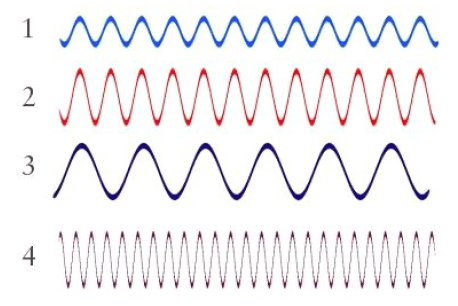
Which wave in the diagram has the greatest wavelength?
a)
1
b)
2
c)
3
d)
4
33.
which material does sound travel the fastest?
a)
solid
b)
liquid
c)
gases
34.

The shortest wavelength in visible light is______.
a)
violet
b)
red
c)
blue
d)
yellow
35.

_____ have the longest wavelengths and lowest frequencies of all electromagnetic waves.
a)
microwaves
b)
radio waves
c)
gamma rays
d)
ultraviolet
36.

_____________________light is the only type of EM wave detected by the human eye.
a)
Red
b)
Gamma
c)
Microwave
d)
Visible
37.

This type of wave has the highest frequency on the electromagnetic spectrum.
a)
Radio waves
b)
Visible light
c)
Gamma Rays
d)
X-rays
38.
Which of the following statements is true for all living things (organisms)?
a)
All living things have organs
b)
All living things produce their own food through photosynthesis
c)
All living things are made of one or more cells
d)
All living things are made of more than one cell
39.
Which of the following shows biological systems from least to most complex?
a)
Cells, tissue, organ, organ system
b)
Tissue, cells, organ, organ system
c)
Organ system, cells, organism, tissue
d)
Organ system, organ, tissue
40.
Why are there so many different types of cells in multicellular organisms?
a)
Humans are relatively big
b)
Humans are heterotrophs
c)
Cells in multicellular organisms are specialized to complete different tasks or functions within the organism
d)
Cells in multicellular organisms are similar and complete only the same tasks or functions within the organism
41.
Where do plants receive the energy necessary to carry out photosynthesis?
a)
Heat from the sun
b)
Gamma radiation
c)
Light from the sun
d)
Wind
42.
Besides energy from the sun, what else does a plant require to complete photosynthesis?
a)
Wind energy
b)
Oxygen and carbon dioxide
c)
Oxygen and water
d)
Water and carbon dioxide
Reset

