
NEW
Font size
S
M
L
XL
 Worksheets
PASS Review
Total questions: 30
Worksheet time: 43mins
Name
Class
Date
1.
The Paleozoic Era was known as the Age of ____.
a)
marine life
b)
mammals
c)
reptiles
d)
humans
2.
when an object speeds up, slows down, OR changes direction
a)
mass
b)
acceleration
c)
velocity
d)
speed
3.
the tendency of an object to resist a change in its motion
a)
acceleration
b)
inertia
c)
mass
d)
frame of reference
4.
the amount of matter in an object
a)
displacement
b)
mass
c)
friction
d)
friction
5.
The SI unit for force
a)
distance
b)
Newton (N)
c)
frame of reference
d)
inertia
6.
Objects with greater _________ also have greater inertia.
a)
speed
b)
mass
c)
temperature
d)
friction
7.
True or false: You can't exert a force on anything unless it also exerts a force on you.
a)
True
b)
False
8.
Newton's third law is the law of __________________.
a)
action and reaction
b)
inertia
c)
acceleration
d)
science rocks
9.

_____ have the longest wavelengths and lowest frequencies of all electromagnetic waves.
a)
microwaves
b)
radio waves
c)
gamma rays
d)
ultraviolet
10.
All electromagnetic waves have the same...
a)
frequency
b)
speed
c)
wavelength
d)
energy
11.
Sound waves are
a)
longitudinal
b)
trasnverse
c)
electromagnetic
d)
not really waves
12.
If Earth rotated slower, we would have...
a)
shorter days.
b)
longer days.
c)
shorter years.
d)
longer years.
13.
A lunar eclipse can occur only during the _________________.
a)
Full moon
b)
New moon
c)
Waxing moon
14.
A solar eclipse can occur only during the _________________.
a)
Full moon
b)
New moon
c)
Quarter moon
15.
Tides are caused mainly by what?
a)
Moon’s gravitational pull
b)
Sun’s gravitational pull
c)
Earth’s gravitational pull
16.
Most places on Earth experience about how many high and low tides in 24 hours?
a)
2 high and 2 low tides
b)
4 high and 4 low tides
c)
1 high and 1 low tides
17.
What type of tide occurs during the first or third quarter moon?
a)
Neap tides
b)
Spring tides
c)
Normal tides
18.
If the Sun, Earth, and Moon are in perfect alignment, the Earth would have a _______ tide.
a)
Spring
b)
Neap
c)
Normal
19.
If the Sun, Earth, and Moon create a 90 degree angle, the Earth would have __________.
a)
Spring tides
b)
Neap tides
c)
Normal tides
20.
As distance between two objects increase the pull of gravity
a)
Increases
b)
Decreases
c)
Stays the same
21.
The force of gravity acting on an object is the object's ______.
a)
mass
b)
matter
c)
weight
d)
terminal velocity
22.
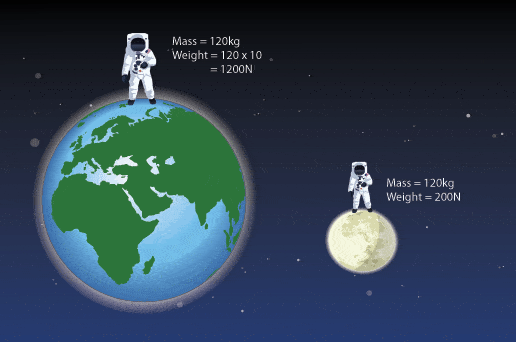
Which of the following will not change in different gravitational fields?
a)
weight
b)
force
c)
mass
d)
pounds
23.

As mass increases, what happens to gravitational force?
a)
increases
b)
decreases
c)
stays the same
d)
i don't know
24.

A bug stuck in amber is an example of what type of fossil?
a)
cast
b)
mold
c)
trace
d)
preserved remains
25.
The Law of Superposition helps scientists to determine what?
a)
The absolute age of rock layers
b)
The age of fossils
c)
The relative age of rock layers
d)
the super powers of rocks
26.
Where the better adapted organisms survive to pass traits along to offspring.
a)
Evolution
b)
Natural Selection
c)
Extinction
d)
Artifical Selection
27.
The theory of evolution by natural selection means that what is changing over time?
a)
The inherited traits of a population.
b)
The acquired traits of a population.
c)
Hair color and eye color
d)
Attractive features.
28.
Why are advantageous traits more likely to be passed onto offspring?
a)
Because they are more likely to survive and reproduce.
b)
Because they come from dominant alleles.
c)
Because they come from recessive alleles.
d)
Because the trait is an acquired phenotype.
29.
What era is the age of mammals?
a)
Precambrian
b)
Palezoic
c)
Mesozoic
d)
Cenozoic
30.
The Mesozoic Era is often called the Age of _____________ because of the success of these animals.
a)
Reptiles
b)
Mammals
Reset

