wayground logo

Free Printable Worksheets

NEW

Font size

S
M
L
XL
Worksheets

GENETICS (QUIZIZZ REVIEW GAME)

Total questions: 20

Worksheet time: 5hrs 0mins

Name
Class
Date
1.
Translation involves the assembling of proteins. Which of the following forms of RNA is responsible for carrying a formed amino acid to the protein assembly site during translation?
a)
mRNA
b)
rRNA
c)
tRNA
d)
RNA polymerase
2.
A diagram demonstrating the process of protein translation is shown.

The structure labeled with a question mark in the diagram represents
a)
a ribosome.
b)
a chloroplast.
c)
a vacuole.
d)
a mitochondrion.
3.

Which molecule is synthesized during transcription?

a)

DNA

b)

mRNA

c)

rRNA

d)

tRNA

4.
Which of the following is true about DNA transcription and protein translation?
a)
The processes of transcription and translation are similar in all living organisms.
b)
Transcription only occurs in plant cells, whereas translation only occurs in animal cells.
c)
The processes of transcription and translation do not occur in prokaryotes.
d)
Transcription only occurs in animal cells, whereas translation only occurs in plant cells.
5.

Which labels correctly complete the diagram?

a)

Y is replication, and Z is translation.

b)

  Y is translation, and Z is replication.

c)

Y is transcription, and Z is translation.

d)

  Y is translation, and Z is transcription.

6.
One possible form of a gene that codes for a particular trait is known as _______.
a)
a chromosome
b)
a phenotype
c)
an allele
d)
a genotype
7.
In pea plants, tall (T) plants are dominant over short (t) plants. If a heterozygous (Tt) pea plant is crossed with a homozygous dominant (TT) pea plant, all of the resulting pea plants should be tall (TT or Tt). Each plant will receive a dominant allele from the homozygous dominant plant, while they could receive either a dominant or recessive allele from the heterozygous plant.
The fact that each plant gets only one allele from each parent plant is detailed in the law of _______.
a)
multiple alleles
b)
independent assortment
c)
segregation
d)
genetic inheritance
8.
Guinea pig coat color is determined by a single gene. The allele for black coat color is dominant to brown. In a cross between two black-haired guinea pigs, 20 offspring are born. If both parents were heterozygous, probability would predict that approximately how many of the 20 offspring would have brown hair?
a)
0
b)
5
c)
10
d)
15
9.
A student crosses two pea plants. One is homozygous dominant for axial flowers, and the other is heterozygous for axial flowers. If the student examines 200 offspring pea plants, which of the following is a reasonable result?
a)
149 with axial flowers, 51 with terminal flowers
b)
200 with axial flowers, 0 with terminal flowers
c)
47 with axial flowers, 153 with terminal flowers
d)
98 with axial flowers, 102 with terminal flowers
10.

An organism's genotype can best be defined as its __________ .

a)

number of recessive genes

b)

physical characteristics

c)

number of chromosomal pairs

d)

genetic makeup

11.
Human height is a polygenic trait. This means that the
a)
trait is controlled by more than one pair of genes.
b)
trait is controlled by the genes inherited from the mother only.
c)
trait is completely controlled by only one pair of genes.
d)
trait is controlled by the genes inherited from the father only.
12.
A recessive gene located on the X chromosome is the cause of hemophilia in affected individuals. Males are more likely to have hemophilia than females because
a)
females have no copies of the X chromosome.
b)
males have only one copy of the X chromosome.
c)
males have two copies of the X chromosome.
d)
hemophilia is associated with high testosterone levels.
13.

A cattle farmer genetically crosses a cow (female) with a white coat with a bull (male) with a red coat.  The resulting calf (offspring) is roan, which means there are red and white hairs intermixed in the coat of the calf.  The genes for coat color in cattle are co-dominant.  What are the phenotypes of the offspring produced from two roan cattle?

a)

75% red and 25% white

b)

100% pink

c)

25% red, 50% roan, and 25% white

d)

100% roan

14.

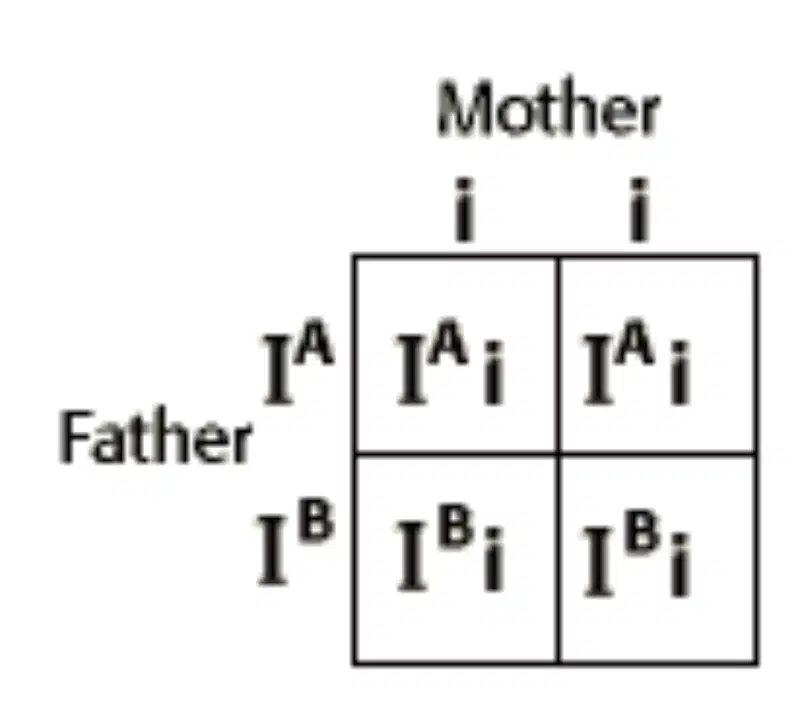
A woman with O blood type and a man with AB blood type get married and have children.  What are the possible blood types of their children?

a)

25% A, 25% B, 25% AB, 25% O

b)

50% AB, 50% O

c)

50% A, 50% B

d)

100% AB

15.

A breed of chicken shows incomplete dominance for feather color. One dominant allele codes for black feathers, another dominant allele codes for white feathers. The feathers of heterozygous chickens of this breed will be....

a)

all black

b)

all white

c)

all gray

d)

speckled black and white

16.
Triple X syndrome, or trisomy X, occurs when a female has an extra X chromosome in each of her cells. This results when the mother's reproductive cells divide improperly, and two X chromosome are moved into one gamete. When that gamete is fertilized and the father's DNA and X chromosome are combined with the mother's, that gives the cell three X chromosomes instead of two.
Triple X syndrome occurs because of _______.
a)
nondisjunction
b)
point mutations
c)
crossing over
d)
deletions
17.

A mutation is a change in DNA that usually occurs during replication. Which mutation is the most likely to result in no effect to the phenotype of a cell?

a)

the replacement of a single base by another base

b)

the insertion or deletion of one or two base pairs

c)

an amino acid codon is changed into a stop codon

d)

one codon is replaced by another codon for the same amino acid

18.

Mutated DNA that cannot be passed to offspring is known as...

a)

duplications.

b)

frameshift mutation.

c)

germline mutation.

d)

somatic mutation.

19.

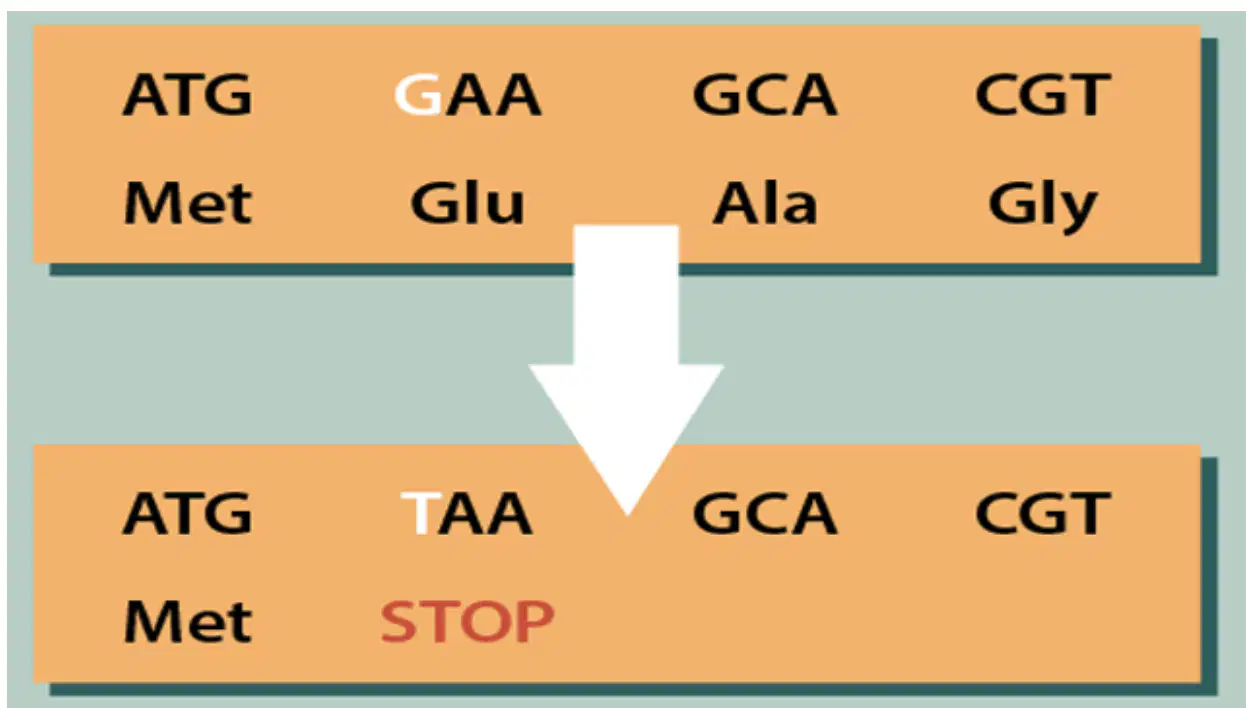
What kind of mutation is shown in the picture?

a)

frameshift

b)

inversion

c)

translocation

d)

nonsense

20.
A genetic mutation that causes a codon that should code for a specific amino acid to be changed into a stop codon results in a shortened protein product and is known as
a)

a chromosomal mutation.

b)

a nonsense mutation.

c)

a silent mutation.

d)

a frame shift mutation.