
 Worksheets
Earth's Processes Test
Total questions: 116
Worksheet time: 2hrs 45mins
Name
Class
Date
1.

Where does sea-floor spreading take place?
a)
Convergent Boundaries
b)
Transform Boundaries
c)
Land Boundaries
d)
Mid-Oceanic Ridges
2.

The hypothesis that land masses spread apart from each other and have done so in the past is known as
a)
Divergent Plate Boundary
b)
Tension
c)
Uplift
d)
Continental drift
3.
Which layer of Earth is made up of tectonic plates?
a)
outer core
b)
inner core
c)
asthenosphere
d)
lithosphere
4.

The four layers that make-up the earth’s composition are
a)
Crust, Lithosphere, Mesosphere, and Core
b)
Lithosphere, Asthenosphere, Mantle, and Core
c)
Crust, Mantle, Outer Core, and Inner Core
d)
Mantle, Outer Core, Lithosphere, and Crust
5.

Hawaii was formed by...?
a)
Earthquakes
b)
Erosion
c)
Volcanoes
d)
Dunes
6.

The Grand Canyon is an example of:
a)
Weathering
b)
Dunes
c)
Deltas
d)
Erosion
7.

What is a tsunami?
a)
a long high sea wave
b)
a moving of the earth
c)
magma flowing from inside the earth
d)
a column of rotating air
8.

A tsunami is caused by______
a)
lots of rain
b)
a meteorite
c)
a tornado
d)
an earthquake
9.
What layer is the hottest?
a)
Core
b)
Crust
c)
Mantle
10.
What are the two types of crust?
a)
top crust,bottom crust
b)
oceanic crust, continental crust
c)
water,land
d)
none of the above
11.
Which of the following occurs because of convection currents?
a)
Tectonic plates on the crust move.
b)
The mantle increases in size.
c)
Pressure in the crust increases.
d)
Pressure in the crust decreases.
12.
Where does the heat come from that drives this convection current in the mantle?
a)
the sun
b)the crust
c)
the mantle
d)
the core
13.
What does the theory of continental drift state?
a)
The continents were once joined in a super-continent and have moved over time
b)
Continents are stationary and do not move
c)
The Earth is broken into lithospheric plates that move due to convection currents
d)
none of the above
14.

Name the boundary
a)
convergent boundary
b)
divergent boundary
c)
transform boundary
d)
sergent boundary
15.

Name the boundary
a)
convergent boundary
b)
divergent boundary
c)
transform boundary
d)
sergent boundary
16.
Associated with transform boundaries.
a)
Volcanoes
b)
mountains
c)
trenches
d)
earthquakes
17.
Where are most faults located?
a)
Along plate boundaries
b)
Along mountain ranges
c)
Near volcanoes
d)
In the ocean
18.

What is magma when it reaches the surface of Earth?
a)
Lava
b)
Mafic Magma
c)
Felsic Magma
d)
None of these
19.

In which layer do convection currents occur?
a)
Outer Core
b)
Crust
c)
Inner Core
d)
Mantle
20.

What was the name of the super continent that Wegner believed once existed?
a)
Ice Age
b)
Wegner Land
c)
Triassic
d)
Pangaea
21.

Which is NOT a piece of evidence that supported Wegener's Theory of Continental Drift?
a)
Evidence of similar fossils on separate continents
b)
Evidence of tectonic plates that are constantly moving
c)
Evidence that continents fit together like puzzle pieces
d)
Evidence of the same mountains & rock formations on separate continents
22.
Melted rock at Earth's surface is called
a)
lava
b)
the mantle
c)
the lithosphere
d)
magma
23.
Molten rock from Earth's mantle
a)
lava
b)
magma
24.
What is the major force of erosion along the coast?
a)
Sand
b)
Earthquakes
c)
Waves
d)
Rain
25.
The process of breaking up rocks on Earth's surface is called...
a)
sediment
b)
erosion
c)
weathering
d)
deposition
26.
How does freezing water cause the weathering of rocks? The freezing water...
a)
keeps the rocks in place
b)
makes the rocks last longer
c)
expands cracks and breaks rocks
d)
causes rocks to fall in landslides
27.
Which of the following is NOT a slow change to Earth's surface?
a)
weathering
b)
erosion
c)
deposition
d)
a landslide
28.

Most earthquakes occur near...
a)
state boundaries
b)
plate boundaries
c)
country boundaries
d)
rivers
29.

A mountain range is an example of which type of plate boundary movement?
a)
Divergent
b)
Transform
c)
Convergent
30.
What is sediment?
a)
the process of rocks being broken down and carried away
b)
bits of rock and sand caused by the weathering of rocks
c)
the top layer of the soil
d)
decaying plant or animal material
31.

How do plants weather rocks?
a)
during photosynthesis
b)
when roots grow into cracks of rocks and expand the rock
c)
when the plant moves water from the roots to the leaves
d)
Plants don't weather rocks
32.

What type of weathering is it when acid rain breaks down and changes the rock?
a)
chemical weathering
b)
physical or mechanical weathering
c)
erosion
33.

Picture A is a mountain in the Sierra Nevada. Picture B shows only the west ridge of the mountain range. What is the most likely reason for the shape of picture B?
a)
It was hit by a volcano
b)
chemical weathering
c)
physical weathering
d)
it was caused by an earthquake
34.
Flood water pounding against a canyon wall and breaking it down
a)
Weathering
b)
Erosion
c)
Deposition
35.
Rain washing away soil from a hillside
a)
Weathering
b)
Erosion
c)
Deposition
36.
Layers of sediment forming at the bottom of the ocean floor
a)
Weathering
b)
Erosion
c)
Deposition
37.
Waves dropping sand on the beach
a)
Weathering
b)
Erosion
c)
Deposition
38.
Water getting into cracks, freezing, and breaking the rocks or pavement apart
a)
Weathering
b)
Erosion
c)
Deposition
39.

This rock started as molten magma. What type of rock is this?
a)
Sedimentary
b)
Igneous
c)
Metamorphic
40.
In order for a metamorphic rock to form, _______ is needed.
a)
Pressure
b)
Heat
c)
Heat and Pressure
d)
Weathering
41.

This rock is made from tiny pieces of other rocks that settled to the bottom of a valley millions of years ago. What type of rock is this?
a)
Sedimentary
b)
Igneous
c)
Metamorphic
42.

After lots of time, pressure, and heat, you get this kind of rock. What type of rock is this?
a)
Sedimentary
b)
Igneous
c)
Metamorphic
43.

This rock was found near the mouth of a volcano. What type of rock is this?
a)
Sedimentary
b)
Igneous
c)
Metamorphic
44.

Wind and water have eroded this rock to show the layers of sediment that were laid down millions of years ago. What type of rock is this?
a)
Sedimentary
b)
Igneous
c)
Metamorphic
45.
Molten material from the mantle that hardens to form rocks
a)
lava
b)
magma
c)
solution
d)
crystals
46.
All of the following are evidence of continental drift EXCEPT:
a)
similar rock layers on separate continents
b)
similar fossils on separate continents
c)
artifacts left by early humans
d)
tree fossils found in places trees do not grow
47.
When the heat source is removed from a fluid, convection currents in the fluid will
a)
change direction
b)
continue forever
c)
speed up
d)
eventually stop
48.
Most geologists think that the movement of Earth's plates is caused by
a)
Earth's magnetic field
b)
conduction
c)
earthquakes
d)
convection currents in the mantle
49.

Heat transfer within a fluid takes place by
a)
conduction
b)
density
c)
convection currents
d)
radiation
50.
In which layer would you expect pressure to be the greatest?
a)
Outer core
b)
Mantle
c)
Crust
d)
Inner core
51.

What kind of plate boundary is shown here?
a)
divergent
b)
convergent
c)
transform
d)
strike slip
52.

What kind of plate boundary is shown here?
a)
divergent
b)
convergent
c)
transform
d)
strike slip
53.

What kind of plate boundary is shown here?
a)
divergent
b)
convergent
c)
transform
d)
strike slip
54.

What process is occurring at Z?
a)
Convection currents
b)
Subduction
c)
Two plates moving apart
d)
New ocean floor forming
55.
What is the term for a heavier, denser plate sliding under a less dense plate?
a)
plate boundary
b)
submersion
c)
accretion
d)
subduction
56.
What would you be most likely to find at a convergent boundary between two pieces of continental crust?
a)
Volcanos
b)
Mountains
c)
Rift valley
d)
Island Arc (chain of islands)
57.
What would you be most likely to find at a divergent boundary between two pieces of oceanic crust?
a)
Rift
b)
Mid-Ocean Ridge
c)
Island Arc
d)
Flat land
58.
What is the primary cause of volcanoes and earthquakes?
a)
crustal plate movements
b)
Earth's gravitational force
c)
higher than usual tides
d)
solar magnetic storms
59.
Plants prevent soil erosion by-
a)
holding dirt in place with their roots
b)
providing food for herbivores
c)
the process of photosynthesis
d)
releasing water into the atmosphere through transpiration
60.
What is the major cause of weathering and erosion?
a)earthquakes
b)
ice
c)
glaciers
d)
moving water
61.
New crust forms at ___________ plate boundaries.
a)
convergent
b)
divergent
c)
fault-block
d)
transform
62.
At convergent plate boundaries, plates ____________________.
a)
pull apart
b)
slide past each other
c)
collide
d)
form rifts
63.
Acid rain is a cause of _____________.
a)
mechanical weathering
b)
cementation
c)
mass movement
d)
chemical weathering
64.
____________ rocks form when heat and pressure inside Earth change one kind of rock into another kind.
a)
Metamorphic
b)
Extrusive
c)
Intrusive
d)
Sedimentary
65.
4 ways erosion occurs are water, ice, wind and ....
a)
sunlight
b)
gravity
c)
root pry
d)
weathering
66.
The dropping off of sediments in a new place is called...
a)
Weathering
b)
Erosion
c)
Deposition
d)
Sublimation
67.
_______ rock forms from magma/lava
a)
Metamorphic
b)
Sedimentary
c)
Igneous
68.
Rock that forms when pressure, temperature, or chemical processes change existing rock.
a)
Igneous Rock
b)
Sedimentary Rock
c)
Metamorphic Rock
d)
Rock Cycle
69.
The name rock is given when it is broken down into smaller pieces.
a)
texture
b)
weathering
c)
sediment
d)
erosion
70.
A metamorphic rock can become ______.
a)
igneous
b)
metamorphic
c)
sedimentary
d)
all of these
71.
The process by which plate tectonics produces ?
a)
Sea Floor Spreading
b)
Continental Drift
c)
Slab
d)
Sea Floor Sinking
72.
Tectonic plates are made up of continental crust and ________ crust.
a)
continental
b)
oceanic
c)
plates
d)
mantle
73.

What is the main method of heat transfer from core to the crust of Earth
a)
conduction
b)
convection
c)
insulation
d)
radiation
74.

The volcanoes (red dots) in this map are MOST LIKELY caused by
a)
folding
b)
subduction
c)
metamorphism
d)
sea floor spreading
75.

During sea floor spreading, molten material rises up from the mantle...
a)
along the continents
b)
at the mid ocean ridges
c)
deep ocean trenches
d)
at north and south poles
76.
Plate movement is caused by ______________.
a)
the rotation of the Earth
b)
ocean tides
c)
convection currents in the mantle
d)
the moon's gravity
77.
Igneous rocks that cool quickly on the surface of Earth are said to be:
a)
intrusive
b)
extrusive
c)
granite
d)
magma
78.
The process by which metamorphic rocks are formed is:
a)
heat and pressure
b)
compaction and cementation
c)
melting and cooling
d)
weathering and erosion
79.
This word describes the process when a rock is broken down into smaller pieces:
a)
texture
b)
weathering
c)
composition
d)
erosion
80.
_______ rock forms when magma or lava cools and hardens
a)
Metamorphic
b)
Sedimentary
c)
Igneous
d)
Oceanic
81.
Rocks formed from pieces of other rocks are:
a)
Igneous
b)
Sedimentary
c)
Metamorphic
82.
What does it mean for a rock to be intrusive?
a)
Made by lava
b)
Made by magma
c)
Made by erosion
d)
Made by heat and pressure
83.
When rocks are broken and moved by things such as water, this is called...
a)
Wind
b)
Erosion
c)
Metamorphosis
d)
Weathering
84.

If an egg were used to model the layers of the Earth, they would be
a)
shell=crust, white=core, yolk=mantle
b)
shell=crust, white=mantle, yolk=core
c)
shell=mantle, white=core, yolk=crust
d)
shell=mantle, white=crust, yolk=core
85.
Which type of rock is formed when magma cools slowly beneath the Earth's surface?
a)
Extrusive igneous
b)
Foliated metamorphic
c)
Intrusive igneous
d)
Non-foliated metamorphic
86.

Which process produces sediments?
a)
Compaction and cementation
b)
Heat and pressure
c)
Melting and cooling
d)
Weathering and erosion
87.

Why are earthquakes more likely to occur at this location?
a)
The rocks are not level
b)
Manmade structures and activities on the surface
c)
Movements occur along the fault due to tectonic movements
d)
Weathering and erosion
88.

Which is not associated with earthquakes
a)
Human deaths
b)
Building structure damage
c)
Personal and economic loss
d)
Climate change
89.

What type of plate movement is best illustrated in the diagram?
a)
Divergent Plates
b)
Convergent Plates
c)
Plate Abruption
d)
Plate Subduction
90.

The process that presses sediments together
a)
deposition
b)
sedimentation
c)
compaction
d)
weathering
91.

The process by which running water, wind, or ice carry away bits of broken-up rock
a)
weathering
b)
sedimentation
c)
erosion
d)
cementation
92.
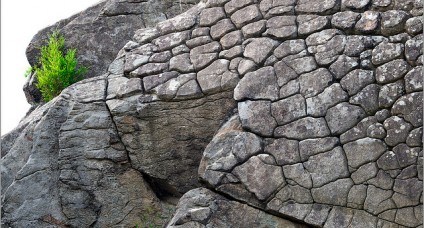
The process that breaks up rock on Earth's surface?
a)
deposition
b)
erosion
c)
compaction
d)
weathering
93.

Which is the correct sequence to form sedimentary rock?
a)
cementation compaction sedimentation
b)
sedimentation
compaction
cementation
compaction
cementation
c)
sedimentation
cementation
compaction
cementation
compaction
d)
compaction
sedimentation
cementation
sedimentation
cementation
94.

A break in the Earth's crust
a)
fault
b)
mountain
c)
plate
d)
fossil
95.
Which landform is created by plates pushing together?
a)
Canyon
b)
Delta
c)
Mountain
d)
Sea arch
96.
Which of these things cause weathering?
a)
Wind
b)
Water
c)
Ice
d)
All of these
97.
How long ago did the Earth form?
a)
4.6 million year
b)
46 million years
c)
4.6 billion years
d)
46 billion years
98.
Most changes to the Earth happen _______.
a)
very slowly
b)
at an average speed
c)
very quickly
99.
Some changes to ...
a)weathering and erosion
b)asteroid impact
c)
natural disasters
d)continental
100.
_____ is the breaking down of rock into smaller pieces, and _____ is the movement of these particles.
a)weathering , erosion
b)erosion , weathering
101.
Fossil are mostly found in _____ rock.
a)
igneous
b)
magma
c)
metamorphic
d)
sedimentary
102.

Which arrows represent weathering and erosion?
a)
7,9,15
b)
10,11,15
c)
6,7,14
d)
6,11,13
103.
Which arrows represent heat and pressure?
a)
9,11
b)
10,11
c)
8,10
d)
9,13
104.
Which arrows represent melting?
a)
10,11,15
b)
6,7,14
c)
7,9,15
d)
10,14
105.
Which sample is igneous rock?
a)
1
b)
2
c)
3
d)
4
106.
Which sample is sedimentary rock?
a)
1
b)
2
c)
3
d)
4
107.
Which sample is metamorphic rock?
a)
1
b)
2
c)
3
d)
4
108.
Which sample is magma?
a)
2
b)
3
c)
4
d)
5
109.
Which sample is sediment?
a)
2
b)
3
c)
4
d)
5
110.
Which arrow represents compaction and cementation?
a)
7
b)
8
c)
11
d)
12
111.
Which arrow represents cooling?
a)
7
b)
8
c)
11
d)
12
112.
Volcanoes form at ...
a)
hotspots
b)
divergent boundaries
c)convergent boundaries
d)all of these places
113.

Convection currents are caused by...
a)very hot material in the deepest part of the mantle rising, then cooling, sinking again and then heating, rising and repeating the cycle over and over
b)cooled material in the deepest part of the mantle rising, then heating , sinking again and then cooling, rising and repeating the cycle over and over
114.
The red arrow represent ___, and the blue arrows represent ___.
a)
magma, lava
b)
rising cold material, sinking hot material
c)
rising hot material, sinking cold material
d)
liquid rock, solid rock
115.

Surface processes such as weathering and erosion that help drive the rock cycle are powered by...
a)
PG&E
b)
the sun
c)
wind power
d)
the core
116.
Processes inside the Earth such as subduction , melting, and metamorphism are powered by...
a)
PG&E
b)
the sun
c)
wind power
d)
the core
100 %

