
 Worksheets
Weather Review
Total questions: 111
Worksheet time: 1hrs 15mins
Name
Class
Date
1.
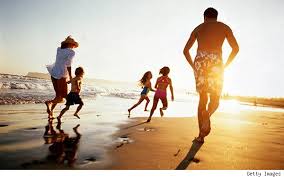
The sun shines down on this family as the play on the beach.
a)
conduction
b)
convection
c)
radiation
2.

A group of friends gather around a fire to stay warm.
a)
conduction
b)
convection
c)
radiation
3.
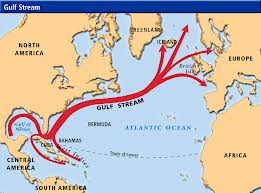
The Gulf Stream is a current that brings warm ocean water from the south to the north.
a)
conduction
b)
convection
c)
radiation
4.

Walking on the warm sand sand with your bare feet.
a)
conduction
b)
convection
c)
radiation
5.

Which direction will the heat flow while this person holds a hot cup of tea?
a)
from the cup to her hand
b)
from her hand to the cup
c)
no heat is transferred
6.

Which direction will the heat flow while this ice cap melts?
a)
there is no heat transfer
b)
from the icecap to the water
c)
from the water to the icecap
7.
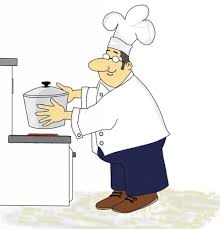
The man goes to take the hot pot off the stove with his bare hands.
a)
conduction
b)
convection
c)
radiation
8.
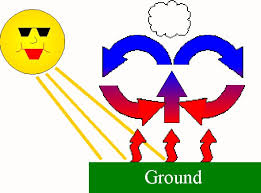
Warm air rises and the cool air sinks.
a)
conduction
b)
convection
c)
radiation
9.
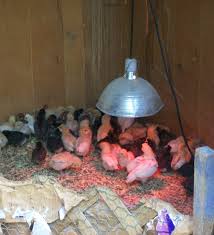
The baby chickens are kept warm from the heat lamps.
a)
conduction
b)
convection
c)
radiation
10.

In some cultures, walking on fire is the ultimate sign of strength.
a)
conduction
b)
convection
c)
radiation
11.

In this experiment, the WARM red dye and the COLD blue dye was placed in the water at the same time. The warm red dye rose to the top while the cold blue dye sank to the bottom.
a)
conduction
b)
convection
c)
radiation
12.
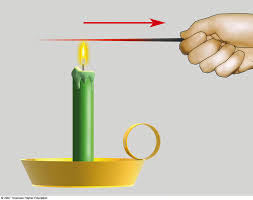
The candle will slowly heat the metal and transfer the heat directly to the mans hand.
a)
conduction
b)
convection
c)
radiation
13.
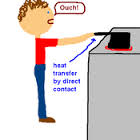
Johnny accidentally grabbed the handle of the hot pot.
a)
conduction
b)
convection
c)
radiation
14.

The warm air from this heater creates a current when the warm air rises and the cold air sinks.
a)
conduction
b)
convection
c)
radiation
15.

Heat transfers from an area of ____temperature to an area of ___ temperature.
a)
high to low
b)
low to high
c)
high to high
16.

The chocolate bunny and the iron.
a)
conduction
b)
convection
c)
radiation
17.

The chocolate bunny and the blow dryer.
a)
conduction
b)
convection
c)
radiation
18.

The chocolate bunny and the lamp.
a)
conduction
b)
convection
c)
radiation
19.
Poor conductors like wood and plastic are called:
a)
conductors
b)
insulators
c)
burners
20.
In heat transfer, heat always flows from the _______________ substance to the _______________ substance.
a)
Hotter to colder
b)
Colder to hotter
c)
Hotter to hotter
d)
Colder to colder
21.
The type of heat transfer that happens through direct contact of molecules or particles with each other is ___________________.
a)
Convection
b)
Conduction
c)
Radiation
d)
insulation.
22.
The kind of heat transfer that travels through space in electromagnetic waves is ______________________.
a)
insulation.
b)
Radiation
c)
Conduction
d)
Convection
23.
___________________ is the type of heat transfer that occurs in fluids, such as warm air rising and cold air sinking; creating wind.
a)
Convection
b)
Conduction
c)
Radiation
d)
insulation.
24.
Which statement is true?
a)
The quicker a molecule moves, the colder it is.
b)
The slower a molecule moves, the warmer it is.
c)
The quicker a molecule moves, the warmer it is
d)
The movement on molecule don�t affect its temperature
25.
Which of the following is the best example of conduction?
a)
A light bulb warming a lampshade
b)
An egg cooking in a frying pan
c)
Water boiling in a pot
d)
Gases circulating in the atmosphere
26.
What kind of heat transfer happens when the sun is heating your body?
a)
Conduction
b)
Radiation
c)
Convection
d)
Density
27.
Ironing a shirt is an example of...
a)
condensation
b)
conduction
c)
convection
d)
radiation
28.
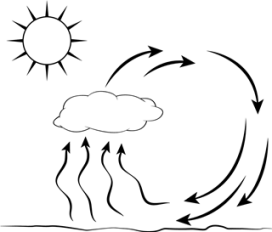
What causes the circulation of air in the atmosphere?
a)
Air in the atmosphere is heated by the sun and sinks to the ground.
b)
The ground is heated by the sun and then heats the air, causing the air to rise.
c)
Air loses heat to the ground and then rises upward to obtain more energy.
d)
The sun heats the clouds which forces the cooler air to move away and sink.
29.
A crayon placed on a dark driveway in bright sunlight melted into a colorful puddle. What caused the crayon to melt?
a)
Solar radiation heated the driveway and then heat transferred to the crayon by conduction.
b)
Solar radiation heated the driveway and then heat transferred to the crayon by radiation.
c)
Solar convection heated the driveway and then heat transferred to the crayon by radiation.
d)
Solar convection heated the driveway and then heat transferred to the crayon by conduction.
30.

Which would have warmer land?
a)
Land at A
b)
Land at B
c)
Same temperature for A and B
31.
Why is land at A warmer than land at B?
a)
The surface current comes from the equator
b)
The surface current comes from the poles
32.
Which would have cooler land?
a)
Land at D
b)
Land at C
c)
Same temperature for A and B
33.
Why is land at D be cooler than land at C?
a)
The surface current comes from the equator
b)
The surface current comes from the poles
34.
Which would have cooler land?
a)
Land at E
b)
Land at F
c)
Same temperature for A and B
35.
Why is land at F cooler than land at E?
a)
The surface current comes from the equator
b)
The surface current comes from the poles
36.
Surface currents distribute heat from the equator to the poles
a)
True
b)
False
37.

California at letter B is cooler than it should be because...
a)
The surface current that runs alongside it comes from Alaska
b)
The surface current that runs alongside it comes from the equator
38.

Which is true?
a)
Surface currents affect the climate by warming land near currents that come from the poles
b)
Surface currents do NOT affect the climate
c)
Surface currents affect the climate by cooling land near currents that come from the poles
39.
The Coriolis Effect is caused by
a)
Earth rotating around the sun
b)
Earth rotating on its axis
c)
The tides
d)
Gravity
40.
The Gulf stream carries _____________ water from the east coast of The United States to the West coast of Europe.
a)
Cold
b)
Warm
c)
Freezing
d)
Fresh
41.
What happens to a current when it comes in contact with a continent or landmass?
a)
It continues over the continent
b)
It stops
c)
It changes direction
d)
It is absorbed by the land
42.
As you go deeper in the ocean, the water is colder and less salty.
a)
True
b)
False
43.
Due to the Coriolis Effect, water in the northern hemisphere moves
a)
clockwise
b)
counter clockwise
c)
both
d)
neither
44.
Due to the Coriolis Effect, water in the southern hemisphere moves
a)
clockwise
b)
counter-clockwise
c)
both
d)
neither
45.
Warm ocean currents generally come from
a)
The North Pole
b)
The South Pole
c)
The Equator
d)
Both A and B
46.
Cold ocean currents generally come from
a)
The North Pole
b)
The South Pole
c)
The Equator
d)
Both A and B
47.
The California Current (west coast) carries _________ water from canada
a)
Cold
b)
Warm
c)
Freezing
d)
Fresh
48.
Two types of water currents are
a)
local and global
b)
sea and land
c)
surface and deep
d)
warm and cold
49.
Ocean currents have an affect on which two things
a)
climate and weather
b)
temperature and density
c)
land and sea
d)
equator and poles
50.
A strong surface current that runs along the east coast of the United States and carries warm water to Europe.
a)
California Current
b)
Global Conveyor Belt
c)
Gulf Stream
d)
Surface Current
51.
A cool current in the Pacific Ocean near North America that brings cold water down from Canada.
a)
California Current
b)
Global Conveyor Belt
c)
Gulf Stream
d)
Surface Current
52.
Constantly moving system of deep-ocean circulation driven by temperature and salinity. It moves water around the globe.
a)
California Current
b)
Global Conveyor Belt
c)
Surface Currents
d)
Gulf Stream
53.
What process brings the deep cold ocean currents up to the surface?
a)
Conduction
b)
Global Wind Patterns
c)
Convection Currents
d)
Temperature and salinity
54.
Why are surface currents at the surface of the ocean?
a)
colder temperature
b)
colder temperature & more salinty
c)
warmer temperature & less salinty
d)
less salinty
55.
Which gas in our atmosphere is most abundant?
a)
Argon
b)
Oxygen
c)
Nitrogen
d)
Carbon Dioxide
56.
Clouds in the stratosphere produce more rain than in the troposphere.
a)
True
b)
False
57.
Temperature decreases as altitude increases in the Thermosphere.
a)
True
b)
False
58.
Temperature in the stratosphere warms as altitude increases.
a)
True
b)
False
59.
What percentage of our atmosphere is made up of other gases such as argon, water vapor, and carbon dioxide?
a)
1%
b)
21%
c)
78%
d)
90%
60.
What is the percentage of oxygen in Earth's atmosphere?
a)
1%
b)
21%
c)
78%
d)
90%
61.
What is the percentage of nitrogen in Earth's atmosphere?
a)
1%
b)
21%
c)
78%
d)
90%
62.
Which layer of the atmosphere contains the greatest amount of water vapor?
a)
Thermosphere
b)
Troposphere
c)
Mesosphere
d)
Stratosphere
63.
What is CO2?
a)
Carbon Dioxide
b)
Carbon Oxygen
c)
Crackers and oranges
d)
Carbon monoxide
64.
What is H2O?
a)
Hydrogen
b)
Water
c)
Happy Oranges
d)
Nitrogen
65.
What is the layer around Earth that contains solids, liquids, and gases?
a)
Atmosphere
b)
Biosphere
c)
Lithosphere
d)
Hydrosphere
66.
In which layer of the atmosphere does weather occur?
a)
Mesosphere
b)
Thermosphere
c)
Stratosphere
d)
Troposphere
67.
What causes the temperature to increase in the stratosphere?
a)
Nitrogen
b)
Ozone
c)
Water Vapor
d)
carbon dioxide
68.
In what layer of earth's atmosphere do meteoroids burn up?
a)
Mesosphere
b)
Thermosphere
c)
Tropsphere
d)
Stratosphere
69.
What is the third main layer of Earth's atmosphere?
a)
Thermosphere
b)
Troposphere
c)
Stratosphere
d)
Mesosphere
70.
What is the lowest main layer of Earth's atmosphere?
a)
Thermosphere
b)
Troposphere
c)
Stratosphere
d)
Mesosphere
71.
What is the second lowest main layer of Earth's atmosphere?
a)
Thermosphere
b)
Troposphere
c)
Stratosphere
d)
Mesosphere
72.
What is the outer most main layer of Earth's atmosphere?
a)
Thermosphere
b)
Troposphere
c)
Stratosphere
d)
Mesosphere
73.
What is needed for animals and humans to survive?
a)
Oxygen
b)
Carbon Dioxide
c)
Carbon Monoxide
74.
In which main layer of the atmosphere is the ozone located?
a)
Thermosphere
b)
Mesosphere
c)
Stratosphere
d)
Troposphere
75.
What protects us from dangerous ultraviolet radiation from the sun?
a)
Ozone
b)
Thermosphere
c)
Ocean water
d)
Carbon Dioxide
76.
rapidly moving cold air mass runs into a warm air mass the cold air slides under the warm air. This is called a .....
a)
cold front
b)
warm front
c)
stationary front
77.
When a warm air mass gently slides on top of a cold air mass, and you have drizzly rain and then warmer weather, what type of front is it?
a)
warm front
b)
cold front
c)
occluded front
d)
stationary front
78.
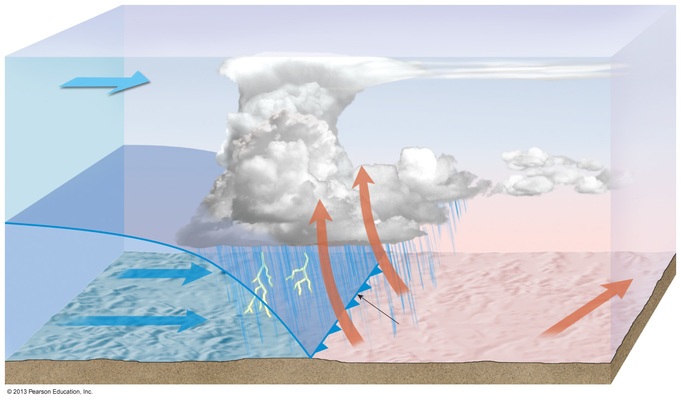
What type of storm front is this?
a)
warm front
b)
cold front
c)
stationary front
d)
occluded front
79.
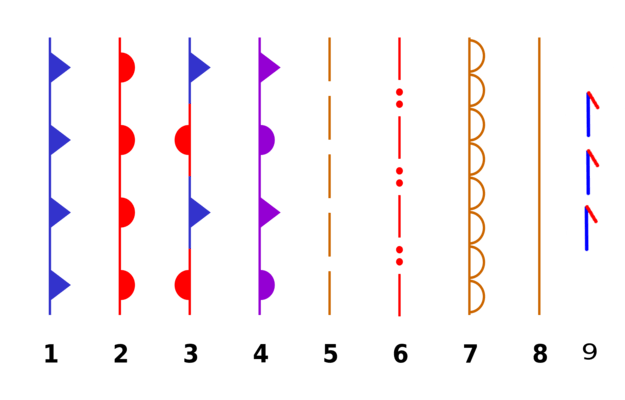
What does symbol # 3 mean?
a)
stationary front
b)
occluded front
c)
warm front
d)
cold front
80.
Which most likely produces clear, cool weather?
a)
zero air pressure
b)
stable air pressure
c)
a low pressure system
d)
a high pressure system
81.
A front is
a)
where warm air is cooling at earth's surface
b)
a line where hot and cold air are separating
c)
a line where two different air masses meet
d)
where cold air is rising and forming rain clouds
82.
_____________ air is more dense and tends to sink
a)
cold
b)
warm
c)
moist
d)
dry
83.
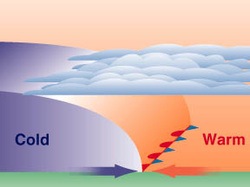
Which type of front is pictured?
a)
Cold front
b)
Warm front
c)
Occluded front
d)
Stationary front
84.
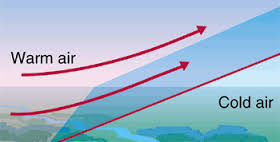
Which type of front is pictured?
a)
Cold front
b)
Warm front
c)
Occluded front
d)
Stationary front
85.
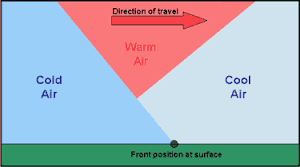
Which type of front is pictured?
a)
Cold front
b)
Warm front
c)
Occluded front
d)
Stationary front
86.
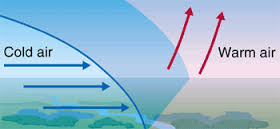
Which type of front is pictured?
a)
Cold front
b)
Warm front
c)
Occluded front
d)
Stationary front
87.
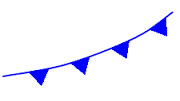
What symbol is this?
a)
warm front
b)
cold front
c)
stationary front
d)
occluded front
88.
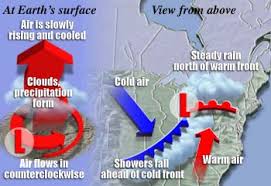
Which system results in rainy or stormy weather?
a)
high pressure
b)
low pressure
c)
hurricane
d)
weather system
89.
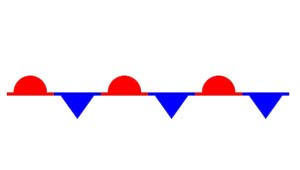
LABEL THE FOLLOWING FRONTS AND/OR WEATHER MAP SYMBOLS.
a)
warm front
b)
cold front
c)
stationary front
d)
occluded front
90.
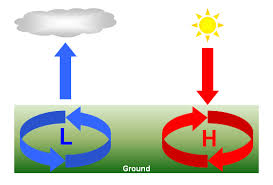
Which system results in drier, fairer weather?
a)
high pressure
b)
low pressure
c)
hurricane
d)
weather system
91.
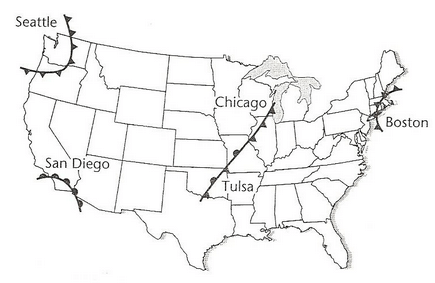
Which type of front is located near Boston?
a)
warm front
b)
cold front
c)
stationary front
d)
occluded front
92.
Which type of front is associated with the front not moving in either direction?
a)
Cold
b)
Warm
c)
Stationary
d)
Occluded
93.
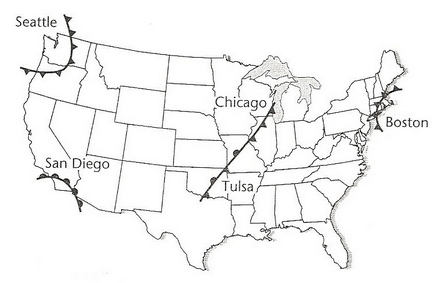
Which type of front is located near Chicago?
a)
warm front
b)
cold front
c)
occluded front
d)
stationary front
94.
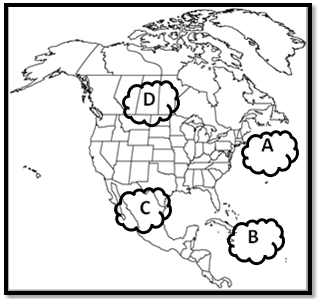
Which type of air would you find at air mass A?
a)
cold, dry
b)
warm, humid
c)
warm, dry
d)
cold, humid
95.
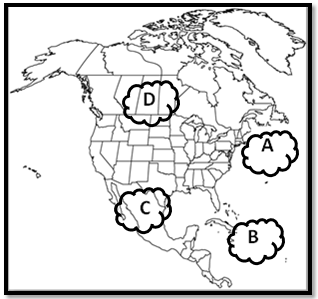
Which type of air would you find at air mass C?
a)
cold, dry
b)
warm, humid
c)
warm, dry
d)
cold, humid
96.
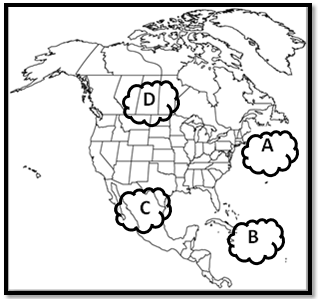
Which type of air would you find at air mass D?
a)
cold, dry
b)
warm, humid
c)
warm, dry
d)
cold, humid
97.
What type of weather would you expect to see after a warm front has passed through an area?
a)
cool and clear skies
b)
warm and humid
c)
thunderstorms
d)
foggy
98.
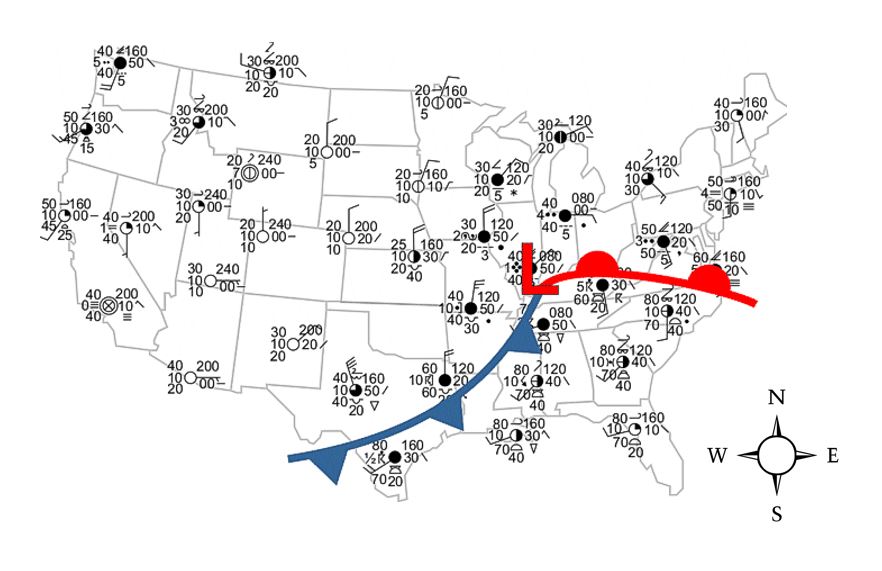
What direction is the warm front moving on the map?
a)
North
b)
South
c)
East
d)
West
99.
What direction is the cold front moving on the map?
a)
Southwest
b)
Northwest
c)
Southeast
d)
Northeast
100.
Ocean currents can travel clockwise or counter-clockwise. Which direction would they travel in the northern hemisphere?
a)
Counter-clockwise
b)
Clockwise
101.
____________ are large streams of moving water that flow through the oceans.
a)
La Niña
b)
El Niño
c)
Currents
d)
Climate
102.
The effect of Earth’s rotation on the direction of winds and currents is called the _______________ .
a)
La Niña
b)
El Niño
c)
Coriolis effect
d)
Currents
103.
______ is the pattern of temperature and precipitation typical of an area over a long period of time.
a)
Climate
b)
Weather
c)
A season
d)
The Coriolis Effect
104.
Which of the following is caused by differences in ocean water density?
a)
surface currents
b)
deep currents
c)
waves
d)
Coriolis effect
105.
What is the Gulf Stream?
a)
a surface current
b)
deep current
c)
a river
d)
a climate event
106.
What are two factors that affect the density differences in the ocean.
a)
Density and temperature
b)
Density and Pressure
c)
Pressure and Temperature
d)
Salinity and El Nino
107.
Ocean water is more dense than fresh water at the same temperature due to differences in:
a)
Wind patterns
b)
Lifeforms
c)
Currents
d)
Salinity
108.
The Gulf Stream ____________ nearby land areas.
a)
cools
b)
causing freezing in
c)
warms
d)
causes rain in
109.
A surface current effects the ________________ of nearby land.
a)
climate
b)
daily temperature
c)
winds
d)
toast
110.

The current that Marlin and Dorry take in "Finding Nemo" is a warm water current known as the ____________________
a)
East Australian Current (EAC)
b)
Antaractic Subpolar Current (ASC)
c)
California Current (CCD)
d)
Canary Atlantic Middle Current (CAM)
111.
______________currents affect water down to a depth of several meters.
a)
Surface
b)
Deep
c)
Transition
d)
Kendrick Lamar
100 %

