wayground logo

Free Printable Worksheets

Font size

S
M
L
XL
Worksheets

Review for the Earth/Space Final Exam Part 1

Total questions: 108

Worksheet time: 1hrs 22mins

Name
Class
Date
1.

Soil belongs to which sphere?

a)

Biosphere

b)

Geosphere

c)

Hydrosphere

d)

Atmosphere

2.
This system relates to weather, clouds, or aerosols (particles in the air). It includes an ever‐changing mixture of gas and small particles located above the Earth’s surface.
a)
Atmosphere
b)
Lithosphere
c)
Biosphere
d)
Hydrosphere
3.

This system(s) is/are associated with water in solid (ice) and liquid states.

a)

Atmosphere

b)

Biosphere

c)

Hydrosphere

d)

Cryosphere

4.

Hurricanes and tornadoes area part of which spheres?

a)

Atmosphere

b)

Biosphere

c)

Lithosphere

d)

Hydrosphere

5.
This system is associated with living systems such as biomes or ecosystems. This includes life on land, in the oceans and rivers, and even life we cannot see with the naked eye.
a)
Atmosphere
b)
Biosphere
c)
Lithosphere
d)
Hydrosphere
6.

Each Sphere (biosphere, hydrosphere, etc) is independent and not affected by things that happen in other spheres.

a)

True

b)

False

7.
The ________ is a collection of large and small bodies that orbit our central star.
a)
Universe 
b)
Solar System
c)
Planet
d)
Moon
8.
This is a large collection of stars, gas, and dust that is held together by gravity.
a)
Galaxy
b)
Spiral Arms
c)
Earth
d)
Star
9.
A planet is a spherical body that orbits the ____?
a)
Earth
b)
Universe 
c)
Sun
d)
King Kong
10.
A celestial body that is composed of Gas and emits light. 
a)
Venus
b)
magellanic cloud
c)
milky way
d)
star
11.
Space and all the matter and energy in it. 
a)
Clusters
b)
Universe
c)
voids
d)
Light Year
12.
What is a light year?
a)
The distance that light travels in 10 seconds
b)
The time it takes light to travel to the moon
c)
The distance that light travels in 1 year
d)
The distance around the Earth
13.
What galaxy do you live in?
a)
Earth
b)
Andromeda
c)
Hersey
d)
Milky Way
14.
Our sun is a ____________ star?
a)
Dwarf
b)
Supergiant
c)
Giant
d)
Medium
15.
Terrestrial Planets________________.
a)
are large and gaseous
b)
are rocky, dense, and relatively small
c)
orbit farthest from the sun
d)
not in our solar system
16.
What type of galaxy is the Milky Way?
a)
Spiral
b)
Elliptical
c)
Irregular
d)
Halo
17.
A cloud of gas and dust that looks like dark luminous matter.
a)
Astroid
b)
Moon
c)
Energy
d)
Nebula
18.
All the things that are kept the same in an experiment. 
a)
Independent Variable
b)
Control
c)
dependent variable
d)
crystal
19.
The average distance between the earth and the sun.
a)
Lightyear
b)
astronomical unit
c)
kilometers
d)
parsec
20.
The factor that is deliberately manipulated-(something that is changed)
a)
Independent Variable
b)
Dependent Variable
c)
control
d)
inference
21.
The factor that changes as the result of manipulation. (The thing that is measured by the scientist.)
a)
Independent variable
b)
Control
c)
dependent variable
d)
observation
22.
What is the main element in a stars composition? 
a)
Hydrogen 
b)
Helium 
c)
Lithium 
d)
Heavy Elements 
23.
Is the sun a star?
a)
yes
b)
no
24.

What is the closest star to the sun?

a)

Proxima Centauri

b)

Alpha Centauri A

c)

Alpha Centauri B

d)

Betelgeuse

25.
The color of the star tells us its 
a)
composition
b)
Temperature
c)
Luminosity 
d)
Mass
26.
Our star is a 
a)
yellow/ large star
b)
yellow/ small star
c)
yellow/ medium star
27.
The only objects in our Universe that produces and emits its own light is
a)
Nebulas
b)
Comets
c)
Planets
d)
Stars
28.
What do we use to classify the temperature, brightness, and size of stars?
a)
Color
b)
The star's shape
c)
H-R Diagram
29.
Which measurements allows astronomers to compare the brightness of stars?
a)
parallax
b)
red shift
c)
absolute magnitude
d)
apparent magnitude
30.
Which statement describes stars from coolest to hottest?
a)
blue, white, red, orange
b)
white, yellow, orange, red
c)
orange, yellow, blue white
d)
red, orange, yellow, white, blue
31.
Galaxies are composed of 
a)
millions of stars
b)
trillions of stars
c)
billions of stars, dust and gas
32.
Because the Earth is 93 million mies from the Sun, the light from this star takes_____ to reach us.
a)
8 hours
b)
1 hour
c)
8 minutes
33.
What is the term used for a cloud of gas and dust?
a)
gas giant
b)
solar dust
c)
solar cloud
d)
nebula
34.
Which star has the lowest luminosity?
a)
A
b)
B
c)
C
d)
D
35.
Which star has the lowest temperature?
a)
A
b)
B
c)
C
d)
D
36.
Which star is considered a Main Sequence Star?
a)
A
b)
B
c)
C
d)
D
37.
Why do other stars appear so much smaller than the sun?
a)
They are much smaller
b)
They are so far away
c)
They are not as bright
d)
They are dwarf stars
38.

The brightness of a star as it would be at a fixed distance from Earth

a)

light year

b)

absolute magnitude

c)

apparent magnitude

d)

parallax

39.
The brightness of a star we see from Earth is called
a)
absolute magnitude
b)
relative magnitude
c)
apparent magnitude
d)
obvious magnitude
40.
Apparent (magnitude) brightness is affected by a star's distance from Earth.
a)
False
b)
True
41.
Which of the following would be the dimmest star? 
a)
-15
b)
-5
c)
0
d)
25
42.
How long does it take the earth to make 1 revolution
a)
One year
b)
One day
c)
One hour
d)
One minute
43.
How long does it take for the earth to make 1 rotation?
a)
One year
b)
One hour
c)
24 hours
d)
One minjute
44.
How long does it take for all the moon phases to go through 1 cycle?
a)
29 days
b)
1 year
c)
1 month
d)
One day
45.
What model is where the earth is in the middle of our universe?
a)
Heliocentric Model
b)
Geocentric Model
c)
Moon phases
d)
Tidal Phases
46.
What Model is where the sun is the center of the universe?
a)
Geocentric
b)
Heliocentric
c)
Earth's rotations
d)
Earth's planets
47.

Who was the person that popularized the geocentric model?

a)

Galileo

b)

Aristotle

c)

Copernicus

48.

Which person popularized the heliocentric model?

a)

Ptolemy

b)

Aristotle

c)

Copernicus

49.

What is the biggest difference between the Geocentric Model and the Heliocentric Model?

a)

the shape of the planets' orbits

b)

the movement of the moon

c)

the center of the solar system

50.

What is inertia?

a)

the relationship between the length of a planet's orbit and the time it takes the planet to complete the orbit

b)

the tendency to resist change

c)

gravity affecting all objects

51.

Kepler's first law states that the orbits of the planets are in the shape of a/an...

a)

perfect circle

b)

ellipse

c)

spiral

52.

Newton's second law states...

a)

an object in motion will stay in motion or an object at rest will stay at rest unless acted upon by an unbalanced force

b)

every action has an equal and opposite reaction

c)

F = ma

53.

Newton's first law states...

a)

an object in motion will stay in motion or an object at rest will stay at rest unless acted upon by an unbalanced force

b)

every action has an equal and opposite reaction

c)

F = ma

54.

Newton's third law states...

a)

an object in motion will stay in motion or an object at rest will stay at rest unless acted upon by an unbalanced force

b)

every action has an equal and opposite reaction

c)

F = ma

55.

Kepler's second law of planetary motion states that a planet moves____________ when ______________ to/from the sun.

a)

slower, closer

b)

faster, farther

c)

faster, closer

56.
  What does "geo-" mean?
a)
Earth
b)
sun
c)
Center
57.
Why did people believe in the Geocentric vs the Heliocentric solar system?
a)
Geocentric system had been around for a LONG time.
b)
People don't like change.
c)
There wasn't enough proof  to support the Heliocentric system.
d)
all of these answers are correct.
58.
What does "helios" mean?
a)
Earth
b)
center of
c)
sun
d)
moon
59.
How many stars are in an average sized galaxy?
a)
Hundreds
b)
Thousands
c)
Millions
d)
Billions
60.
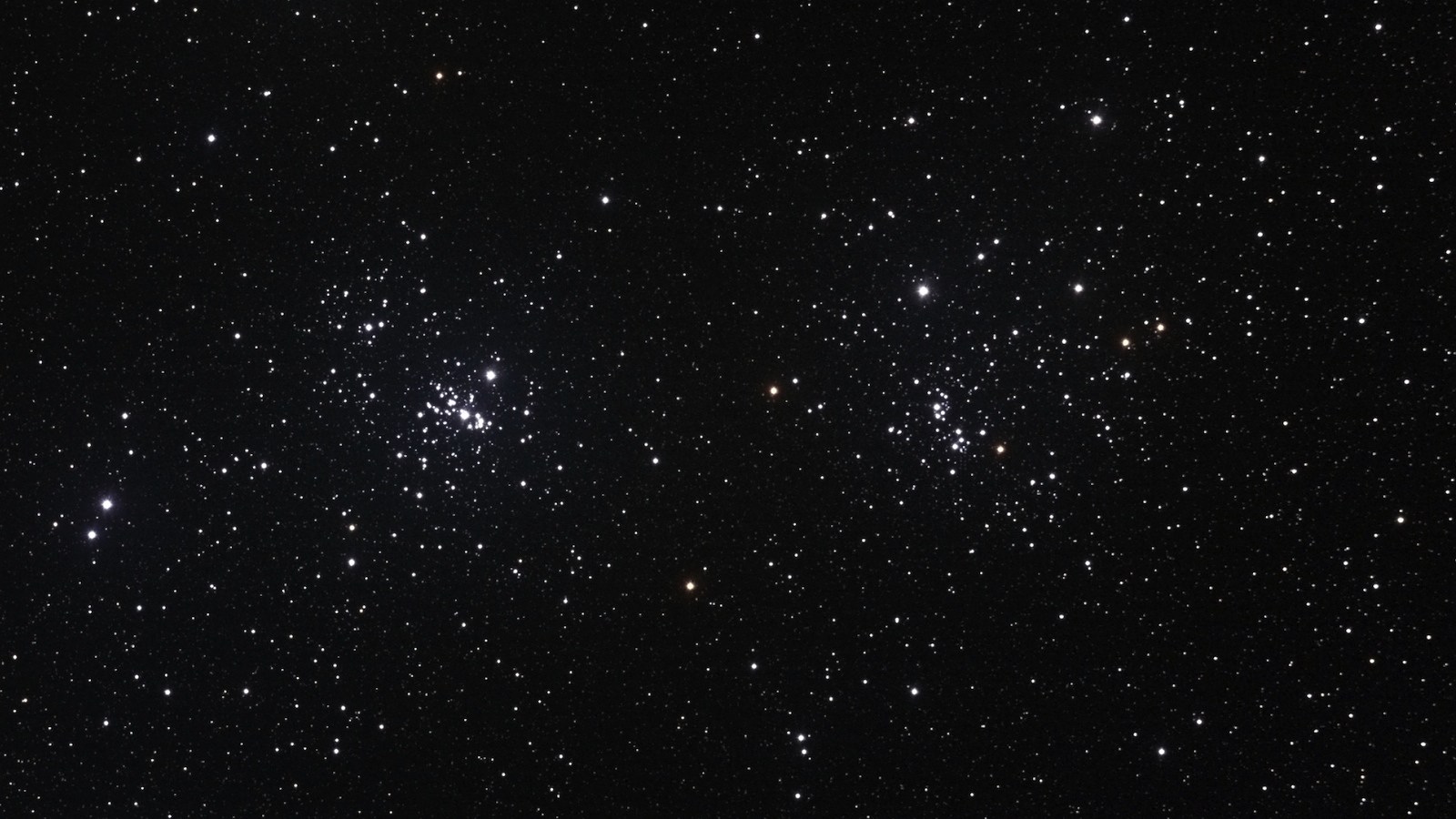
What type of galaxy is this?
a)
Spiral
b)
Elliptical
c)
Irregular 
d)
Irrational
61.
The Solar System was formed
a)
inside of a black hole
b)
by Edwin Hubble
c)
by the big bang
d)
from a nebula
62.
Our cosmic address is....
a)
Sun, Mercury, Venus, Earth, Mars, Saturn, Uranus, Neptune
b)
Earth, Solar System, Milky Way, Local Group, Virgo Supercluster, Observable Universe
c)
Earth, Solar System, Andromeda Galaxy, Supergroup, Observable Universe
d)
Earth, Milky Way, Local Group, The Rolling Stones, Observable Universe
63.
Objects with more mass... 
a)
Have fewer molecules.
b)
Have stronger gravitational pull.
c)
Move more slowly.
d)
None of these.
64.

The greater the mass, the

a)

weaker the gravitational pull

b)

the stronger the gravitational pull

65.

When the distance between two objects decreases, the gravitational pull..

a)

increases

b)

decreases

c)

stays the same

66.
Why do planets orbit the sun?
a)
Gravitational attraction
b)
Magnetic pull
c)
Attached by strings
d)
They don't orbit the sun
67.
During the phases of the Moon, the Moon appears to change shape.  This change in appearance is due to the Moon...
a)
physically changing size and shape.
b)
moving closer and then farther away from Earth.
c)
reflecting a different amount of light due to alignment with Earth and the Sun.
d)
having craters on its surface.
68.
What part of the moon do we see from Earth?
a)
all of it
b)
the same side
c)
none of it
d)
only one quarter
69.
As the moon's shape appears to get smaller, we say that the moon is _.
a)
swelling
b)
waxing
c)
waning
d)
disappearing
70.
About how long does it take the moon to make one complete cycle around the earth?
a)
65 days
b)
8 days
c)
365 days
d)
28 days
71.
Which moon phase is when you can't see the moon at all?
a)
Waning crescent
b)
Full moon
c)
Waxing gibbous
d)
New moon
72.
Phases of the moon in which the moon appears to be getting larger are referred to as _.
a)
waxing
b)
waning
c)
new
d)
eclipse
73.
The cycle of the moon lasts about a _.
a)
day
b)
year
c)
week
d)
month
74.
Which of the following words describe the phases of the moon?
a)
none, quarter, half, three quarters, full
b)
new, crescent, quarter, gibbous, full
c)
dark, light, half, quarter, blue
d)
first quarter, second quarter, third quarter, fourth quarter
75.
What Moon phase is this?
a)
Full Moon
b)
Waxing Gibbous
c)
New Moon
d)
Half Moon
76.
What phase comes AFTER this one?
a)
Waxing Crescent
b)
Waning Gibbous
c)
Waxing Gibbous
d)
Third Quarter
77.
What Moon phase is this?
a)
Waxing Crescent
b)
Waning Gibbous
c)
Waning Crescent
d)
Waxing Gibbous
78.
What phase comes BEFORE this one?
a)
New Moon
b)
Third Quarter
c)
Waxing Crescent
d)
Full Moon
79.
What happens when the area in which you live tilts away from the sun?
a)
It is summer.
b)
It is spring.
c)
It is winter.
d)
It is fall.
80.
Why does the area around the equator stay the same temperature all year?
a)
The equator rotates slower than the poles.
b)
The equator remains the same distance from the sun.
c)
The equator always receives direct sunlight.
d)
The equator has 18 hour days.
81.
What are the reasons for the seasons?
a)
Earth's tilt and rotation.
b)
Earth's rotation and revolution.
c)
Earth's tilt and revolution.
d)
Earth's tilt and resolution
82.
Why don't we have a solar or lunar eclipse every month?  
a)
The moon and sun don't align properly
b)
because the sun is too big to be blocked
c)
because the moon is usually on a different plane
d)
They DO occur every month, we just don't see them!
83.
Why do we always see the same side of the moon from Earth?
a)
because the phases change
b)
because it rotates and revolves at the same rate
c)
because half of the moon always receives sunlight
d)
The moon changes positions�
84.
What season is it in the Southern Hemisphere when it is fall in the Northern Hemisphere?
a)
winter
b)
spring
c)
summer
d)
fall
85.
When the Earth is between the moon and sun, it is most likely a:
a)
new moon
b)
full moon
c)
waxing crescent
d)
waxing gibbous
86.
What is the correct order of the moon phases?
a)
new, full, 1st quarter, 3rd quarter
b)
new moon, 1st quarter, full moon, 3rd quarter
c)
1st quarter, 3rd quarter, new moon, full moon
d)
new, 1st quarter, 3rd quarter, full
87.

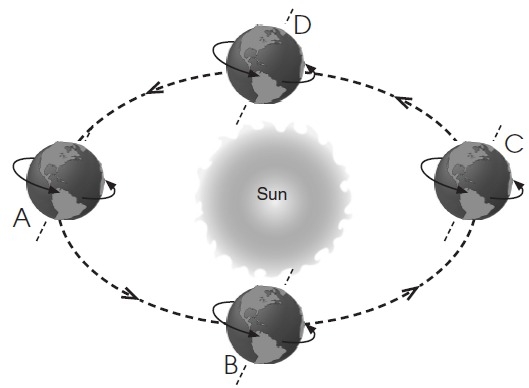
What season is letter A in the northern hemisphere?

a)

Winter

b)

Summer

c)

Spring

d)

Fall

88.
When the Northern Hemisphere is pointing towards the sun, what season is the Southern Hemisphere?
a)
Winter
b)
Spring
c)
Fall
d)
Summer
89.
Which moon phase is shown in this diagram?
a)
new moon
b)
first quarter
c)
full moon
d)
last quarter/3rd quarter
90.
Tides are caused by ___________
a)
wind
b)
gravitational pull of moon
c)
waves gravitation toward land
d)
rain
91.
What would be the result if the Earth's axis was not tilted but straight up and down?
a)
Nothing would change
b)
There would be no seasons
c)
Days would get longer
d)
The Equator would burn up and the poles would freeze
92.
Name the phase of the moon for letter a
a)
First Quarter
b)
Last Quarter
c)
Waxing Gibbous
d)
Waning Gibbous
93.
Name the phase of the moon for letter f
a)
Waning Gibbous
b)
Waxing Gibbous
c)
Waning Crescent
d)
Waxing Crescent
94.
A[n] ______________ tide occurs when the sun is at right angles to the line between Earth and the moon. 
a)
high
b)
neap
c)
low
d)
spring
95.
Differences in the moon's and sun's pull on different sides of the Earth cause _________.
a)
gravity
b)
lunar phases
c)
tides
d)
dabbing
96.
A[n] ___________ tide occurs when the sun, Earth, and the moon are nearly in a line. 
a)
spring
b)
high
c)
low
d)
neap
97.
The bulge of water on the side of the Earth closest to the moon produces ___________.
a)
high tide
b)
low tide
c)
neap tide
d)
spring tide
98.
Tides are the cycle of rising and falling ocean water that repeats automatically every
a)
24 hours
b)
12.5 hours
c)
25 hours
d)
6.25 hours
99.
A neap tide is a tide with the greatest difference between low and high tides
a)
true
b)
false
100.
Changes in the positions of Earth, the moon, and the sun affect the height of high tides during a month. 
a)
True
b)
False
101.
When does a lunar eclipse occur?
a)
At night
b)
When the moon's shadow is on the earth
c)
when the moon comes between the sun and earth
d)
During the day
102.
During a lunar eclipse, what color does the moon appear?
a)
Black
b)
Red-orange
c)
Yellow-green
d)
White
103.
A solar eclipse only happens during a ________ moon.
a)
New
b)
Cresent
c)
Gibbous
d)
Full
104.
A lunar eclipse only happens during a ________ moon.
a)
New
b)
Cresent
c)
Gibbous
d)
Full
105.
Where must you be to see a total solar eclipse?
a)
a corona
b)
an orbit
c)
the moon's shadow
d)
the earth's shadow
106.
What do we call the sun's outer atmosphere that you see during a solar eclipse?
a)
an umbra
b)
a corona
c)
an orbit
d)
a shadow
107.
Why is a lunar eclipse very rare?
a)
Because it happens every new moon
b)
Because the moon's orbit is tilted, so the sun, moon and earth rarely line up
c)
because the moon isn't close enough to the earth
d)
because the earth isn't close enough to the sun
108.
Which of the following is not true about a total solar eclipse?
a)
It can be viewed once a year from every spot on earth
b)
It is dangerous to look at without the proper device
c)
When it happens, the moon blocks all of the sun except the corona
d)
You must be within the moon's umbra to see it