
 Worksheets
The Moon & Seasons (May 17)
Total questions: 68
Worksheet time: 2hrs 15mins
Name
Class
Date
1.
About how many days does it take to moon to go through a complete cycle?
a)
7 days
b)
365 days
c)
29 days
d)
20 days
2.

When the visible (lit) portion of the moon is increasing, the moon is:
a)
waning
b)
full
c)
waxing
d)
new
3.

Approximately how much time passes between the new moon and full moon?
a)
one month
b)
two weeks
c)
3 days
d)
24 hours�
4.
What causes the moon's phases
a)
Where you are standing on Earth
b)
the amt of sunlight reflected onto the moon from the sun
c)
The tilt of Earth
d)
how fast the moon is moving
5.

How long does it take the moon to complete an orbit around Earth?
a)
23 days
b)
29 days (1 month)
c)
2 weeks (half a month)
d)
365 days (a year)
6.
Why do we always see the same side of the moon from Earth?
a)
because the phases change
b)
because it rotates and revolves at the same rate
c)
because half of the moon always receives sunlight
d)
The moon changes positions�
7.
Define Waxing
a)
Moon is increasing and light part appears to be growing
b)
Completely illuminated
c)
dark side is facing earth
d)
Moon is decreasing and light part appears to be�shrinking
8.
Define Gibbous
a)
Less than half of moon visible
b)
More than half of moon visible
c)
All of moon visible
d)
None of moon visible
9.

Name the moon phase
a)
Waxing Gibbous
b)
Waxing Crescent
c)
Waning Crescent
d)
Waning Gibbous
10.

Name the moon phase
a)
Waning Crescent
b)
Waxing Crescent
c)
Waning Gibbous
d)
Waxing Gibbous
11.
The 1st Quarter moon is lit on the:
a)
Left Side
b)
Right Side
12.

When only a small part of the moon is visible, it is probably in what phase?
a)
waxing or waning crescent
b)
first quarter
c)
new moon phase
d)
waxing or waning gibbous phase
13.
Define Waning
a)
Moon appears to be gradually increasing in�size�
b)
Moon is completely illuminated�
c)
Moon appears to be gradually decreasing in size
d)
More than half illuminated�
14.

What moon phase is this picture?
a)
This is the full moon phase.
b)
This is the waxing gibbous moon phase.
c)
This is the waning gibbous moon phase.
d)
This is the first quarter moon phase.
15.

What moon phase is this picture?
a)
This is the waning crescent phase.
b)
This is the waxing gibbous phase.
c)
This is the waning gibbous phase.
d)
This is the new moon phase.
16.

What is this moon phase?
a)
This is the waxing crescent phase.
b)
This is the full moon phase.
c)
This is the waxing gibbous phase.
d)
This is the last quarter moon.
17.

What is this moon phase?
a)
This is the waxing gibbous moon phase.
b)
This is the last quarter moon phase.
c)
This is the first quarter moon phase.
d)
This is the new moon phase.
18.

What moon phase is this picture?
a)
This is the full moon phase.
b)
This is the waxing crescent moon phase.
c)
This is the waning gibbous moon phase.
d)
This is the waning crescent moon phase.
19.

What moon phase is this picture?
a)
This is the new moon phase.
b)
This is the waxing crescent moon phase.
c)
This is the waxing gibbous moon phase.
d)
This is the waning crescent moon phase.
20.

What moon phase is this image?
a)
This is the full moon phase.
b)
This is the last quarter moon phase.
c)
This is the waxing gibbous moon.
d)
This is the new moon phase.
21.

What phase of the moon is this image?
a)
This is the last quarter moon phase.
b)
This is the full moon phase.
c)
This is the first quarter moon phase.
d)
This is the waxing gibbous moon phase.
22.
What is the difference between a gibbous moon and a crescent moon?
a)
The gibbous shows more than half of the bright side of the moon.
b)
The crescent shows more than half of the bright side of the moon.
c)
The gibbous shows less than half of the bright side of the moon.
23.
As the moon's shape appears to get smaller, we say that the moon is _.
a)
swelling
b)
waxing
c)
waning
d)
disappearing
24.
Phases of the moon in which the moon appears to be getting larger are referred to as _.
a)
waxing
b)
waning
c)
new
d)
eclipse
25.
How long is a lunar month?
a)
30 days
b)
29.5 days
c)
27 days
d)
27.3 days
26.

Choose the correct phase.
a)
waning crescent
b)
waxing crescent
c)
waning gibbous
d)
waxing gibbous
27.

Choose the correct phase.
a)
First Quarter
b)
Last Quarter
c)
waning gibbous
d)
waxing gibbous
28.

Choose the correct phase.
a)
Waning Gibbous
b)
Waxing Gibbous
c)
Waning Crescent
d)
Waxing Crescent
29.

Choose the correct phase.
a)
Waning Gibbous
b)
Waxing Gibbous
c)
Last Quarter
d)
First Quarter
30.

Spinning a basketball on your finger is an example of ________.
a)
Revolution
b)
Rotation
c)
A year
d)
An orbit
31.
Revolution is
a)
when the Earth spins around the sun.
b)
when the Earth spins on its axis.
c)
when the Earth orbits the sun.
d)
when the Earth orbits on its axis.
32.

This picture represents day and night. What is the motion?
a)
Revolution
b)
Orbit
c)
Rotation
d)
Axis
33.

This motion determines a year. What is this motion?
a)
Spinning
b)
Elipse
c)
Revolution
d)
Rotation
34.
How many degrees is the Earth's axis tilted?
a)
0
b)
23.5
c)
50
d)
90
35.
What is the name of a day in which day and night are of equal duration?
a)
solstice
b)
equinox
c)
axis
d)
hemisphere
36.
The moon ____ around the Earth.
a)
revoloves
b)
rotates
c)
up
d)
down
37.
9. When the moon goes from a NEW MOON to a FULL MOON, we say it is getting larger. What's another word for "getting larger?"
a)
waxing
b)
waning
38.
10. When the moon goes from a FULL MOON back to a NEW MOON, we say it is getting smaller. What's another word for "getting smaller?"
a)
waxing
b)
waning
39.
12. How long does it take the Earth to revolve around the sun?
a)
about a week
b)
about a year
c)
about 10 years
d)
wait...doesn't the sun revolve around Earth?!
40.

What season is it in the Southern Hemisphere when it is fall in the Northern Hemisphere?
a)
winter
b)
spring
c)
summer
d)
fall
41.

What happens when the area in which you live tilts away from the sun?
a)
It is summer.
b)
It is spring.
c)
It is winter.
d)
It is fall.
42.
Day and night is caused by the ______ of earth on its axis.
a)
revolution
b)
orbit
c)
rotation
43.
Tides are caused by
a)
strong winds that blow over ocean waters.
b)
the interaction of Earth, the moon and the sun.
c)
the shifting of the plates on the ocean floor.
d)
variations in the salinity of ocean water
44.
Which of these affects tides the most?
a)
Mars
b)
the Sun
c)
the stars
d)
the Moon
45.

What causes Day and Night on Earth?
a)
The rotation of the Earth
b)
Earth moving farther from and closer to the Sun
c)
The Revolution of Earth
d)
The Sun moving around Earth
46.
Which of the following statements is most accurate about the Movement of Earth and the Sun?
a)
The Sun revolves around the Earth
b)
The Earth rotates around the Sun
c)
The Earth revolves around the Sun
d)
The Earth rotates and revolves around the Sun
47.

What is it call when more than half of the moon is lit on the left side and light is decreasing?
a)
Waxing cresent
b)
Waxing gibbous
c)
Waning gibbous
d)
Waning cresent
48.

What is it call when more than half of the moon is lit on the right side and light is increasing?
a)
Waxing cresent
b)
Waxing gibbous
c)
Waning gibbous
d)
Waning cresent
49.

What Moon phase is this?
a)
Last Quarter
b)
New Moon
c)
Third Quarter
d)
First Quarter
50.
How long after a new moon will it take to see another new moon?
a)
12 days
b)
29.5 days
c)
27.3 days
d)
365 days
51.
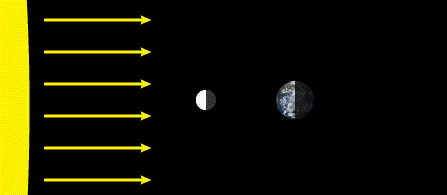
Name this phase
a)
New Moon
b)
First Quarter
c)
Last Quarter
d)
Full Moon
52.
How long is the lunar cycle?
a)
29.5 days
b)
23.5 days
c)
27.5 days
d)
Answer not shown
53.

In summer, the axis of the earth is pointed away or toward the sun?
a)
towards
b)
up
c)
down
d)
away
54.

What causes the seasons to change?
a)
The warming and cooling of Earth's core.
b)
The distance from the sun.
c)
Earth's tilt in relation to the sun.
d)
Earth's rotation on its axis.
55.

In winter, the axis of the earth is pointed away or toward the sun?
a)
towards
b)
up
c)
down
d)
away
56.

Which season is taking place in the Southern Hemisphere in Position 4?
a)
Winter
b)
Spring
c)
Summer
d)
Fall
57.

Which season is taking place in the Northern Hemisphere in Position 2?
a)
Winter
b)
Spring
c)
Summer
d)
Fall
58.

Which season is taking place in the Southern Hemisphere in Position 1?
a)
Winter
b)
Spring
c)
Summer
d)
Fall
59.
True or False? We always see the same side of the moon.
a)
True
b)
False
c)
Maybe
d)
Sometimes
60.
The motion of one body around another. (like the earth orbits the sun)
a)
rotation
b)
seasons
c)
revolution
d)
equinox
61.
One part of a pattern of temperature changes and other weather trends over the course of a year.
a)
seasons
b)
months
c)
semesters
d)
trimesters
62.
A position in orbit where sunlight shines equally on the Northern and Southern hemisphere. When daylight and darkness are equal for most of earth.
a)
solstice
b)
daylight savings
c)
equator
d)
equinox
63.
How often does the earth turn on its axis?
a)
every 24 hours
b)
every 365 days
c)
every 12 hours
d)
only on the weekends
64.
How long does it take for the earth to orbit the sun?
a)
A Day
b)
A Week
c)
A Month
d)
A year
65.
Path an object revolves around another object.
a)
axis
b)
orbit
c)
tilt
66.
The spinning of Earth on it's axis is called...
a)
rotation
b)
revolution
c)
orbit
d)
inertia
67.
The movement of Earth around the sun is called it's
a)
rotation
b)
axis
c)
revolution
d)
orbit
68.
The path that Earth travels around the Sun is called its
a)
rotation
b)
axis
c)
revolution
d)
orbit
100 %

