
NEW
Font size
S
M
L
XL
 Worksheets
2nd Sem Review
Total questions: 36
Worksheet time: 20mins
Name
Class
Date
1.
The basic unit of structure and function in a living things.
a)
chloroplast
b)
nucleus
c)
cell
d)
cell membrane
2.
This thin layer protects the cell and regulates what substances enter and leave the cell.
a)
cell membrane
b)
cell
c)
cell wall
d)
golgi body
3.
In a plant cell, a stiff wall surrounds the membrane, giving the cell a rigid, boxlike shape?
a)
cell membrane
b)
cell
c)
ribosome
d)
cell wall
4.
These organelles capture energy from sunlight and use it to produce food for the cell.
a)
cell membrane
b)
chloroplasts
c)
cell wall
d)
ribosomes
5.
A gel-like fluid in which many different organelles are found.
a)
cell membrane
b)
nucleus
c)
organelle
d)
cytoplasm
6.
This organelle receives materials from the endoplasmic reticulum and sends them to other parts of the cell.
a)
ribosomes
b)
mitchondria
c)
cytoplasm
d)
golgi bodies
7.
Most of the cell's energy is produced within these rod-shaped organelles. This organelle is considered the "powerhouse" of the cell.
a)
ribosomes
b)
mitochondria
c)
vacuole
d)
endoplasmic reticulum
8.
Directs all the cell's activities.
a)
mitochondria
b)
chloroplasts
c)
vacuole
d)
nucleus
9.
A tiny cell structure that carries out a specific function within a cell.
a)
organelle
b)
cell
c)
nucleus
d)
ribosomes
10.
This sac with the cytoplasm stores water, food, waste, products and other materials.
a)
vacoule
b)
organelle
c)
cytoplasm
d)
cell membrane
11.

Examine the cell diagrams shown. Which of the following choices identifies the eukaryotic cell for the correct reason?
a)
Cell A, because it is a single cell
b)
Cell A, because a nuclear membrane contains the cell’s DNA
c)
Cell B, because it is much smaller
d)
Cell B, because it contains genetic material
Cell B, because it contains genetic material
12.
What is multicellular?
a)
one cell
b)
no cells
c)
many cells
d)
no nucleus
13.
All living things are made of...
a)
atoms
b)
cells
c)
bacteria
d)
plants
14.
All cells come from other...
a)
cells
b)
plants
c)
nucleus
d)
microscopes
15.
Where is the DNA found in a eukaryotic cell?
a)
floating around in the cytoplasm
b)
in the nucleus
16.
What type of cell has a nucleus?
a)
eukaryotic
b)
prokaryotic
17.
Plants and animal cells are examples of ___ cells
a)
prokaryotic cells
b)
eukaryotic cells
18.
Bacteria is what kind of cell?
a)
Eukaryotic
b)
Prokaryotic
19.

What type of cell is pictured?
a)
Prokaryotic
b)
Eukaryotic
c)
Plant
d)
Animal
20.
Contains a nucleus
a)
Eukaryotic Cells
b)
Prokaryotic Cells
c)
Both
d)
Neither
21.
Contains DNA
a)
Eukaryotic Cells
b)
Prokaryotic Cells
c)
Both
d)
Neither
22.
Which types of cells are ONLY unicellular?
a)
prokaryotes
b)
eukaryotes
c)
plants
d)
animals
23.
Which kingdom are mosses, ferns, conifers, and flowering plants a part of?
a)
Archaebacteria
b)
Plantae
c)
Animalia
d)
Protista
24.
Organisms that are classified as autotrophic are able to-
a)
be seen with the human eye
b)
move
c)
reproduce
d)
make their own food
25.

Which kingdom would this organism belong to?
a)
Protista
b)
Plantae
c)
Animalia
d)
Fungi
26.

What type of organism makes its own food internally?
a)
heterotroph
b)
autotroph
c)
carnivore
d)
omnivore
27.

Which kingdoms are prokaryotic?
a)
Archaebacteria and Animalia
b)
Eubacteria and Archaebacteria
c)
Fungi and Protista
d)
None of them are
28.
The broadest or most general taxonomic classification of living organisms is organized by --
a)
Kingdom
b)
Domain
c)
Species
d)
Organisms
29.
What do protists, plants, fungi, and animals have in common?
a)
Multicellular
b)
Eukaryotic
c)
Prokaryotic
d)
Consumers
30.
What are the three domains?
a)
Archaea, Bacteria, and Eubacteria
b)
Archaea, Protists, and Eubacteria
c)
Archaea, Bacteria, and Eukarya
d)
Archaea, Fungi, Animalia
31.
I am made of many cells. My cells have an organized nucleus. I mostly have two parents, but sometimes one. I make my own food.
a)
Fungi
b)
Bacteria
c)
Plantae
d)
Animalia
32.
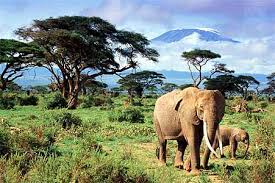
What are the biotic factors in this image?
a)
sunlight, elephants, and grasses
b)
sunlight, water, and air
c)
elephants, plants, trees
33.
Temperature, light, air, water, and soil are all _____ parts of the environment
a)
alive
b)
biotic
c)
abiotic
d)
living
34.
Which of the following is not a Kingdom?
a)
archaebacteria
b)
plant
c)
virus
d)
protist
35.

What is this?
a)
Euglena
b)
Paramecium
c)
Amoeba
d)
Volvox
36.
Which of the following are classified as single called?
a)
protozoa
b)
human
c)
flower
d)
water
Reset

