
 Worksheets
Biology 2nd Semester Review
Total questions: 57
Worksheet time: 42mins
Name
Class
Date
1.
TGATGCTAGC
What is the sequence of the original strand?
What is the sequence of the original strand?
a)
TGATGCTAGC
b)
AGUACGAUCG
c)
GTCGTAGCTA
d)
ACTACGATCG
2.

In humans, earlobe shape is determined by two alleles, F (for free earlobes) and f (for attached earlobes), carried on an autosome. A father has the genotype Ff. The mother has the genotype ff. What if the probability that their child will have attached earlobes?
a)
0%
b)
25%
c)
50%
d)
75%
3.

A farmer finds an ear of corn in his field that has some yellow and some red seeds. He chooses only corn with yellow seeds for the seeds for the next crop. In the new crop he finds one more ear of corn with some red seeds. What is the BEST explanation of why this occurs?
a)
A nutrient is missing from the soil under the plant with red seeds.
b)
A sudden change in temperature causes the color change.
c)
Red seeds are due to an allele that is recessive to yellow seeds
d)
The corn with red seeds did not receive adequate sunlight.
4.

In humans, cleft chins are dominant. Two parents each have one gene for a cleft chin. What is the probability that their child has a cleft chin?
a)
0%
b)
25%
c)
50%
d)
75%
5.

If two parents are heterozygous for dimples, a dominant trait (Dd and Dd), what percentage of their offspring will MOST LIKELY have dimples?
a)
0%
b)
25%
c)
50%
d)
75%
6.
According to Mendel's Law of Segregation, which of the following is TRUE?
a)
Each gamete has half dominant alleles and half recessive.
b)
Gametes contain two alleles for half the genes in the organism.
c)
Gametes inherit one allele for each trait from a parent cell.
d)
Gametes produced from a single cell are identical to each other.
7.
In a cross between heterozygous parents (Bb), what is the zygote's possible combination of alleles?
a)
BB, BB, Bb, Bb
b)
bb, bb, bb, bb
c)
Bb, Bb, bb, bb
d)
BB, Bb, Bb, bb
8.

What is the result of the process shown?
a)
four genetically identical diploid cells
b)
four genetically identical haploid cells
c)
two pairs of genetically identical diploid cells
d)
four genetically different haploid cells
9.

A scientist observes a cell undergoing meiosis. The cell was MOST likely produced by which of the following?
a)
the skin of a multicellular organism
b)
a single-celled prokaryote
c)
the reproductive organs of a multicellular organism
d)
a single-celled eukaryote
10.

Crossing-over occurs when
a)
chromosomes exchange alleles.
b)
chromosomes are exchanged between two cells.
c)
chromosomes are divided between two new cells.
d)
chromosomes are replicated to make identical copies.
11.

How does the process of fertilization lead to genetic variation in a population?
a)
Fertilization causes more dominant alleles to be passed to the zygote from the parent gametes.
b)
Fertilization allows the zygote to receive a few chromosomes from the female parent and more from the male parent.
c)
Fertilization results in a new combination of alleles from the male and female gametes.
d)
Fertilization joins complete copies of the male and female chromosomes from the parents.
12.

Kangaroos reproduce when an egg cell is fertilized by a sperm cell. The fertilized egg develops into a baby kangaroo. Which of the following is one characteristic of the baby kangaroo?
a)
Depending on its sex, it is identical to either the male or female parent.
b)
It contains a unique combination of its parents' genetic information.
c)
Depending on the conditions of its birth, it reproduces sexually or asexually.
d)
It most closely resembles either one parent or the other.
13.

During sexual reproduction, which types of cells join together to form a zygote?
a)
two haploid cells produced by meiosis
b)
two diploid cells produced by meiosis
c)
two diploid cells produced by mitosis
d)
two haploid cells produced by mitosis
14.

A human zygote was formed when an egg with an X chromosome united with a sperm containing a Y chromosome. Which of the following describes the child that develops from this zygote?
a)
The child is shorter than average.
b)
The child has red-green color blindness.
c)
The child has a sex-linked disorder.
d)
The child is male.
15.
Where does the genetic information contained in a zygote come from?
a)
50% of the DNA comes from each parent.
b)
The percentage of DNA from each parent depends on the sex of the offspring.
c)
The DNA comes from the parents, but the percentage is random.
d)
75% of the DNA comes from the dominant parent.
16.

Which of the following characteristics is a lion least likely to pass on to its offspring?
a)
Colors of its fur
b)
Length of its tail
c)
Scars on its leg
d)
Size of its body
17.

A mutation in which of the following types of cells could be passed on to an organism’s offspring?
a)
Blood
b)
Egg
c)
Muscle
d)
Nerve
18.
Genetic information usually flows in one specific direction. Which of the following best represents this flow?
a)
DNA ---> Protein ---> RNA
b)
DNA ---> RNA ---> Protein
c)
Protein ---> DNA ---> RNA
d)
DNA ---> Protein ---> RNA
19.

The pictures of the dogs above show two dogs of the same breed that have different coat colors. The instructions that determine coat color are stored in the ___________.
a)
Cytoplasm of skin cells
b)
Membrane of every cell
c)
Mitochondria of hair cells
d)
Chromosomes of every cells
20.

Normal mitotic cell division results in each daughter cell having
a)
Half the number of chromosomes as the parent cell
b)
The same number and kinds of chromosomes as the parent cell
c)
The same number but different kinds of chromosomes as the parent cell
d)
Twice the number of chromosomes as the parent cell
21.

A mutation is best described as
a)
The formation of a DNA molecule
b)
A change in DNA sequence
c)
The structure of a DNA molecule
d)
A nucleotide in the DNA molecule
22.

The process of biological change over time by which descendants come to differ from their ancestors is called ___.
a)
mutation
b)
artificial selection
c)
Evolution
d)
uniformitarianism
23.

The development by scientists of a new color in a rose is the result of
a)
artificial selection
b)
descent with modification
c)
natural selection
d)
overproduction
24.

A ___ is a group of individuals of the same species in the same geographic area.
a)
community
b)
population
c)
breeding family
d)
species
25.

Which of the five mechanisms of evolution is illustrated in the following scenario: A change in body color enabled animals to better hide from predators.
a)
natural selection
b)
gene flow
c)
genetic drift
d)
adaptation
26.

Modern whales have vestigial pelvic bones and lungs instead of gills. What does this evidence suggest about whale ancestors?
a)
Whale ancestors ate opossums.
b)
Whale ancestors did not evolve.
c)
Whale ancestors lived on land.
d)
Whale ancestors lived 850 million years ago.
27.

The difference in the physical traits of an individual from those of other individuals in a group is called a(n)
a)
variation.
b)
adaptation.
c)
species.
d)
change
28.

Two organisms that are closely related would have ___.
a)
exactly the same DNA sequences
b)
completely different DNA sequences
c)
no proteins in common
d)
very similar DNA sequences
29.

In natural selection, the selective agent is ___.
a)
a breeder
b)
a virus
c)
the environment
d)
mutation
30.

Modern humans are members of which species?
a)
Homo habilis
b)
Homo sapiens
c)
Homo erectus
d)
Homo neanderthalensis
31.

What is the term for a feature that allows an organism to survive better in its environment?
a)
variation
b)
adaptation
c)
homologous structure
d)
vestigial structure
32.

The process by which individuals that are better suited to their environment survive and reproduce more successfully than others is known as ___.
a)
genetic drift
b)
gene flow
c)
sexual selection
d)
natural selection
33.

Which of the following is a fossil?
a)
a trace of an organism that existed in the past
b)
a structure or organ that no longer functions
c)
a plant that has recently died
d)
a group of similar organisms that can reproduce
34.

Genetic variation can arise from a random change in the DNA of a gene. This change is called a(n) ___.
a)
mutation
b)
gene pool
c)
allele
d)
gene flow
35.

An ecosystem contains many types of trees. The average height of fullgrown trees of one tree species used to be about 5 meters. Over thousands of years, the full-grown height of this species increased to 10 meters. Which of the following MOST LIKELY describes the conditions under which the mechanism of natural selection caused this change to occur?
a)
The gene for height and the gene for disease resistance are on the same chromosome.
b)
The DNA of the taller trees tends to be more stable than the DNA of the shorter trees.
c)
This species of tree must compete with species of taller trees for access to sunlight
d)
This tree species has an unusually high rate of DNA mutations
36.

In a population of rabbits, there are individuals with thick fur and individuals with thin fur. The thick fur (T) is dominant. Within this population, there are also individuals with black fur and those with white fur. The black fur (B) is dominant. During the winter months when it snows, individuals with which of the following genotypes are MOST likely to survive?
a)
Ttbb
b)
TTBB
c)
TtBb
d)
ttbb
37.

A scientist hypothesizes that if a mutation produces one bacterial cell with antibiotic resistance, after several generations a large percentage of the cells in the population will have the resistance. Which of the following best describes the mechanism by which this series of events could occur?
a)
The resistant cell uses its superior genotype to produce more offspring than other cells produce.
b)
Proteins in the resistant cell's DNA are tougher and therefore survive longer.
c)
The resistant cell survives longer and reproduces more successfully than other cells.
d)
The resistant cell's DNA aggressively crosses over to other cells.
38.

In any given population of organisms, there are differences between the organisms. Why is it ADVANTAGEOUS for a population to have variation?
a)
Variation in a population provides males with a wider selection of females when mating.
b)
Variation means the organisms are better able to hide in different areas of their habitat
c)
Variation makes it easier for organisms to recognize members of their own families.
d)
Variation increases the likelihood that at least some individuals will survive if there is a change in the environment
39.

A termite population was sprayed with a certain brand of insecticide (bug poison). After being sprayed, the number of surviving termites within the population were counted and recorded as a percentage of the total. This process was repeated until a total of six generations of termites had been sprayed. The results are shown in the table to the side. Which statement best explains why later generations had higher percentages of termites that survived?
a)
Earlier generations had several members that were old and weak.
b)
Earlier generations had smaller numbers of termites than later generations.
c)
Later generations were able to live through the spraying because they were used to it.
d)
Later generations were the offspring of termites that were more resistant to the spraying.
40.

A farmer notices that one of the lambs in his flock has very short legs. Which of the following mechanisms is most likely responsible for this new trait?
a)
segregation of chromosomes
b)
genetic mutation
c)
stable environmental conditions
d)
cell differentiation
41.

In one species of flowering plants, white plant color is due to a lack of chlorophyll (green pigment). The seed germinates (sprouts), but the white plant dies after only two or three leaves appear. The lack of chlorophyll is an inherited lethal (deadly) characteristic. Why are there still some seeds that produce the lethal characteristic?
a)
Heterozygous parent plants carry the lethal allele.
b)
Plants that have the characteristic due to a mutation survive to reproduce.
c)
The characteristic is found in only a few leaves of the plants.
d)
A few of the plants with the characteristic are able to produce seeds.
42.
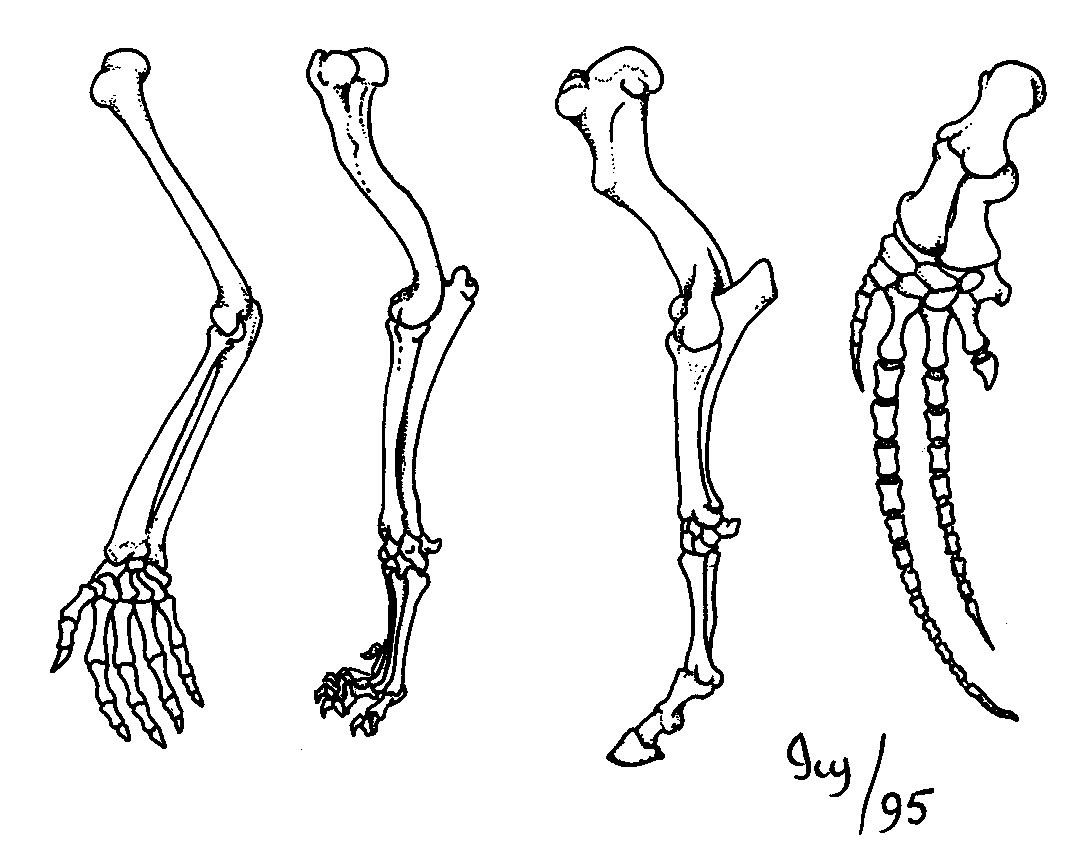
Structures with the same parts have different functions; suggests that organisms share a common ancestry
a)
vestigial structures
b)
homologous structures
c)
adaptive radiation
d)
fossil
43.

If an organism has a vestigial structure, that structure likely once had a function in a(n)
a)
close relative
b)
early ancestor
c)
unrelated organism
d)
embryological stage
44.

Some organisms that share a common ancestor have features that have different functions, but similar structures. These are known as
a)
vestigial structures
b)
analogous structures
c)
homologous structures
d)
fossil structures
45.

Study of embryos of various organisms to show a common ancestor because of similarities in development
a)
natural selection
b)
embryology
c)
speciation
d)
evolution
46.
Structures that have the same function but different structures are...
a)
homologous structures
b)
analogous structures
c)
vestigial structures
d)
embryology
47.

Two organisms that are closely related would have
a)
very similar DNA sequence
b)
exactly the same DNA sequences
c)
no proteins in common
d)
completely different DNA sequence
48.

Which layer is the oldest
a)
B
b)
A
c)
E
d)
C
49.
If two organisms have similar traits of DNA they are probably
a)
share a common ancestor
b)
share a common environment
c)
share a common population
d)
speciation
50.
What does Darwin's theory of evolution suggest?
a)
species change over time
b)
extinct species are not related to living species
c)
different species can interbreed
d)
animals that look alike are most closely related
51.
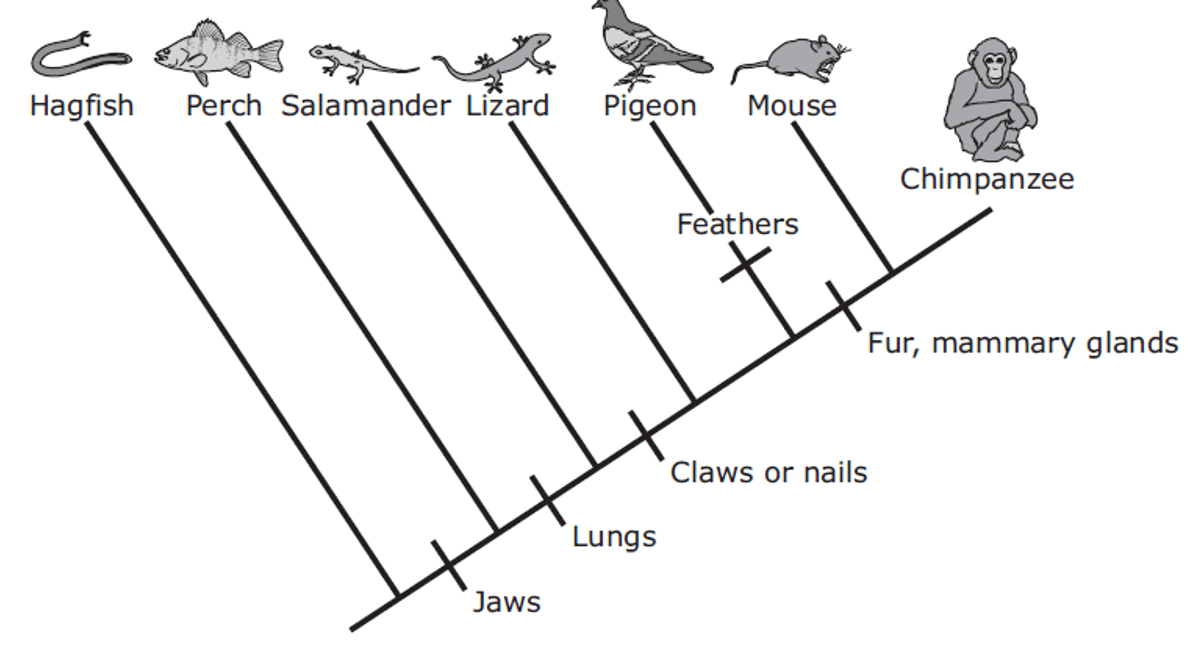
All the animals to the right of the hagfish would have the common characteristic of -
a)
Fur
b)
Claws or nails
c)
Lungs
d)
Jaws
52.
When you compare DNA or proteins to support evolution, you are using what kind of evidence?
a)
anatomical evidence
b)
molecular evidence
c)
fossil evidence
53.

This fossil shows the traits of an ancestor (ancestral traits) and its descendants (derived traits). It shows links between more than one species.
a)
Fossil
b)
Transitional Fossil
c)
Fossil Fuels
d)
There is no fossil
54.
Structures like bird wings and insect wings that have the same function but different structures are...
a)
homologous structures
b)
analogous structures
c)
vestigial structures
d)
embryology
55.

What is suggested by the similarity of early embryos of different species of vertebrates?
a)
no evolutionary relationships between the groups
b)
recent common ancestry
c)
similar environments in the past
d)
evolution from a distant common ancestor
56.

How do fossils provide evidence that evolution has happened on Earth?
a)
Fossils show how the sizes of certain animals has changed drastically over millions of years
b)
Fossils show that some species have gone extinct
c)
Fossils show how life forms present today are different than those from the past
d)
Different sedimentary rock layers provide evidence for how the environment has changed over time
57.
What is NOT used as evidence to support evolution?
a)
Fossil Record
b)
Internal Skeleton
c)
DNA Similarity
d)
Embryonic Development
100 %

