
 Worksheets
Sat Scholars Natural Selection & Evidence of Evolution
Total questions: 24
Worksheet time: 3570secs
Name
Class
Date
1.
Which of the following is a fossil?
a)
a plant that has recently died
b)
a group of organisms that can reproduce
c)
a structure or organ that no longer functions
d)
a trace of an organisms that existed in the past
2.

What is suggested by the similarity of early embryos of different species of vertebrates?
a)
no evolutionary relationships between the groups
b)
recent common ancestry
c)
similar environments in the past
d)
evolution from a distant common ancestor
3.

Some organisms that share a common ancestor have features that have different functions, but similar structures. These are known as
a)
vestigial structures
b)
analogous structures
c)
homologous structures
d)
fossil structures
4.

Two organisms that are closely related would have
a)
very similar DNA sequences
b)
exactly the same DNA sequences
c)
no proteins in common
d)
completely different DNA sequence
5.
How do fossils provide evidence that evolution has happened on Earth?
a)
Fossils show how the sizes of certain animals has changed drastically over millions of years
b)
Fossils show that some species have gone extinct
c)
Fossils show how life forms present today are different than those from the past
d)
Different sedimentary rock layers provide evidence for how the environment has changed over time
6.

When scientists compare animals currently living on different continents, they often find those with similar characteristics, who are not actually close relatives, living in similar environmental conditions even though they are geographically very distant. One example is the Anteater/Armadillos of the Americas and the Pangolin of Africa. What can we deduce from this evidence?
a)
Living things can adapt similarly to similar environments over time.
b)
Living things do not change over time
c)
They must all have the same recent common ancestor
7.

If an organism has a vestigial structure, that structure likely once had a function in a(n)
a)
close relative
b)
common early ancestor
c)
unrelated organism
d)
embryological stage
8.
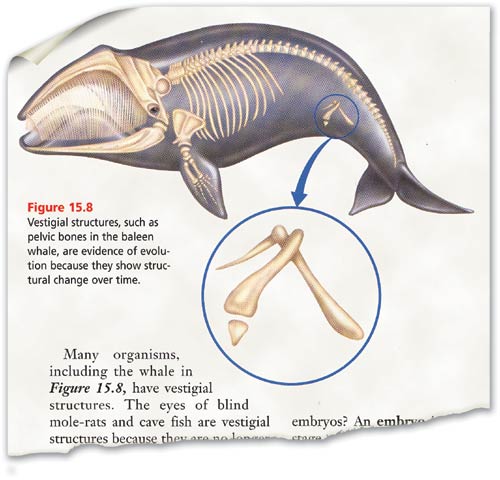
Which of the following is an example of a vestigial structure?
a)
the wings of a red-tailed hawk
b)
the hind limbs of a house cat
c)
the fins of sharks
d)
the tailbone of a human
9.

The diagram shows fossils in different rock layers. Which of these statements about the age of these fossils is most likely correct?
a)
Fossil A and C are the same age
b)
Fossil B is older than fossil C
c)
Fossils A is older than fossil B
d)
Fossil D is older than fossil C
10.

Darwin wrote that organisms with traits that are best suited to the environment will ________________
a)
survive and produce offspring
b)
become extinct
c)
evolve into new species
11.

According to this cladogram, birds are most closely related to
a)
Amphibians
b)
Sharks
c)
Ray Finned Fish
d)
Crocodiles
12.

Individuals that are well adapted to their environment will survive and produce:
a)
Fewer mutations
b)
Stronger genes
c)
More offspring
d)
Better traits
13.

According to the diagram, which organism is the oldest?
a)
ammonite
b)
fern
c)
trilobite
d)
coral
14.

According to the diagram, which bird has the most similar DNA to a large tree finch?
a)
small tree finch
b)
medium tree finch
c)
large ground finch
d)
green warbler finch
15.
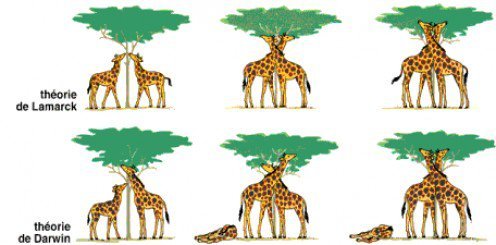
What would happen if the Giraffes never evolve?
a)
They would survive
b)
They would produce many offspring
c)
They would become extinct
d)
They would find another source of food
16.

What is this an example of?
a)
homologous structures
b)
variation
c)
vestigial structures
d)
DNA evidence
17.

Male lions will display aggression and fight for reproductive dominance over female lionesses. Which principle of Darwin's Theory is this?
a)
variation
b)
overproduction
c)
struggle for existence/competition
d)
descent with modification
18.

Over a long period of time, horses have evolved to become larger, hoofed mammals. Which principle of Darwin's Theory of Natural Selection is this?
a)
variation
b)
struggle for existence/competition
c)
survival of the fittest
d)
descent with modification
19.
Traits such as camouflage, sharp claws, or using a sound to communicate are examples of
a)
natural selection
b)
mutations
c)
speciation
d)
adaptations
20.
Mutations and gene shuffling that occurs during the production of gametes during meiosis lead to
a)
selective breeding of an animal
b)
adaptive radiation of a species
c)
variations within a population
d)
genetic engineering
21.
Why do frogs and other organism reproduce so many eggs or offspring?
a)
so that their babies can have friends to play with
b)
the more offspring the more likely the offspring will survive
c)
the more offspring the less likely offspring will survive
d)
the more offspring the less competition
22.
Which organisms are most likely to survive?
a)
the best adapted
b)
the fastest
c)
the strongest
d)
the most domesticated (tamed)
23.
Natural selection acts directly on the ________________ of an individual.
a)
genotype
b)
phenotype
c)
mutations
d)
offspring
24.
Evolutionary processes and selective pressures result in _________________ evolving over time.
a)
individuals
b)
populations
c)
fossils
100 %

