
 Worksheets
Electromagnetism
Total questions: 30
Worksheet time: 23mins
Name
Class
Date
1.
Two objects with LIKE static charges will
a)
attract each other
b)
even out in the end
c)
repel each other
d)
cause a spark
2.

What kind of circuit is this?
a)
series
b)
parallel
3.
Static electricity is:
a)
electricity flowing in a wire
b)
the buildup of electric charges on an object
c)
when protons move between objects
4.
Which is true of a series circuit...
a)
All parts are connected in a single loop
b)
The charges travel in one path
c)
all loads must be functional for the circuit to be complete
d)
All of the above.
5.
How can you increase the resistance of a wire?
a)
Increasing the temperature of the wire
b)
Lower the resistivity of the material
c)
Decrease the length of the wire
d)
Increase the cross sectional area
6.
Which of these objects is an insulator?
a)
Copper Wire
b)
Paper Clip
c)
Steel Pole
d)
Rubber Gloves
7.
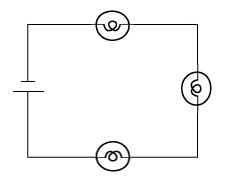
The picture shows an electrical circuit. This circuit is a series circuit because:
a)
It has 3 light bulbs.
b)
The same current flows through all three light bulbs.
c)
It uses a single battery.
d)
The electrical current is divided between the three light bulbs.
8.

What type of circuit is show in the image?
a)
Series Circuit
b)
Parallel Circuit
9.

Which do you expect to have the brightest light?
a)
1
b)
2
c)
3
d)
4
10.

What effect will the south pole of one magnet have on the south pole of another magnet?
a)
Repulsive
b)
Attractive
c)
Combative
d)
No effect
11.
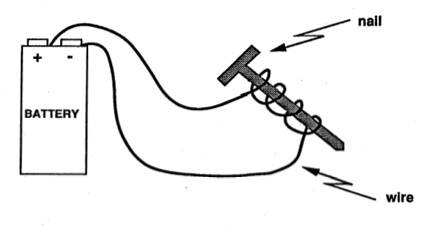
This is a picture of a simple electromagnet. How can the electromagnet be made stronger?
a)
Add more coils of wire to the nail.
b)
Use a smaller battery.
c)
Reverse the poles of the magnet.
d)
Remove all the coils and the nail.
12.
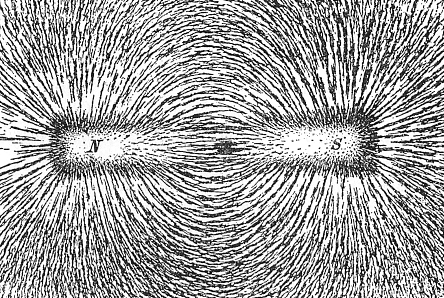
Surrounding every magnet is a __________ __________.
a)
magnetic field
b)
electrical current
c)
another magnet
d)
an enemy
13.
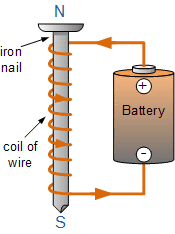
In order for an electromagnet to be formed, an __________ current must pass through a coil of __________ wrapped around an ________ core.
a)
wire, iron, electric
b)
electric, wire, iron
c)
iron, electric, wire
d)
excited, hair, apple
14.
What are the ends of a magnet called?
a)
East and west poles
b)
Left and Right ends
c)
North and South ends
d)
North and South poles
15.

A compass needle responds to a magnetic field, because the compass needle is a
a)
A. generator.
b)
B. motor.
c)
C. magnet.
d)
D. transformer.
16.

Where does a magnetic field occur in relation to an electrified wire?
a)
At either end, but not in the middle
b)
Only the side closest to source
c)
Around the entire length of wire
d)
Only the side furthest from source
17.

Why are paper clips attracted to magnets?
a)
They contain silver.
b)
They contain aluminum
c)
They contain tin.
d)
They contain iron.
18.
Generators are devices that convert _____ energy into _____ energy.
a)
chemical; mechanical
b)
mechanical; electrical
c)
electrical; mechanical
d)
potential; kinetic
19.
Which of these pairs of devices operate in reverse of each other?
a)
generator and motor
b)
generator and electromagnet
c)
motor and electromagnet
d)
electromagnet and resistor
20.
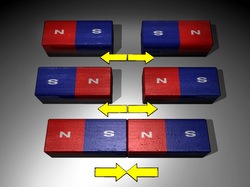
If I were to try to connect the north pole of one magnet to the north pole of another magnet, the two poles would:
a)
attract
b)
repel
c)
neither
d)
flip
21.
What is Resistance?
a)
The flow of electrons
b)
Electric potential difference
c)
A battery
d)
The ability to reduce the flow of electrons
22.
Electricity that flows in a closed path is called a
a)
path
b)
current
c)
circuit
d)
light
23.
The mathematical relationship among Voltage, Current, and Resistance
a)
Faraday's Law
b)
Tesla's Law
c)
Edison's Law
d)
Ohm's Law
24.
What is current measured in?
a)
Ω (Ohms)
b)
V (Volts)
c)
A (Amps)
d)
W (Watts)
25.
Current is...
a)
moving protons
b)
moving electrons
c)
measured in volts
d)
measured in ohms
26.
If the current increases it could be because of...
a)
increasing voltage
b)
decreasing resistance
c)
both
27.
An object through which electrons can easily flow is called a(n) ___________.
a)
Conductor
b)
Insulator
28.
If an object has more negative charges than positive charges, its electrcial charge is...
a)
positive
b)
negative
c)
neutral or no charge
d)
opposite
29.
What is the major difference between static electricity and current electricity?
a)
Current electricity involves a continuous flow of elecrons; static electricity is a sudden transfer of protons
b)
Current electricity can be deadly; static electricity is almost always safe
c)
In current electricity, there's a single transfer of electrons; in static electricity, there's a steady flow of electrons
d)
Current electricity involves a flow of electrons; static electricity involves a single transfer of electrons
30.

The strongest parts of the magnet are ...
a)
fronts
b)
backs
c)
poles
d)
middle
100 %

