
 Worksheets
Final Review
Total questions: 157
Worksheet time: 2hrs 19mins
Name
Class
Date
1.
A person has a stroke on her occipital lobe. What might happen to her?
a)
reduced planning abilities
b)
deafness
c)
coma
d)
blindness
2.
Makes decisions, plans, reasons, and carries out behaviors
a)
Frontal Lobe
b)
Parietal Lobe
c)
Occipital Lobe
d)
Temporal Lobe
3.

The parietal lobe controls __________.
a)
Vision
b)
Problem Solving
c)
Memory
d)
Sense of touch, pain, pressure
4.

The lobe responsible for making plans and evaluating consequences
a)
Frontal Lobe
b)
Temporal Lobe
c)
Parietal Lobe
d)
Occipital Lobe
5.
What is the largest part of the brain?
a)
Thalamus
b)
Cerebellum
c)
Spinal Cord
d)
Cerebrum
6.
Without the ____ the two sides of our brain couldn't communicate.
a)
Frontal Lobe
b)
Cerebral Cortex
c)
Thalamus
d)
Corpus Callosum
7.

Which of the following is represented by the PINK section?
a)
Frontal Lobe
b)
Temporal Lobe
c)
Parietal Lobe
d)
Occipital Lobe
8.
Damage to the cerebellum would most affect the career of
a)
an architect
b)
a teacher
c)
an athlete
d)
a librarian
9.

Receives sensory information and relays it to the proper part of brain for further processing
a)
Hypothalamus
b)
Reticular Formation
c)
Cerebellum
d)
Thalamus
10.
Controls hearing and smell
a)
Frontal Lobe
b)
Temporal Lobe
c)
Occipital Lobe
d)
Parietal Lobe
11.
What functions are carried out by the parasympathetic system?
a)
Rest and Digest
b)
Fight or Flight
c)
Sensory
d)
Integrative
12.
Which neurotransmitter is involved in muscle movements?
a)
Acetylcholine
b)
Endorphins
c)
Serotonin
d)
GABA
13.
The gap that a message has to cross to get from one neuron to the other is called the _____
a)
synapse
b)
dendrite
c)
axon
d)
nucleus
14.
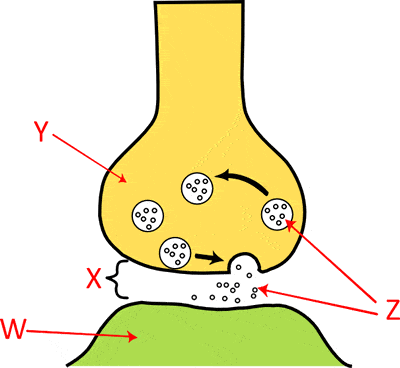
W
a)
Axon Terminal Button
b)
Neurotransmitters
c)
Dendrite
d)
Synapse
15.
Neurons that send information from the ENVIRONMENT to the brain
a)
Sensory Neurons
b)
Motor Neurons
c)
Interneurons
16.

This system triggers arousal and puts you in "fight or flight" mode.
a)
Central
b)
Somatic
c)
Sympathetic
d)
Parasympathetic
17.

This allows you to kick a ball and juggle.
a)
Vestibular
b)
Somatic
c)
Central
d)
Autonomic
18.

This controls most functions of the body and mind, and is made up of the brain and the spinal cord.
a)
Parasympathetic Nervous System
b)
Cerebellum
c)
Peripheral Nervous System
d)
Central Nervous System
19.

This is what helps you respond to someone trying to rob you.
a)
Central Nervous System
b)
Parasympathetic Nervous System
c)
Sympathetic Nervous System
d)
None of these
20.
What was the only life present during early Earth?
a)
microbial
b)
small multicellular
c)
plant
21.
What allowed larger, more complex life to form during ancient Earth?
a)
oxygen in the oceans and atmosphere
b)
carbon dioxide increased in the atmosphere
c)
high energy, inorganic compounds
22.
Fossils form in which type of rock?
a)
sedimentary
b)
igneous
c)
metamorphic
23.
Which is NOT a piece of evidence for ancient life on Earth?
a)
stromatolites
b)
banded iron formations
c)
isotopic ratios resulting from biological processess
d)
the presence of Earth's atmosphere
24.
What is the hallmark of eukaryotes?
a)
organelles
b)
DNA
c)
cell membrane (phospholipid bilayer)
d)
ribosomes
25.
Mitochondria and chloroplasts were probably:
a)
captured bacteria that carried out important energy processes
b)
the result of many mutations to the DNA that form ribosomes
c)
organelles that were important in ancient times but are no longer useful today
26.

According to the law of superposition, the oldest fossils are found
a)
At the top of the rock layers
b)
Near the bottom of the rock layers
c)
In the middle of the rock layers
d)
Somewhat near the surface
27.

According to the law of superposition, which layer is the youngest?
a)
A
b)
B
c)
C
28.

In the diagram there are 4 outcrops or 4 different locations for rock layers shown. Fossils are found at all 4 locations. Looking at the diagrams, which letter (A, B, C, or D) most likely represents an index fossil?
a)
A
b)
B
c)
C
d)
D
29.
What is a Fossil?
a)
A Bone
b)
Nasty
c)
the preserved remains or traces of animals, plants, and other organisms from the remote past
d)
The Bone of a dead thing
30.
A species that is no longer living and cannot come back is classified as _____________.
a)
Absolute
b)
Relative
c)
Extinct
d)
Living
31.

Which rock layer is the oldest
a)
A
b)
E
c)
D
d)
C
32.
The age of Earth is estimated to be
a)
2 million years.
b)
2 billion years.
c)
2 trillion years.
d)
4.5 billion years.
33.
Many scientists think that early aerobic prokaryotes invaded larger cells and eventually gave rise to
a)
cell walls.
b)
DNA
c)
mitochondria.
d)
ribosomes.
34.
The process by which two species, for example, a flower and a pollinating insect, evolve in response to each other is called
a)
convergent evolution
b)
adaptive radiation.
c)
coevolution.
d)
punctuated equilibrium.
35.
A single species that has evolved into several different forms that live in different ways has undergone
a)
adaptive radiation.
b)
coevolution.
c)
punctuated equilibrium.
d)
mass extinction.
36.
________ is the amount of time for ½ of the original radioactive sample to decay.
a)
radioactive isotope
b)
chemical life
c)
biological life
d)
half-life
37.
Pattern of evolution in which one species fills many ecological niches and becomes many different species.
a)
co evolution
b)
convergent evolution
c)
punctuated equilirbium
d)
adaptive radiation
38.
Which of the following is a requirement for all life on earth?
a)
Movement
b)
Use of water
c)
Eating plants
d)
Sunlight
39.
You find a rock sample with radioactive atoms present. If 25% of the original radioactive atoms were present, how many half-lives has the rock been around for?
a)
zero
b)
1
c)
2
d)
3
40.
If the half-life of a radioactive group of atoms is 100 years, then how old is the rock if there have been ten half-lives?
a)
10 years
b)
100 years
c)
1000 years
d)
10000 years
41.
Suppose you found a material in which 50% of the original radioactive atoms were still present. If the half-life of an atom is 60 years, how old is the material?
a)
30 years old
b)
60 years old
c)
120 years old
d)
180 years old
42.
Carbon-14 has a half-life of 5,730 years. Dinosaur fossils are 65 million years old or more. Do scientists expect to find any Carbon-14 left in dinosaur fossils?
a)
Yes, there will still be a significant amount a radioactive atoms that are still decaying
b)
No, after 100 half-lives, the decay becomes almost undetectable
43.
What is another name for B cells that produce antibodies?
a)
plasma cells
b)
memory cells
c)
natural killer cells
d)
macrophages
44.
Which of the following is not associated with humoral immunity?
a)
antibodies
b)
breast milk
c)
B cells
d)
cytotoxic T cells
45.
The primary purpose of vaccines is to __.
a)
induce inflammation
b)
activate the immune system to produce memory cells
c)
stimulate natural killer cells
d)
initiate the innate immune response
46.
Passive immunity can be acquired through which of the following methods?
a)
vaccination
b)
infection
c)
mother's milk
d)
topical cream
47.
The protein that sits on pathogenic surfaces and elicits an immune response is known as
a)
antigen
b)
histamine
c)
antibody
d)
anticytosis
48.
Which type of cell will remember what the antigen looks like and produce a rapid secondary response?
a)
Plasma B cells
b)
Memory B cells
c)
Plasma T cells
d)
Memory T cells
49.
HIV attacks and kills which of the following?
a)
Plasma B cells
b)
Memory B cells
c)
Helper T cells
d)
Cytotoxic T cells
50.

Virus-infected cells release interferon a chemical which inhibits the ability of the virus to infect other cells. How does interferon work?
a)
by causing the cell to lyse
b)
by inducing viral reproduction
c)
by blocking viral reproduction
d)
by inhibiting cell wall production
51.
Produced by B cells and designed to mark antigens to be destroyed.
a)
Antigens
b)
Active Immunity
c)
Antibodies
d)
Antibiotics
52.
What type of immune response are B cells responsible for?
a)
humoral
b)
systemic
c)
cell mediated
d)
general
53.
Which of the following describes when the body's immune system attacks its own tissues?
a)
allergies
b)
anaphylactic shock
c)
autoimmune
54.
Which of the following describes an over exaggerated immune response?
a)
allergies
b)
autoimmune
c)
anaphlyactic shock
55.
__________ postulates are rules that help scientists determine the cause of disease.
a)
SCID
b)
Koch's
c)
Koko's
d)
Myelin
56.
_________________ is produced by a virus infected cell to help other cells.
a)
interferon
b)
complement
c)
antibody
d)
thymus
57.
Which is NOT considered a first line of defense?
a)
White Blood Cells
b)
Skin
c)
Hair
d)
Mucous Membranes
58.
Y shaped proteins that may mark pathogens for destruction are
a)
antigens
b)
T cells
c)
antibodies
d)
neutrophils
59.
Cells that sound the alarm are
a)
memory T cells
b)
memory B cells
c)
plasma cells
d)
helper T cells
60.
An autoimmune disorder that attacks the joints is
a)
Multiple sclerosis
b)
rheumatoid arthritis
c)
diabetes
d)
SCID
61.

Which one is a way the body defends against a pathogen?
a)
Fever
b)
Stomach Acid digesting
c)
White Blood Cells fighing
d)
All of these are correct
62.
Bacteria, virus, and parasites are considered
a)
erythrocytes
b)
leukocytes
c)
Caribs
d)
pathogens
63.
What is immunity?
a)
The body's ability to produce cells that inactivate foreign cells or substances.
b)
The body's ability to regulate homeostasis through feedback loops.
c)
The body's ability to produce the "fight or flight" response.
d)
The body's ability to use the endocrine system to fight disease.
64.
Which of the following are examples of chemical barriers of the immune system?
a)
Skin
b)
Tears
c)
T-Cells
d)
Killer Cells
65.
Tears, stomach acid, and saliva are examples if
a)
Mechanical barriers
b)
Chemical barriers
c)
Macrophages
d)
Inflammatory Organs
66.
How many alleles does an individual have for each trait?
a)
1
b)
2
c)
3
d)
4
67.
What type of inheritance do two alleles have if their traits blend together?
a)
Incomplete Dominance
b)
Co-Dominance
c)
Mendelian Inheritance (Complete Dominance)
d)
Homozygous Inheritance
68.
A pattern of inheritance in which a trait is carried on one of the sex-determining chromosomes.
a)
Mendelian Inheritance
b)
Co-dominance
c)
Incomplete dominance
d)
Sex-linked inheritance
69.

A calico cat shows both the traits for orange fur and black fur. What kind of allele expression is this?
a)
Incomplete Dominance
b)
Co dominance
c)
Independent assortment
d)
Recessive inheritance
70.

A roan cow shows co-dominance in fur color (orange and white). What is the phenotype ratio expected if a roan cow and a roan steer mate together?
a)
4: Orange and White
b)
1: Orange : 1 White
c)
2 Orange: 2 Orange and White: 0 White
d)
1: Orange: 2 Orange and White: 1 White
71.

Colorblindness is a recessive, X chromosome sex-link disorder. Cross the parents to figure out which percentage of their offspring will be colorblind.
a)
25%
b)
0%
c)
75%
d)
50%
72.

This type of inheritance pattern shows BOTH traits in possible offspring
a)
complete dominance
b)
incomplete dominance
c)
co-dominance
d)
dominant pattern
73.
Snap dragon color is a incomplete dominant trait. A red flower (RR) is crossed with white flower (rr)? What color are flowers that are Rr?
a)
Red
b)
Red and White
c)
White
d)
Pink
74.
Which of the following is a hybrid?
a)
BB
b)
bb
c)
Bb
75.
This type of inheritance pattern shows BOTH traits in possible offspring
a)
complete dominance
b)
incomplete dominance
c)
co-dominance
d)
dominant pattern
76.
In Andalusian fowls, black individuals (BB) and white individuals (bb) are homozygous. Heterozygous individuals are grey (Bb).
What is the genotype ratio for a cross between a grey fowl and a white fowl?
What is the genotype ratio for a cross between a grey fowl and a white fowl?
a)
2 BB: 2 Bb: 0 bb
b)
0 BB: 4 Bb: 0 bb
c)
0 BB: 2 Bb: 2 b
d)
1 BB: 2 Bb: 1 bb
77.
The passing of characters from parents to offspring is called?
a)
Monohybrid cross
b)
Heredity
c)
True breeding
d)
Genetics
78.

The range of human skin colors is caused by a variety of genes, each of which has at least 2 alleles. This is an example of:
a)
incomplete dominance
b)
codominance
c)
multiple alleles
d)
polygenic inheritance
79.

What gender of offspring are most often affected by sex-linked inheritance? What gender are usually carriers of the trait?
a)
males, males
b)
females, males
c)
males, females
d)
females, females
80.

Colorblindness is a trait that is seen more often in males and is passed to them by their mothers, who may not be colorblind. Colorblindness is...
a)
a codominant trait
b)
a sex-linked trait
c)
carried on the Y chromosome
d)
associated with a dominant allele
81.
How much of your DNA do you inherit from your mom?
a)
10%
b)
25%
c)
50%
d)
it varies
82.

In which inheritance pattern are heterozygous individuals a blend of the dominant and recessive phenotypes?
a)
sex-linked inheritance
b)
complete dominance
c)
codominance
d)
incomplete dominance
83.

Meiosis makes sperm and egg cells. In humans, sperm and egg cells each have _____ chromosomes. Therefore a fertilized human egg cell (sperm and egg cell combined) would create a cell with _____ chromosomes.
a)
23, 46
b)
46, 23
c)
2, 4
d)
50, 100
84.
Unlike mitosis, meiosis in male mammals results in the formation of
a)
one haploid gamete
b)
three diploid gametes
c)
four diploid gametes
d)
four haploid gametes
85.
All offspring plants in the F1 generation were purple because purple is the ______________ trait.
a)
Heterozygous
b)
Homozygous
c)
Dominant
d)
Recessive
86.

Which of the following does NOT describe the flowers in the F1 Generation?
a)
Hybrid
b)
Heterozygous
c)
Purebred
87.
A __________ is a segment of DNA that codes for a particular protein, which leads to a particular trait.
a)
Gene
b)
Allele
c)
Codon
d)
Nucleotide
88.
The different forms of a gene are known as _____________.
a)
Codons
b)
Proteins
c)
Alleles
d)
Nucleotides
89.
Which of Mendel's laws states that alleles are separated during meiosis?
a)
Law of Dominance
b)
Law of Segregation
c)
Law of Independent Assortment
d)
Law of Meiosis
90.
Which of the following is an example of a GENOTYPE?
a)
25%
b)
Blue
c)
1:2:1
d)
Bb
91.
Which of the following is an example of a PHENOTYPE?
a)
25%
b)
Blue
c)
1:2:1
d)
Bb
92.
Which of the following is an example of a homozygous dominant genotype?
a)
RR
b)
Rr
c)
rr
93.
Which of the following is an example of a homozygous recessive genotype?
a)
RR
b)
Rr
c)
rr
94.
Which of the following is an example of a heterozygous genotype?
a)
RR
b)
Rr
c)
rr
95.

What is the FUNCTION of the visual tool seen in the image?
a)
Identifies the location of a gene.
b)
Determines the DNA sequence of an organism.
c)
Predicts the possible results of a genetic cross.
d)
Tests for the presence of dominant alleles.
96.

The letters on the TOP AND SIDE of a punnett square represent ______________.
a)
The combination of alleles in offspring.
b)
The possible alleles given by the parents following meiosis.
c)
The genotype and phenotype of offspring.
d)
The results of genetic mutations in offspring.
97.
True or False: A phenotype describes the physical expression (characteristics) of a gene. In other words, how something looks.
a)
True
b)
False
98.
What would indicate a human male?
a)
XX
b)
X
c)
XY
d)
XXY
99.
The likely cause of genetic disorders is...
a)
Nondisjunction
b)
Overfertilization
c)
Uncontrolled Meiosis
d)
Translocation
100.
What is a picture used to examine chromosomes called?
a)
Sonogram
b)
Electrocardiogram
c)
X-Ray
d)
Karyotype
101.

What phase is represented?
a)
metaphase 1
b)
metaphase 2
c)
anaphase 1
d)
anaphase 2
102.

What phase is represented?
a)
metaphase 1
b)
metaphase 2
c)
anaphase 1
d)
anaphase 2
103.
What causes genetic variation in meiosis?
a)
chromosomes lining up
b)
crossing over of chromosomes
c)
separation of chromosomes
d)
chromosomes pulling apart
104.
The process of crossing over occurs in what phase of meiosis?
a)
anaphase 1
b)
prophase 1
c)
prophase 2
d)
telophase 1
105.

In guinea pigs, black hair is dominant to white hair and short hair is dominant to long hair. What are the original genotypes of the PARENTS in this particular dihybrid cross?
a)
Bbss x bbSs
b)
bbSs x BBss
c)
BbSs x BbSs
d)
BBSS x bbss
106.

In guinea pigs, black hair is dominant to white hair and short hair is dominant to long hair. What is the PHENOTYPE RATIO for the offspring in the following cross?
a)
9:3:3:1
b)
1:1:1:1
c)
4:2:2:5
d)
8:2:2:4
107.

What is the chromosomal condition of the individual whose karyotype is seen in the image?
a)
Turner's Syndrome
b)
Trisomy 21 (Down Syndrome)
c)
Trisomy 13
d)
Trisomy 18
108.

What is the chromosomal condition of the individual whose karyotype is seen in the image?
a)
Trisomy 21 (Down Syndrome)
b)
Trisomy 13
c)
Trisomy 18
d)
Klinefelter's Syndrome
109.

What phase is shown in the picture?
a)
anaphase 1
b)
anaphase 2
c)
metaphase 1
d)
telophase 1
110.

Identify the phase:
a)
Metaphase I
b)
Metaphase II
c)
Anaphase I
d)
Anaphase II
111.
Probability is used in genetics to determine
a)
possible genotypes of offspring
b)
possible phenotypes of parents
c)
definite genotypes of offspring
d)
definite genotypes of parents
112.
How many alleles do you get from each parent?
a)
1
b)
2
c)
23
d)
46
113.
The purpose of gene therapy is to
a)
remove mutations from genes
b)
cure genetic disorders
c)
determine the sequences of genes
114.
The cloned animal looks like the
a)
egg donor
b)
nucleus donor
c)
host mother
d)
all of the above
115.

Glowing cats that contain jellyfish biolumenesence genes inserted into their DNA are an example of?
a)
neon dye
b)
transgenics
c)
cloning
d)
gene therapy
116.
Who was the first adult mammal successfully cloned?
a)
Dolly the Sheep
b)
Copy Cat the Cat
c)
Donald Trump the Donald
d)
Agouti Gout the Mouse
117.
What is recombinant DNA?
a)
DNA containing genes foreign to that organism
b)
DNA which has been impacted by epigenetics
c)
DNA that has restriction enzymes
d)
DNA that has been sequenced
118.
A ____ is a small ring of DNA found in a bacterial cell.
a)
virus
b)
plasmid
c)
gene bullet
d)
PCR
119.
Hypervariable repetitive regions of DNA are used in:
a)
gel electrophoresis
b)
recombinant DNA
c)
human genome project
d)
DNA fingerprinting
120.
Which of the following is often used as a genetic marker?
a)
origin of replication
b)
gene for antibiotics
c)
gene for antibiotic resistance
d)
gene for DNA polymerase
121.
What is a GMO?
a)
An organism with foreign DNA
b)
An organism missing genes
c)
Epigenetics
d)
A genetically identical organism
122.
Which enzyme helps fuse the foreign into the new DNA?
a)
Ligase
b)
BamHI
c)
HindIII
d)
Polymerase
123.

Which DNA strands move the fastest through the gel when the electricity is turned on?
a)
The long strands
b)
The short strands
c)
The medium strands
d)
They all move the same
124.
In gel electrophoresis, DNA moves...
a)
Toward the positive electrode
b)
Toward the negative electrode
c)
According to its varied charge
d)
From lane to lane depending on size
125.
True or false: The larger the DNA fragment, the further it will travel.
a)
True
b)
False
126.
A scientist cloned a goat. Which of these is a true statement about the cloned goat?
a)
It has new genes and traits
b)
It lacks the genes for reproduction
c)
It has the genes that are identical to the original goat
d)
It looks the same but has different genes.
127.
The process of making changes in the DNA code of a living organism is called
a)
selective breeding
b)
genetic engineering
c)
inbreeding
d)
hybridization
128.

Which of these is the "gene of interest"?
a)
A
b)
B
c)
C
d)
D
129.

In which step would the enzyme ligase be used?
a)
A
b)
B
c)
C
d)
D
130.

Which suspect is linked to the crime scene by this DNA analysis
a)
Suspect A
b)
Suspect C
c)
Suspect D
d)
Suspect B
131.
Pattern of DNA fragments unique to each individual.
a)
PCR
b)
Chromosome
c)
Gel Electrophoresis
d)
DNA Fingerprinting
132.

Restriction enzymes are used to ___ DNA.
a)
glue together
b)
cut
c)
reconnect
d)
exchange
133.
An organism in which foreign genes have been incorporated is called a(n)
a)
recombinant organism
b)
transgene recombinant
c)
polymorphism
d)
transgenic organism
134.
All dogs today are ancestors of
a)
Wolves
b)
German Shepherds
c)
Cocker Spaniels
d)
Dingos
135.
What is selective breeding?
a)
A process in which mates pick which partner to have offspring with
b)
It is a process humans use to breed or reinforce desired traits into a particular organism.
c)
A process to get rid of beneficial traits
d)
A process to add harmful traits
136.
Crossing a cheetah with a jaguar to make a cheetuar is an example of:
a)
inbreeding
b)
recombinant DNA
c)
genetic engineering
d)
hybridization
137.
What is an example of selective breeding by farmers?
a)
Mating 2 small chickens to create more large chickens
b)
Mating 2 large chickens to create more large chickens
c)
Mating 2 large chickens to create more small chickens
d)
Using a machine to change the DNA of a chick
138.
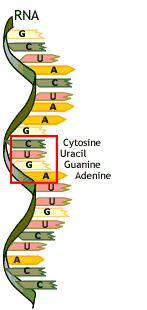
In RNA, Uracil pairs with ______.
a)
cytosine
b)
adenine
c)
guanine
d)
thymine
139.
The process to go from DNA to mRNA is _______
a)
translation
b)
transcription
c)
replication
140.
The process to go from mRNA to a protein is called ____
a)
transcription
b)
rRNA
c)
replication
d)
translation
141.
DNA holds the code for
a)
lipids
b)
carbohydrates
c)
protein
d)
sugar
142.
Choose the nucleotide sequence of the RNA strand that would be complementary to the following strand:
GTAGTCA
GTAGTCA
a)
UATUAGA
b)
ACGACTG
c)
CAUCAGU
d)
CATCAGT
143.
The main function of tRNA is to...
a)
carry a message that, when translated, forms proteins
b)
form a portion of ribosomes
c)
string together complementary RNA and DNA strands
d)
bring amino acids from the cytoplasm to the ribosomes
144.
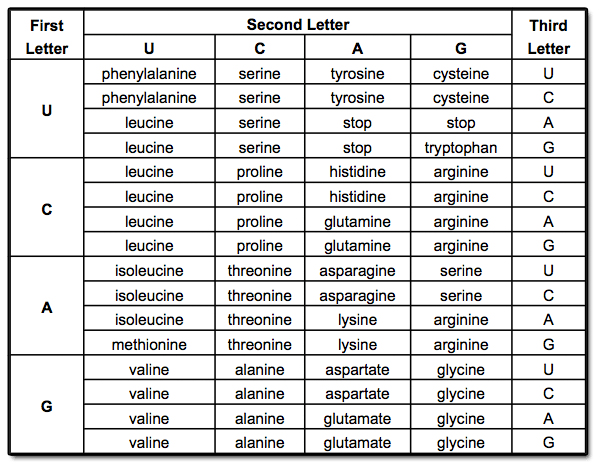
What amino acid is represented by the codon UUA?
a)
Phenylalanine
b)
Tyrosine
c)
Leucine
d)
Stop codon
145.
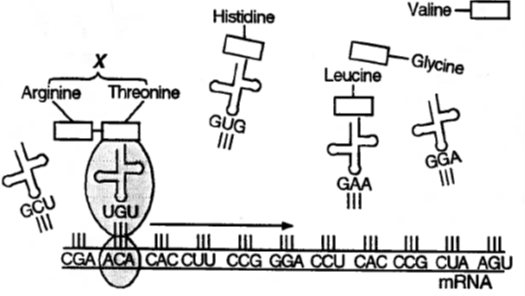
What process is going on in this photo?
a)
Transcription
b)
Translation
c)
Replication
d)
All the above
146.
Translation is the process where
a)
mRNA is created in the Nucleus
b)
mRNA is decoded to form a protein
c)
glucose molecules are made
d)
is where lipids are synthesised
147.
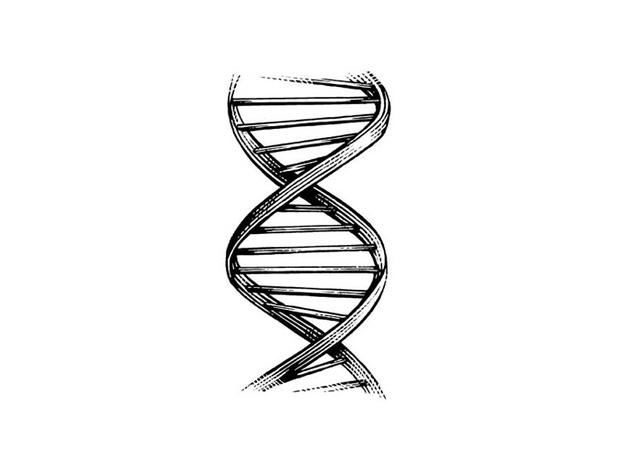
DNA has a _____________ structure.
a)
double helix
b)
single strand
c)
ring
d)
chain
148.
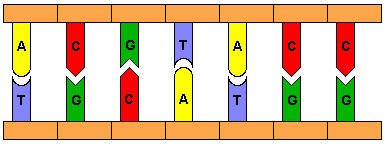
In DNA, Adenine pairs with ___________.
a)
Guanine
b)
Cytosine
c)
Thymine
d)
Uracil
149.
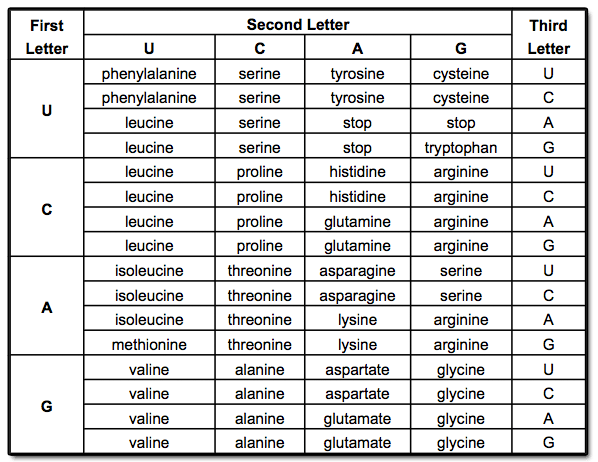
What is the correct amino acid sequence for the mRNA code AUGCCAGUAUGA
a)
Met-Pro-Ala-Val
b)
Met-Pro-Val
c)
Tyr-Gly-His
d)
Tyr-Gly-Arg-His
150.
How many amino acids are coded for by this sequence of nucleotides:
ATG GGA ACT CCA
ATG GGA ACT CCA
a)
4
b)
2
c)
6
d)
12
151.
What is the first step in protein synthesis in which DNA is used as a template to create a mRNA molecule?
a)
Transcription
b)
Translation
152.
Which nucleic acid contains the sugar deoxyribose?
a)
DNA
b)
RNA
c)
ATP
153.
What is the second step in protein synthesis in which mRNA is translated by a ribosome to create a string of amino acids (a protein)?
a)
Transcription
b)
Translation
154.
What is the location in the cell for transcription?
a)
nucleus
b)
cytoplasm
c)
ribosome
d)
mitochondria
155.
What is the location in the cell for translation?
a)
nucleus
b)
mitochondria
c)
ribosome
d)
chloroplast
156.
What is the point on mRNA at which protein synthesis begins?
a)
start codon
b)
fast triplet
c)
beginning of the strand
d)
stop codon
157.
Which nitrogen base CAN’T you use during transcription?
a)
adenine
b)
uracil
c)
cytosine
d)
thymine
100 %

