
 Worksheets
Biology PMA 3 Review-OCPS
Total questions: 155
Worksheet time: 3hrs 30mins
Name
Class
Date
1.
A rabbit with white fur was crossed with a rabbit with black fur. The cross produced offspring with black and white fur. This type of inheritance is known as
a)
dihybrid recessive
b)
dominance
c)
codominance
d)
multiple alleles
2.
The probability that a human sperm cell will carry a Y chromosome is:
a)
0%
b)
25%
c)
50%
d)
100%
3.
Which two genotypes would have the same blood type?
a)
IAIA and IAi
b)
IBIB and IAIB
c)
IBi and ii
d)
IAIA and IAIB
4.
7. A baby has type AB blood. What could the genotypes of the baby’s parents be?
a)
IAi x ii
b)
IBIB x IBIB
c)
IAIA x IBi
d)
ii x ii
5.

7. The Figure 3 pedigree shows a disease found equally in males and females and that all children who had the disease had at least one parent who also had the disease. The gene coding for the disease is
a)
autosomal recessive
b)
autosomal dominant
c)
sex-linked recessive
d)
sex-linked dominant
6.

This type of inheritance pattern is a MIXTURE of both traits.
a)
incomplete dominance
b)
co-dominance
c)
complete dominance
d)
recessive pattern
7.

This type of inheritance pattern shows BOTH traits in possible offspring
a)
complete dominance
b)
incomplete dominance
c)
co-dominance
d)
dominant pattern
8.
Snap dragon color is a incomplete dominant trait. A red flower (RR) is crossed with white flower (rr)? What color are flowers that are Rr?
a)
Red
b)
Red and White
c)
White
d)
Pink
9.

Based off this punnett square, what fraction of the offspring will have wrinkled, yellow seeds?
a)
9/16
b)
3/16
c)
1/16
d)
16/16
10.
Cross Two Homozygous plants
(RRYY x rryy)
R = round seeds, r = wrinkled seeds Y = yellow seeds, y = green seeds
What percent will have Round and Yellow seeds?
(RRYY x rryy)
R = round seeds, r = wrinkled seeds Y = yellow seeds, y = green seeds
What percent will have Round and Yellow seeds?
a)
0/16
b)
4/16
c)
8/16
d)
16/16
11.
If a colorblind male marries a woman who is a carrier, what percentage of their FEMALE children will be colorblind?
a)
0%
b)
25%
c)
50%
d)
100%
12.

An offspring will receive how many alleles from each parent to determine a specific trait?
a)
one
b)
two
c)
three
d)
five
13.
Which would be considered a somatic cell?
a)
Sperm cell
b)
Egg Cell
c)
Skin Cell
d)
All of these
14.
Which of the following would be considered a Gamete cell?
a)
Egg Cell
b)
Sperm Cell
c)
Both of these
d)
None of these
15.
Determine the phenotypic ratio of the offspring for a tall plant (Tt) crossed with a short plant (tt).
a)
100% Tall
b)
50% Tall 50%short
50% Tall 50%short
c)
50% Tt50%tt
d)
100% TT
16.
During which phase of the cell cycle, do the chromosomes become visible and the nuclear membrane starts to break down.
a)
Interphase
b)
Prophase
c)
Metaphase
d)
Anaphase
17.

Which is Metaphase?
a)
A
b)
E
c)
C
d)
F
18.

This picture shows...
a)
prophase
b)
metaphase
c)
anaphase
d)
telophase
19.
A jelly-like substance found inside a cell surrounding its organelles is
a)
cytokenisis
b)
cytoplasm
c)
mitosis
d)
epithelial
20.
The first stage of the cell cycle during which the cell matures and prepares to divide and copies its DNA; The stage the cell stays in the most
a)
interphase
b)
prophase
c)
metaphase
d)
anaphase
21.
Which of these is NOT a part of the Cell Theory?
a)
Cells sell shelly some seashells
b)
Cells are the basic unit of living things.
c)
All living things are one or more cells
d)
Cells come from cells
22.
The basic unit of life is called a (n)
a)
atom
b)
compound
c)
cell
d)
energy
23.
How many gametes are produced at the end of meiosis II?
a)
2
b)
3
c)
4
d)
8
24.
Crossing-over is an important process in meiosis cell division in that:
a)
it allows for genetic recombination within gametes found in an individual. This is why you may have blonde hair, but you mom or dad does not have blonde hair.
b)
it allows for the chromosomes to split apart during prophase I, within which they are able to pair up and design the DNA that makes up an individuals gametes.
c)
it allows for people to have many different cells that provide the structure to form new somatic cells.
d)
none of the answers are correct
25.
Sexual reproduction uses the process of meiosis to increase genetic diversity. Offspring created through asexual reproduction (mitosis) are genetically identical to their parent, but the germ cells created during meiosis are different from their parent cells.
a)
TRUE
b)
FALSE
26.
How would you be able to tell if two chromosomes were homologous?
a)
Homologous chromosomes are chromosomes that are the same. These chromosomes cross-over during anaphase I, within which the chromosomes share genetic information (DNA).
b)
Homologous chromosomes are chromosomes that are the same. These chromosomes cross-over during metaphase I, within which the chromosomes share genetic information (DNA).
c)
Homologous chromosomes are chromosomes that are the same. These chromosomes cross-over during prophase I, within which the chromosomes share genetic information (DNA).
d)
Homologous chromosomes are chromosomes that are the same. These chromosomes cross-over during prophase II, within which the chromosomes share genetic information (DNA).
27.
How many cells are produced at the end of meiosis I?
a)
one
b)
two
c)
four
d)
sixteen
28.
Which of the following events occurs in both meiosis and mitosis?
a)
prophase I - the major event is crossing-over.
b)
anaphase I - this is where the homologous chromosomes are separated.
c)
interphase - this occurs only one in both meiosis and mitosis
d)
metaphase I - This is where homologous chromosomes line up in pairs in the middle of the cell.
29.
Which of the following processes occurs only in meiosis, but not in mitosis?
a)
Interphase - this is where the cell performs cellular processes essential for life.
b)
Prophase I - Crossing-over occurs, within which the chromosomes are sharing their DNA with identical genes.
c)
Metaphase I - This is where the chromosomes line up in the middle of the cell.
d)
there is no alikeness between meiosis and mitosis.
30.
Which of the following cell divisions is responsible for cellular growth and repair?
a)
mitosis
b)
meiosis
c)
miosis
d)
myeosis
31.

Looking at the image provided on quizizz, the homologous chromosomes are performing an important process. What is the process that is occurring between the homologous chromosomes?
a)
the chromosomes found within the cell are aligned in the nucleus so they can further cell division.
b)
The chromosomes found within the cell are pairing up with other chromosomes that are similar and unalike within gene combination.
c)
The chromosomes found within the cell are pairing up with other chromosomes that are alike, and are performing a process called crossing-over.
d)
Mr. Boice has changed.
32.
Proteins are made of monomers called ___________
a)
Nucleotides
b)
Monosaccharides
c)
Amino Acids
d)
Glycerol and fatty acids
33.
_________ are composed out of carbon (C), hydrogen (H), oxygen (O), nitrogen (N), and phosphorus (P)
a)
Carbohydrates
b)
Lipids
c)
Proteins
d)
Nucleic Acids
34.
Monosaccharides are monomers of
a)
Carbohydrates
b)
Lipids
c)
Proteins
d)
Nucleic Acids
35.
Waxes, oils and fats are examples of
a)
Carbohydrates
b)
Lipids
c)
Proteins
d)
Nucleic Acids
36.

Which macromolecule is shown?
View Figure 1 (if not visible)
View Figure 1 (if not visible)
a)
lipid
b)
protein
c)
nucleic acid
d)
carbohydrate
37.
What is the function of nucleic acids?
a)
store genetic information
b)
store energy (long-term)
c)
store energy (short-term)
d)
build skin, hair, nails, muscles
38.

Which macromolecule is shown?
View Figure 2 (if not visible)
View Figure 2 (if not visible)
a)
lipid
b)
protein
c)
nucleic acid
d)
carbohydrate
39.

Which macromolecule is shown?
View Figure 3 (if not visible)
View Figure 3 (if not visible)
a)
lipid
b)
protein
c)
nucleic acid
d)
carbohydrate
40.

Which macromolecule is shown?
View Figure 4 (if not visible)
View Figure 4 (if not visible)
a)
lipid
b)
protein
c)
nucleic acid
d)
carbohydrate
41.
What type of macromolecule are enzymes?
a)
Protein
b)
Carbohydrate
c)
Lipid
d)
Nucleic Acid
42.
Which of the following organic compounds is the main source of energy for living things?
a)
carbohydrates
b)
lipids
c)
nucleic acids
d)
proteins
43.
Which macromolecule stores energy, insulates us, and makes up the cell membrane?
a)
lipids
b)
proteins
c)
carbohydrates
d)
nucleic acids
44.
Subunit is to Macrocolecule like ___ is to ____
a)
Building is to Bricks.
b)
Brick is to Building.
c)
Carpenter is to Building.
d)
Building is to Carpenter.
45.
All of the following are examples of lipids except:
a)
oil
b)
wax
c)
fatty acid
d)
cellulose
46.

What type of macromolecule is being represented in this image?
a)
carbohydrate
b)
lipid
c)
protein
d)
nucleic acid
47.

What is the building block of a lipid?
a)
monosaccharide
b)
nucleic acid
c)
fatty acid
d)
amino acid
48.

The following is a diagram of the product of protein synthesis. This protein is a chain of a certain molecule. The molecule labeled Z is most likely classified as
a)
Amino acid
b)
Polypeptide
c)
Glycerol
d)
Sugar
49.

What is the correct name of the macromolecule in the diagram below and what is its correct function?
a)
Nucleic acid/ Storage of energy
b)
Protein/ Formation of enzymes
c)
Nucleic acid/ Contains genetic information
d)
Lipid/ Water soluble membranes
50.
What are the products of photosynthesis?
a)
water and carbon dioxide
b)
oxygen and glucose
c)
oxygen and carbon dioxide
d)
oxygen and water
51.
Which statement about photosynthesis is correct?
a)
Plants get the energy they need for photosynthesis from water.
b)
Plants get the energy they need for photosynthesis from soil.
c)
Plants get the energy they need for photosynthesis from sunlight.
d)
Plants do not require energy to perform photosynthesis.
52.
The raw materials or reactants of photosynthesis are
a)
sugar and water.
b)
sugar and oxygen.
c)
carbon dioxide and water.
d)
carbon dioxide and oxygen.
53.
The main source of energy for all life comes from ____.
a)
the Earth
b)
the moon
c)
the sun
d)
the food we eat/make
54.
Where does photosynthesis occur?
a)
mitochondria
b)
stomata
c)
xylem
d)
chloroplast
55.
Which of the following is the correct equation for PHOTOSYNTHESIS?
a)
6CO2 + 6H2O --> 6O2 + C6H12O6
b)
6CO2 + C6H12O6 + 6H2O --> O2
c)
6O2 + 6H2O --> 6CO2 + C6H12O6
d)
C6H12O6 + 6O2 ---> 6H2O + 6CO2
56.
Which of the following best describes photosynthesis?
a)
Photosynthesis converts radiant energy into chemical energy.
b)
Photosynthesis produces carbohydrates.
c)
Plants need sunlight, carbon dioxide, water, nutrients, and chlorophyll to complete photosynthesis.
d)
Plants use chlorophyll, water, and carbon dioxide to make sugar.
57.
Where does cellular respiration take place in the cell?
a)
Cell Membrane
b)
Nucleus
c)
Mitochondria
d)
Vacuole
58.
What is the purpose of cellular respiration?
a)
to break down food
b)
to create energy in the body
c)
to release energy from food
d)
there is none; it's a waste of time
59.
Which plant parts are the tubes that carry water throughout the plant?
a)
xylem
b)
phloem
c)
roots
d)
leaves
60.
Which plant parts carry sugars and other nutrients throughout the plant?
a)
phloem
b)
xylem
c)
roots
d)
leaves
61.

The male part of the flower which contains the filament and anther
a)
stigma
b)
style
c)
stamen
d)
stomata
62.

Which plant part is responsible for reproduction?
a)
1 flower
b)
4 roots
c)
3 stem
d)
2 leaves
63.

Which plant part supports the plant?
a)
3 stem
b)
4 roots
c)
2 leaves
d)
1 flower
64.

#8 The tube of the female part of the flower
a)
pistil
b)
stigma
c)
style
d)
ovary
65.

#4 The bottom of the female part of the flower where eggs are developed into seeds or fruit
a)
pistil
b)
stigma
c)
style
d)
ovary
66.

#3 The eggs that are produced by the female part of the flower
a)
ovules
b)
stigma
c)
style
d)
ovary
67.

The female part of the flower that contains the stigma, style, ovary, and ovules.
a)
pistil
b)
stamen
c)
petals
d)
sepal
68.

#7 the small green leaf-like structure that contains and protects new buds
a)
petal
b)
sepal
c)
pistil
d)
stamen
69.
The Miller-Urey experiment of 1953 was designed to test the hypothesis that lightning supplied the energy needed to turn atmospheric gases into organic molecules such as amino acids. Which of the following describes why the Miller-Urey theory is widely accepted today?
a)
Amino acids spontaneously form from molecules in the atmosphere today
b)
Organic molecules are present today in extremely high concentrations
c)
The process of synthesizing organic molecules from a mixture of gases has been successfully modeled in the laboratory
d)
No other alternative hypotheses have been introduced
70.
One of the accepted scientific theories describing the origin of life on Earth is known as chemical evolution. According to this theory, which of the following events would need to occur first for life to evolve?
a)
onset of photosynthesis
b)
origin of genetic material
c)
Synthesis of organic molecules
d)
formation of the plasma membrane
71.
Which types of organisms developed first due to the early environmental conditions on Earth?
a)
prokaryotic and aerobic
b)
prokaryotic and anaerobic
c)
eukaryotic and aerobic
d)
eukaryotic and anaerobic
72.
Which principle of natural selection is stated incorrectly?
a)
Individuals in a population show variations.
b)
Variations are not inherited from parents.
c)
Organisms have more offspring than can survive on available resources
d)
Variations that increase reproductive success will be more common in the next generation.
73.
Which of the following best illustrates natural selection?
a)
An organism with favorable genetic variations will tend to survive and breed successfully.
b)
A population monopolizes all of the resources in its habitat, forcing other species to migrate.
c)
A community whose members work together utilizing all existing resources and migratory routes.
d)
The largest organisms in a species receive the only breeding opportunities
74.

The diagram illustrates an embryonic stage of two organisms. Which of the following can be determined by observing the embryos shown in the diagram?
a)
The organisms share a common ancestry.
b)
The organisms belong to the same genus.
c)
The organisms are native to the same geographic areas.
d)
The organisms will grow into anatomically similar adults
75.

Scientists have found evidence that about 2.4 million years ago a gene regulating jaw muscles mutated and may have led to the more graceful human jaw we see today. The diagram below shows the skulls of 3 hominid species. Which statement below most closely explains the link between jaw size and hominid evolution?
a)
The jaws of hominids evolved to be smaller and less protruding over time
b)
The jaws of hominids evolved to be larger and more protruding over time.
c)
There appears to be no change in the jaws of hominids over time
d)
The jaws of hominids changed over time due to a change in brain size.
76.

The scientific theory of evolution is supported by different types of evidence. The diagrams below show the skeletons of two different animal species. How does comparing the skeletons of these animals provide support for the scientific theory of evolution?
a)
It provides information about the organisms' habitats.
b)
It shows possible common ancestry between organisms
c)
It provides information to determine the organisms' ages.
d)
It shows possible chromosomal similarities between organisms
77.

Structures that have different mature forms but develop from the same embryonic tissue are called
a)
analagous
b)
adaptations
c)
homologous
d)
fossils
78.

Which rock layer most likely contains fossils of the most recently evolved organisms?
a)
1
b)
2
c)
3
d)
4
79.

According to this cladogram, sharks are MOST closely related to which organism?
a)
Amphibians
b)
Ray finned fish
c)
Crocodiles
d)
Birds
80.

which of the following is an example of a vestigial structure?
a)
the wings of a red-tailed hawk
b)
the hind limbs of a house cat
c)
the fins of sharks
d)
the wings of an ostrich
81.
Scientists think that dolphins and whales may have evolved from a common ancestor. What evidence supports this hypothesis?
a)
They swim the same way.
b)
They eat the same food.
c)
They live in the same area of the ocean.
d)
They have similar anatomies.
82.

A large population of cockroaches was sprayed with an insecticide. A few of the cockroaches survived and produced a population of cockroaches that was resistant to this spray. What can best be inferred from this example?
a)
A species will adapt no matter what the environment.
b)
The environment has no effect on the survival of an organism.
c)
Insecticides cause mutations that are passed on to the next generation.
d)
Individuals with favorable variations survive and reproduce.
83.

The experiments shown here disproved
a)
sexual reproduction
b)
homeostasis
c)
cell theory
d)
spontaneous generation
84.
According to the skittles lab, Genetic drift (bottleneck or founder) tends to ___________ genetic variation (diversity)
a)
Increase
b)
Decrease
c)
Stabilize
d)
Exaggerate
85.
Gene Flow tends to ___________ genetic variation (diversity)
a)
Increase
b)
Decrease
c)
Stabilize
d)
Exaggerate
86.
Happens only in small populations, and is the change in the frequency of a gene variant (allele) in a population due to random sampling of organisms.
a)
Extinction
b)
Genetic Drift
c)
Bottleneck Effect
d)
Founder Effect
87.
Any inherited trait that gives an organism an advantage in its environment is called ___.
a)
a mutation
b)
an adaptation
c)
evolution
d)
natural selection
88.
Which of the following means "change over time"
a)
natural selection
b)
speciation
c)
evolution
d)
isolation
89.
Which kingdom is autotrophic AND has a cell wall?
a)
Bacteria
b)
Fungi
c)
Plantae
d)
Protista
90.

You would find mushrooms in which kingdom?
a)
Plantae
b)
Protists
c)
Fungi
d)
Animalia
91.

Which kingdom do humans belong to?
a)
Plantae
b)
Fungi
c)
Animalia
d)
Protista
92.
The scientific name for an organism is made from the:
a)
class and family name
b)
genus and species name
c)
domain and kingdom name
d)
kingdom and phylum name
93.
The 8 levels of classification, most broad to most specific.
a)
Domain, Genus, Family, Order, Class, Phylum, Kingdom, Species
b)
Domain, Species, Kingdom, Genus, Phylum, Family, Class, Order
c)
Domain, Kingdom, Phylum, Class, Order, Family, Genus, Species
d)
Order, Kingdom, Species, Domain, Phylum, Family, Class, Genus
94.
Which of the following organisms are MOST closely related?
a)
organisms that share a domain
b)
organisms that share a family
c)
organisms that share a genus
d)
organisms that share an order
95.

According to this cladogram, birds are LEAST related to:
a)
Amphibians
b)
Sharks
c)
Ray Finned Fish
d)
Crocodiles
96.

Which domain is capable of living in extreme environments like hot springs, geysers, or very salty waters?
a)
Bacteria
b)
Archaea
c)
Eukarya
97.

Which domain includes all animals and plants?
a)
Archaea
b)
Eukarya
c)
Bacteria
98.

Which two kingdoms are entirely multicellular?
a)
Animalia and Plantae
b)
Animalia and Protista
c)
Protista and Plantae
99.
To say that an organism is heterotrophic means...
a)
it cannot reproduce asexually
b)
it cannot make its own food
c)
it cannot breathe oxygen gas
100.
Organisms whose cells have NO nucleus are classified as...
a)
Eukaryotic
b)
Prokaryotic
c)
Dead
101.

In the diagram strand I and II represent portions of DNA molecule. Strand II would normally include...
a)
AGC
b)
TCG
c)
TAC
d)
GAT
102.
The genetic code of a DNA molecule is determined by a specific sequence of
a)
ATP molecules
b)
sugar molecules
c)
chemical bonds
d)
molecular bases
103.

In DNA, a sequence of three bases is a code for the placement of a certain amino acid in a protein chain. The table below shows some amino acids with their abbreviations and DNA codes. Which acid chain would be produced by the DNA base sequence below:
C-A-A-G-T-T-A-A-A-T-T-A-T-T-G-T-G-A
C-A-A-G-T-T-A-A-A-T-T-A-T-T-G-T-G-A
a)
VAL-GLU-PHE-ASP-THR-ASP
b)
VAL-PRO-PHE-ASP-ASP-THR
c)
VAL-GLU-PHE-ASP-ASP-THR
d)
VAL-GLU-PHE-THR-ASP-ASP
104.
Which statement best describes a chromosome?
a)
It is a gene that has thousands of different forms.
b)
It has genetic information contained in DNA
c)
It is a reproductive cell that influences more than one trait
d)
It contains hundreds of genetically identical DNA molecules
105.

Diagram represents a portion of DNA molecule. The letters represent different types of
a)
sugar molecules
b)
molecular bases
c)
enzymes
d)
proteins
106.

Four different segments of a DNA molecule are represented below. There is an error in the DNA molecule in
a)
Segment 1 only
b)
segment 3 only
c)
Segment 2 and 3
d)
segment 2 and 4
107.
Genes for medically important proteins can be cloned and inserted into bacteria. Why can bacteria recognize a human gene and then produce a human protein?
a)
DNA replication in bacteria and humans is the same
b)
Bacterial cells contain the same organelles as human cells
c)
The basic components of DNA are the same in humans and bacteria
d)
bacterial cells and human cells contain the same kind of chromosomes
108.
A base that is present in RNA but not in DNA is
a)
Thymine
b)
Uracil
c)
Cytosine
d)
Adenine
109.

A diagram of a cellular process is shown below. Which of the following identifies the process for Y?
a)
translation
b)
transcription
c)
replication
d)
translocation
110.
Which choice describes DNA after replication has taken place
a)
one molecule with two original strands and one molecule with two new strands
b)
two molecules, each with one original and one new strand
c)
two molecules, each with two new strands
d)
two molecules, each with two old strands
111.
At what point in the cell cycle does DNA replication take place and why
a)
before the cell divides to provide each of the two resulting cells with a complete set of DNA instructions
b)
before the cell divides, to insure that the DNA will fit into the resulting cells
c)
during cell division, to ensure that the DNA will fit into the resulting cells
d)
after the cell divides, to provide each of the two resulting cells with a complete set of DNA instructions
112.
The sequence of DNA below is part of a gene. How many amino acids are coded for by this segment?
5' ATCAGCGCTGGC 3'
5' ATCAGCGCTGGC 3'
a)
4
b)
8
c)
12
d)
20
113.
Which of the following would most likely cause a mutation?
a)
the placement of ribosomes on the endoplasmic reticulum
b)
the insertion of a nucleotide into DNA
c)
the movement of tRNA out of the nucleus
d)
the release of mRNA from DNA
114.
If 20% of a DNA sequence is thymine, T, what percentage of the sample is made up of cytosine, C?
a)
15%
b)
30%
c)
35%
d)
50%
115.
A medical test indicates that a patient has a defective protein. This condition is most likely due to a change in the directions coded in the
a)
number of nitrogenous bases
b)
number of phosphate sugar molecules
c)
sequence of sugar molecules
d)
sequence of subunits of DNA
116.
Which of the following is not a concern of biotechnology?
a)
Ethics concerns with cloning humans.
b)
Health concerns about eating genetically modified foods.
c)
Concerns that we will harvest too much food for the global population.
d)
Environmental concerns of releasing genetically modified organisms into an ecosystem.
117.
What is the biggest benefit for biotechnologies being researched in North Carolina?
a)
More animals are modified in NC
b)
Less farms in NC.
c)
Fewer scientists move to NC.
d)
More jobs move to NC.
118.
Which of the following is a way in which doctors can use biotechnologies in their offices?
a)
Input genes into a patient to grow taller or run faster.
b)
Allow patients to choose what traits their babies will show when born.
c)
Doctors can predict if patients will develop a genetic disease.
d)
Doctors can give a patient new genes to pass on to their children.
119.
Which of the following lists the three goals for medical biotechnology?
a)
Diagnose, treat, prevent
b)
Treat, cure, vaccinate
c)
Cure, prevent, antibiotic
d)
Vaccine, antibiotic, anti-fungal
120.
Which of these fields are most likely related to the use of biotechnology?
a)
construction and engineering
b)
medicine and agriculture
c)
water treatment and electricity generation
d)
communication and computer technology
121.
Which is a benefit of storing the genetic information of someone who has committed a crime?
a)
Offenders will be easier for victims to identify because their information is on file.
b)
Offenders can be genetically tested to see what kind of crimes they might commit in the future.
c)
Offenders can be more easily identified by their genetic information if they commit another crime.
d)
Offenders can have their DNA altered so they are less likely to commit crimes in the future.
122.
What factor describes when populations decrease because animals are moving out of a population?
a)
Emigration
b)
Limiting Factors
c)
Immigration
d)
Exponential Growth
123.
What factor describes when populations increase because animals are moving into a population?
a)
Emigration
b)
Limiting Factors
c)
Immigration
d)
Exponential Growth
124.
Human population grew exponentially after the industrial revolution. Which of the following DOES NOT help determine patterns in human population growth?
a)
age structure
b)
births
c)
deaths
d)
limiting factors
125.
A population is...
a)
A group of one species in one area
b)
Multiple species that live in one area
c)
All of the living and nonliving things in an area
d)
None of these
126.

What is the carrying capacity of the following graph?
a)
1000
b)
8000
c)
800
d)
600
127.

All of the living and nonliving things in an area that interact with each other are called a/an ______.
a)
community
b)
habitat
c)
population
d)
ecosystem
128.
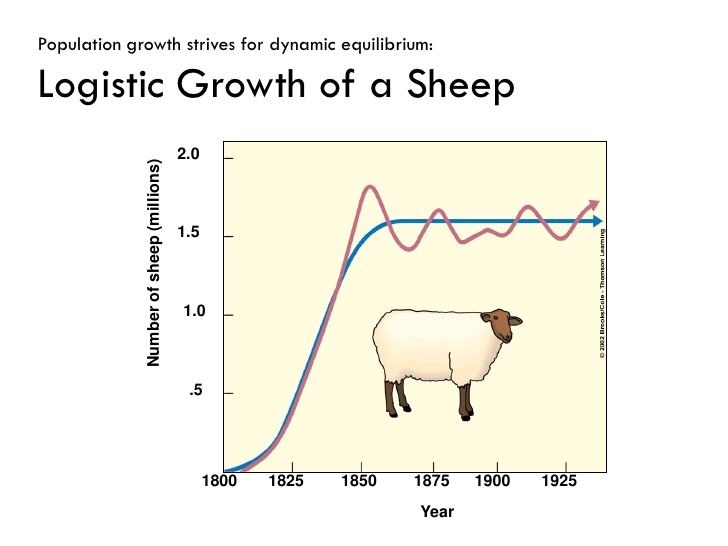
What is the carrying capacity for this sheep population?
a)
1.8 million
b)
1.25 million
c)
1.6 million
d)
1.o million
129.
Temperature, sunlight, and water are examples of _______ factors.
a)
biotic
b)
abiotic
130.
Food, predators, mates are examples of _______ factors.
a)
biotic
b)
abiotic
131.
If a population grows larger than the carrying capacity of the environment, the
a)
death rate may rise
b)
birth rate may rise
c)
death rate must fall
d)
birth rate must fall
132.
All of the following are limiting factors EXCEPT
a)
immigration
b)
competition
c)
drought
d)
predation
133.
If the number of births in a population is the same as the number of deaths in a population, what will happen to the growth of the population?
a)
It will increase.
b)
It will decrease.
c)
It will stay the same.
d)
It will fluctuate.
134.
Which level is a food web has the most available energy?
a)
Secondary consumers
b)
Decomposers
c)
Producers
d)
Primary consumers
135.

If all of the mice died in this energy pyramid, which organisms would be affected?
a)
The snakes and the eagles
b)
All of the organisms would be affected in some way.
c)
Only the omnivores
d)
Only the eagle
136.

According to the energy pyramid, the organism that obtains the least energy is the ___
a)
Garter Snake
b)
Field Mouse
c)
Red-tailed Hawk
d)
Alfalfa
137.

What does this diagram display?
a)
The predator-prey relationship between vertebrates
b)
The movement of energy throughout an ecosystem
c)
The changing types of organisms in a forest
d)
The standard lifespan of trees and animals
138.

The grass that the mice eat contains energy. what is the source of energy for the grass?
a)
Rainwater
b)
The Sun
c)
The soil
d)
Minerals
139.

Which species most likely has the largest population?
a)
Herring
b)
Plankton
c)
Shrimp
d)
Shark
140.
Which of the following is NOT considered a natural/renewable resource?
a)
Wind
b)
Water
c)
Oil
d)
Sunlight
141.
Which of the following is a result of greenhouse gases?
a)
Less Pollution
b)
Global Warming
c)
Clean Air
d)
Energy
142.
Which of the following does not contribute to your ecological Carbon Footprint?
a)
Washing laundry
b)
Riding in a car to school
c)
Riding your bike to school
d)
Eating at a restaurant
143.
Fossil fuels are an important natural resource used by society. Which of the following best describes fossil fuels?
a)
They are any liquid fuel derived from once-living matter.
b)
They are organic fuels derived from ancient plants and animals.
c)
They are fuels in which dinosaur fossils are commonly found.
d)
They are naturally occurring inorganic fuels like coal and petroleum.
144.
The natural resources used by society are limited by various factors. Why is coal considered a nonrenewable resource?
a)
Once coal is used up, it can never be replaced.
b)
Coal is a nonrenewable resource, because it comes from the impact of meteors with the Earth
c)
Coal was a renewable resource, until it was mismanaged by humans
d)
Coal is considered a nonrenewable resource, because it takes millions of years to form
145.

Which process is shown?
a)
diffusion
b)
repiration
c)
recombination
d)
translation
146.

If there is 1000 Kcal available in the producers in trophic level 1, how much energy is available in the herbivores in trophic level 2?
a)
10 Kcal
b)
1 Kcal
c)
100 Kcal
d)
1000 Kcal
147.
In an energy pyramid, energy_______ as you move up the pyramid.
a)
Increases
b)
Decreases
c)
Stays the same
d)
Changes up and down
148.

Interpret the graph to correctly complete the following statement. When the lynx population increases _
a)
the hare population increases.
b)
the hare population decreases
c)
the hare population stays the same.
149.

plants and animals that have migrated to areas where they are not native; often displace native species by out-competing them for resources
a)
predators
b)
biological magnification
c)
invasive (non-native) species
d)
prey
150.

What traits do crocodiles and amphibians have in common?
a)
Vertebrae and hair
b)
Four limbs and amniotic eggs
c)
Bony skeleton and vertebrae
d)
Amniotic eggs and hair
151.
Which of the following activities contributes the most to carbon emissions globally?
a)
Deforestation
b)
Agriculture
c)
Burning fossil fuels
d)
Respiration
152.
Carbon is released into the atmosphere through all of the following ways except:
a)
respiration
b)
cow flatulence
c)
photosynthesis
d)
all of the above
153.
What is biodiversity?
a)
The variety of species used for food sources
b)
The variety of exotic species
c)
The variety of extinct species
d)
the variety of life in the world or in a particular habitat or ecosystem.
154.
Where are proteins made?
a)
Golgi body
b)
Mitoichondria
c)
Chromosomes
d)
Ribosomes
155.
Similar arm bones in a human and the wings of birds are considered
a)
homologous structures
b)
analogous structures
c)
fossils
d)
vestigals
100 %

