wayground logo

Free Printable Worksheets

NEW

Font size

S
M
L
XL
Worksheets

NHS Physics MCAS Review Game

Total questions: 75

Worksheet time: 2hrs 16mins

Name
Class
Date
1.
The momentum of an object depends upon the object's ___________&_____________.  
a)
size and shape
b)
mass and veloctiy
c)
mass and energy
2.
In any collision (crash) the ______ is ALWAYS constant
a)
total momentum
b)
total speed
c)
total velocity
3.
A Falling Object has what kind of energy?
a)
Kinetic Energy
b)
Potential Energy
c)
Kinetic Energy and Potential Energy
d)
Neither
4.
Find the Kinetic Energy of a 20 kg mass moving at a speed of 2 m/sec
a)
40 J
b)
40 m/sec
c)
40 kg
d)
50 J
5.
If an action force is a golf club hitting a golf ball, then the reaction force is
a)
exerted on the golf ball
b)
exerted on the golf cart
c)
exerted on the golf club by the golf ball
d)
exerted by the squirrel that is hiding in the tree
6.
The momentum of a truck traveling in a straight line at 25 m/s is 37,500 kg m/s. What is the truck's mass? 
a)
937,500 kg
b)
937,500 N
c)
1,500 N
d)
1,500 kg
7.
A car starts from rest and accelerated to 30 m/s in 3 seconds. What was its rate of acceleration?
a)
0.1 m/s2
b)
10 m/s2
c)
90 m/s2
d)
33 m/s2
8.
What type of motion is this? (pay attention to axis)
a)
At rest
b)
Constant velocity
c)
Constant acceleration
9.

What type of motion is this (pay attention to y-axis).

a)

At rest

b)

Constant velocity

c)

Constant acceleration

10.
A Physics book has a mass of 2 kg. How much does it weigh on Earth?
a)
0.2 N
b)
2 N
c)
20 N
11.
If the net force on an object is zero, the object has no:
a)
Velocity
b)
Acceleration
c)
Weight
d)
Motion
12.
What is the net force?
a)
17 N Right
b)
3 N Right
c)
3 N Left
d)
17 N Left
13.
What does this graph represent?
a)
Constant speed
b)
Acceleration
c)
Not moving
d)
Turning around
14.
Which car is accelerating?
a)
A car that is not moving
b)
A  car that rounds a curve at a constant speed
c)
A car traveling at a constant speed 
d)
A car that has a set speed of 60mph
15.
A force exerted over a distance to move an object is ______________________.
a)
power
b)
work
c)
momentum
d)
Watt
16.
A 5000N block is lifted 10 m. How much work was done?
a)
50000 J
b)
5000 J
c)
500 J
d)
50 J
17.

Which is an example of doing work?

a)

pushing a wall

b)

holding a box

c)

picking up a pencil

d)

sitting in a chair

18.
A ball will be rolled four times. In which of the following situations will some of the kinetic energy of the ball be converted into potential energy as the ball rolls?
a)
A
b)
B
c)
C
d)
D
19.
The graph below shows the motion of four different bicyclists during a one-hour bicycle ride. Based on the graph, which bicyclist traveled at a constant speed during the entire ride?
a)
R
b)
S
c)
T
d)
U
20.
What is happening in this graph from point B to C?
a)
The object is going down a hill.
b)
The object is returning to its starting location.
c)
The object is slowing down.
d)
The object is staying still.
21.
Your teacher has walked from the physics room around the entire school and back to the same spot in the physics room. Your teacher’s displacement is 
a)
The perimeter of the school
b)
Zero
c)
Less than Zero
d)
More than Zero
22.
An object is stationary.  What do you know about its energy?
a)
It has PE because it is not moving
b)
It has KE because it is not moving
c)
KE = 0 J   because it is not moving
d)
It has KE and PE
23.
How much force would it take to accelerate a 5 kg box at a rate of 10 m/s²?
a)
2 N
b)
0.5 N
c)
15 N
d)
50 N
24.
The diagram below shows the top view of two carts with different masses on a frictionless surface. The carts are pushed from rest, and they reach the finish line at the same time. Which of the following statements describes and explains the forces applied to the carts?
a)
Equal force is required to push the carts because they move on a frictionless surface.
b)
Equal force is required to push the carts because they reach the finish line at the same time
c)
A greater force is applied to cart Y because it accelerates at the same rate as cart Z but has less mass.
d)
A greater force is applied to cart Z because it accelerates at the same rate as cart Y but has more mass.
25.
A 10kg toy truck moves at 5m/s East. It collides head-on with a 5kg toy car moving 10 m/s moving west. What is the total momentum of the system?
a)
0 kgm/s
b)
30 kgm/s
c)
50 kgm/s
d)
10 kgm/s
26.
If a girl has a mass of 20 kg, and is at a height of 30 m. What is her potential energy?
a)
500 J
b)
6000 J
c)
600 J
d)
50 J
27.
Two ships orbit the same planet as shown in the image.  Ship B orbits at a distance twice that of A.  Which ship feels the greater gravitational force with the planet?
a)
A
b)
B
c)
Both ships feel the same force.
28.
When a glass rod is rubbed with silk and the glass rod becomes positively charged, what happens to the electrons?
a)
they are removed from the rod
b)
they are added to the rod
29.
An atom loses an electron.  What type of charge does it have now?
a)
positive
b)
negative
30.
When the distance between two charges is halved, the electrical force between the charges
a)
quadruples
b)
reduces to one fourth
c)
halves
d)
doubles
31.
This is an example of a _______ circuit
a)
open
b)
series
c)
parallel
d)
square
32.
If the voltage across the battery was 10V in this diagram. What would the voltage across each bulb be?
a)
10V
b)
5V
c)
20V
d)
0V
33.
If the current coming out of the battery is 10 A, and the current through the top bulb is 3 A, then what will the current be in the second bulb?
a)
10 A
b)
3 A
c)
7 A
d)
5 A
34.
If the current through the battery was 10A in this diagram. What would the current through each bulb be?
a)
10A
b)
5A
c)
20A
d)
0A
35.
If the battery is a 12 V battery, and the left light bulb has a 7 V drop, then what is the voltage drop of the right light bulb?
a)
12 V
b)
7 V
c)
5 V
d)
6 V
36.
If switch 1 is closed (on), switch 2 is closed (on), and switch 3 is open (off), what will happen?
a)
Light bulb 1 will light up, but light bulb 2 will not light up
b)
Light bulb 2 will light up, but light bulb 1 will not light up
c)
Neither light bulb will light up
d)
Both light bulbs will light up
37.
Temperature is proportional to:
a)
Transfer of heat from a warmer object to a cooler object
b)
Heat
c)
 The average kinetic energy of the particles of a substance 
d)
The total energy in a substance
38.
Calculate the heat needed to raise the temperature of 0.25 kg of aluminum 7°C (c=900 J/kg°C)
a)
1575 J
b)
-1575 J
c)
514 J
d)
-514 J
39.
Which of the following is the best conductor?
a)
Wood
b)
Iron
c)
Styrofoam
d)
Plastic
40.
When mixing hot water and room temperature water,
a)
hot water absorbs and the room temperature water releases
b)
hot water releases and the room temperature water absorbs
c)
both of the waters absorb energy
d)
both of the waters release energy
41.
What is the term used in calorimetry when the temperature of the system no longer changes?
a)
Heat
b)
Thermal Energy
c)
Thermal Equilibrium
d)
Temperature
42.
As the temperature decreases the average kinetic energy of the molecules will
a)
Increase
b)
Decrease
c)
Remain the same
43.
Answer?
a)
brass
b)
silver
c)
iron
d)
aluminum
44.
Which of the following has the greatest average kinetic energy?
a)
4.5 kg of aluminum 45 °C
b)
6.5 kg of gold at 65 °C 
c)

75 kg of iron at -50 ºC

d)

100 kg of air at -100 ºC

45.
Heating a pan on a stove is primarily an example of 
a)
conduction
b)
convection
c)
radiation
46.
When food heats up in a microwave, it is primarily an example of ______________.
a)
conduction
b)
convection
c)
radiation
47.
Based on the heating curve, what is the melting point of the substance?
a)
0°C
b)
100°C
c)
Between 0°C and 100 °C
48.
When water heats up in a pot on a stove through currents is an example of 
a)
conduction
b)
convection
c)
radiation
49.
Based on the heating curve, when is(are) the potential energy of the substance changing?
a)
A & E
b)
C & E
c)
B & D
d)
A & B
50.
Based on the heating curve, when is(are) the kinetic energy of the substance changing?
a)
A & C
b)
C & E
c)
B & D
d)
A, C, E
51.
A wave that requires a medium through wave which to travel
a)
electromagnetic  wave
b)
longitudinal wave
c)
mechanical wave
d)
transverse wave
52.
A wave that does not require a medium
a)
electromagnetic  wave. 
b)
surface wave
c)
medium
d)
transverse wave
53.
A wave in which the particles of the medium move perpendicularly to the direction the wave is traveling
a)
surface wave
b)
transverse wave
c)
electromagnetic  wave
d)
longitudinal wave
54.
A wave in which the particles of the medium vibrate parallel to the direction of the wave motion
a)
mechanical wave
b)
surface wave
c)
longitudinal wave
d)
wave
55.

Which of these activities would NOT be possible for an astronaut floating outside their space station?

a)

Playing drums for another astronaut to hear.

b)

Waving "hello" to another astronaut.

c)

Taking an X-Ray image with a portable X-Ray machine.     

d)

Shining a flashlight at another astronaut.

56.
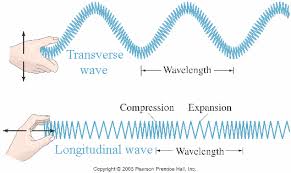
What type of wave is this?
a)
Medium
b)
Transverse
c)
Longitudinal
57.
What type of wave is this?
a)
Longitudinal
b)
Medium
c)
Transverse
58.
Why is sound able to travel faster through a solid than a gas?
a)
Gas molecules are packed tightly.
b)
Sound does not travel faster through a solid than a gas.
c)
Solid molecules are packed tightly.
d)
Gas molecules move slowly.
59.
Sound waves are ALWAYS what type of wave?
a)
Transverse
b)
Longitudinal 
c)
Depends 
d)
always different
60.
The electromagnetic wave with the longest wavelength is
a)
microwave
b)
radio
c)
gamma
d)
visible light
61.
If the wave speed is constant, and if the wavelength increases the frequency will
a)
increase
b)
decrease
62.

All electromagnetic waves travel at

a)

different speeds

b)

the speed of sound

c)

the speed of light, c = 3 x 10⁸ m/s

d)

the speed of a vacuum

63.

Predict which electromagnetic wave could cause more damage

a)

Radio wave

b)

UV wave

c)

X-ray

d)

Gamma ray

64.

Which of these lists the electromagnetic waves from lowest to highest frequency?

a)

Radio - Micro - Gamma - Visible light - UV - Xrays - Infrared - Xrays

b)

Radio - Micro - Infrared - Visible light - UV - X ray - Gamma waves

c)

Gamma - Xray - UV - Visible light - Infrared - Micro - radio

65.
What is the wavelength of a wave traveling at 45 m/s with a frequency of 2000 Hz?
a)
0.0225 m
b)
44.4 m
c)
90,000 m
d)
90 m
66.
Which vocabulary term is used to identify the distance between points C & G?
a)
Amplitude
b)
Crest
c)
Frequency
d)
Wavelength
67.
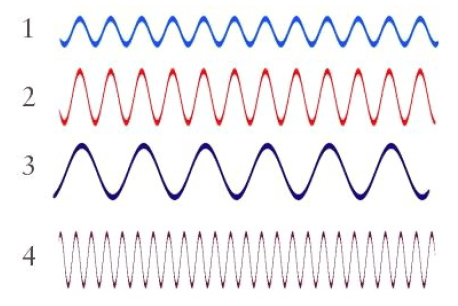
Which wave in the diagram has the greatest frequency?
a)
1
b)
2
c)
3
d)
4
68.
What property of waves stays constant during refraction?
a)
frequency
b)
wavelength
c)
speed
d)
amplitude
69.
According to the Law of reflection, a light ray striking a mirror
a)
continues moving through the mirror in the same direction
b)
moves into the mirror at a slightly different angle
c)
bounces off the mirror toward the direction it came from
d)
bounces off the mirror at the same angle it hits.
70.
When light travels from air to glass, it bends toward the normal line because light travels (faster/slower) in glass than in air.  This "bending" is called ______.
a)
faster; refraction
b)
faster; reflection
c)
slower; refraction
d)
slower; incidence
71.
Which of the following forces allow a battery-powered motor to generate mechanical energy?
a)
magnetic and static
b)
electric and magnetic
c)
static and gravitational
d)
electric and gravitational
72.
The diagram shows a bar magnet within a coil of conducting wire.  The magnet moves back and forth and never has contact with the wire.  As the magnet is moved, the wire will
a)
decrease in temperature.
b)
become negatively charged.
c)
demagnetize the bar magnet.
d)
have an electric current.
73.

Which of the concepts listed below make it possible for Jack to hear Jill in the image?

a)

Thermal Equilibrium

b)

Photoelectric Effect

c)

Resonance

d)

Diffraction

74.

In the Photoelectric Effect, electrons in a metal absorb particles of light, called __________.  If the particles of light have a high enough frequency, electrons would escape from the metal with ___________.

a)

photons;  kinetic energy

b)

protons;  kinetic energy

c)

photons;  potential energy

d)

neutrons;  potential energy

75.

Some atomic nuclei can be split apart into fragments and other particles, such as neutrons. Once a nucleus is split, fragments move away from each other very quickly. What type of nuclear process occurs when an atomic nucleus splits into fragments, as shown in the image?

a)

Fusion

b)

Fission

c)

Beta Decay

d)

Gamma Decay