Wayground logo

Free Printable Worksheets

Font size

S
M
L
XL
Worksheets

Science Final Exam Review Grade 7

Total questions: 60

Worksheet time: 31mins

Name
Class
Date
1.
Distance divided by time is the formula for
a)
acceleration
b)
speed
c)
gravity
2.

This force opposes motion between objects that are touching (slows things down):

a)
gravity
b)
speed
c)
friction
3.
A change in speed, velocity, and direction
a)
speed
b)
acceleration
c)
stopping
4.
A push or pull, that can cause an object to move or slow down
a)
mass
b)
friction
c)
force
5.
The upward force of the air on an object
a)
air resistance
b)
free fall
c)
speed
6.
Tendency of an object to resist a change in motion  (causes you to slide when a car makes a sharp turn)
a)
free fall
b)
inertia
c)
fluidity
7.

Unit for energy

a)
Watt
b)
Newton
c)
Joule
8.
An object in motion has this type of energy
a)
kinetic
b)
potential
c)
active
9.
When energy changes from one form to another, it is an energy
a)
solution
b)
radiation
c)
conversion
10.
Used to measure temperature
a)
thermometer
b)
scale
c)
ruler
11.
Unit used to measure mass
a)
gram
b)
Liter
c)
meter
12.
Unit used to measure length
a)
meter
b)
Liter
c)
gram
13.
This is used to display data
a)
balance
b)
spring scale
c)
graph
14.
Unit used to measure force
a)
Joule
b)
Newton
c)
Watt
15.
The procedure scientists use to solve problems
a)
Scientific Method
b)
Observations
c)
Guessing
16.
Prediction or statement that can be tested (educated guess)
a)
hypothesis
b)
summary
c)
problem
17.
On the periodic table the elements are listed by increasing
a)
density
b)
atomic mass
c)
atomic number
18.
The three parts to an atom are the protons, neutrons, and
a)
energy levels
b)
electrons
c)
shells
19.
In an atom, the electrons are located
a)
in the nucleus
b)
paired with neutrons
c)
outside of the nucleus (in the electron cloud)
20.
If an atom has 13 protons, 13 electrons, and 15 neutrons, the mass number is
a)
24
b)
26
c)
28
21.
These are located between the metals and nonmetals on the periodic table
a)
metalloids
b)
halogens
c)
noble gases
22.
A horizontal row in the Periodic Table (left to right) is called a
a)
special row
b)
group
c)
period
23.
The relationship between force, mass and acceleration is described in Newton's
a)
First Law
b)
Second Law
c)
Third Law
24.
Kinetic energy is ________ motion.
a)
energy of
b)
work when you are in
c)
the total amount of
25.
Which of the following does NOT reduce friction?
a)
oil
b)
grease
c)
cotton
26.
The water droplets that form on your mirror after a hot shower are the result of
a)
evaporation
b)
condensation
c)
melting
27.
Forces that are equal in size but opposite in direction are called
a)
unbalanced forces
b)
balanced forces
c)
uneven forces
28.
Distance is measured in
a)
meters
b)
Liters
c)
grams
29.
This is a fossil fuel
a)
biomass
b)
oil
c)
solar energy
30.
These are renewable resources EXCEPT:
a)
wind and solar energy
b)
manure, plants, trees
c)
oil
31.
What kind of energy is stored in a stretched rubber band?
a)
kinetic energy
b)
active energy
c)
potential energy
32.
who is that pokemon
a)
hephop
b)
Victini
c)
Charmander
d)
loved
33.

It takes you 10 minutes to drive 20 miles to the mall. What can you find with the information given?

a)

speed

b)

acceleration

c)

force

34.

A nail gets rusty in the rain. What type of change did the nail go through?

a)

physical change

b)

chemical change

c)

there was no change

35.

The relationship between force, mass and acceleration is described by which one of Newton's 3 Laws? (F = ma)

a)

Newton's First Law

b)

Newton's Second Law

c)

Newton's Third Law

36.

Which of the following is a fossil fuel?

a)

plants

b)

trees

c)

oil

37.

The procedure that scientists use to solve problems is called the:

a)

Scientific Method

b)

Guess and Test Method

c)

Outline Method

38.

An educated guess is a

a)

problem

b)

answer

c)

hypothesis

39.

A 20 kg toy wagon accelerates at a rate of 15 m/s/s. What is the force? (F = ma)

a)

5 Newtons

b)

35 Newtons

c)

300 Newtons

40.

At room temperature, most metals are:

a)

solids

b)

liquids

c)

soft

41.

Melting chocolate, cutting your hair, and carving wood are all examples of:

a)

chemical changes

b)

physical changes

c)

irreversible changes

42.

Solar, wind and geothermal energy are all examples of renewable resources.

a)

true

b)

false

43.

Velocity describes speed in a particular:

a)

direction

b)

acceleration

c)

force

44.

Scientific experiments help to solve problems, find answers, collect data, and support hypotheses.

a)

true

b)

false

45.
What is the unit to MEASURE force?
a)
Kilogram
b)
Meter
c)
Pascal
d)
Newton
46.
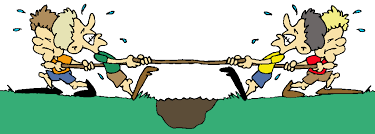
If these teams are pulling with the same amount of force what will happen?
a)
The boy in blue will win.
b)
They will not move at all.
c)
The boy in red will win.
d)
Both will fall down.
47.

The measure of the gravitational force on an object is:

a)

length

b)

mass

c)

weight

d)

volume

48.

If a block of wood is floating in water, its density is:

a)

less than 1.0 g/cm3

b)

greater than 1.0 g/cm3

c)

exactly 5.0 g/cm3

49.

What determines where an element is placed on the Periodic Table?

a)

its density

b)

its atomic number

c)

its atomic mass

d)

its chemical symbol

50.

Information that we gather using our senses is:

a)

an inference

b)

an opinion

c)

an observation

d)

logical reasoning

51.

If a rock is sitting high on a cliff and you are about to kick it off, which of the following is true?

a)

It has the highest potential energy

b)

It has the lowest potential energy

c)

It has the highest kinetic energy

d)

it has no energy

52.

If you kick a rock off of a cliff and it begins to fall, its potential energy changes to:

a)

kinetic energy

b)

chemical energy

c)

light energy

d)

sound energy

53.

Which of the following is an observation?

a)

My chihuahua is black and white.

b)

She is really angry today.

c)

He likes math the best.

d)

It is cloudy so it will rain.

54.

An object with more mass has _____ momentum than an object with less mass.

a)

less

b)

the same

c)

more

55.

A salad is what type of mixture?

a)

homogeneous mixture

b)

heterogeneous mixture

56.

What do we use to find the volume of an irregular object, such as a rock?

a)

triple beam balance

b)

graduated cylinder

c)

metric ruler

57.

In science class, what tool do we use to measure the weight of an object?

a)

spring scale or newton-meter

b)

triple beam balance

c)

calibrated scale

58.

What is the mass of this object?

(a)  

59.

An irregular shaped object was placed in a graduated cylinder. The initial volume was 50mL. The final volume was 75mL. What is the volume of the irregular shaped object?

a)

25mL

b)

125mL

c)

75mL

d)

50mL

60.

What is the volume of the liquid in the graduated cylinder ?

(a)