
 Worksheets
Unit #1: Matter and Bonding
Total questions: 25
Worksheet time: 20mins
Name
Class
Date
1.
What is the name for an ion with a positive charge?
a)
Anion
b)
Cation
c)
Dogion
d)
Ion
2.
What is the name for an ion with a negative charge?
a)
Anion
b)
Cation
c)
Dogion
d)
Ion
3.
What is the name for sulfur after it gains two electrons?
a)
Sulfur ion
b)
Sulfate
c)
Sulfide
d)
Sulfite
4.
Predict the bond that will form between Be and F.
a)
Ionic
b)
Covalent
5.
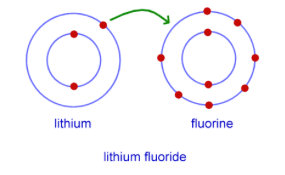
What type of bond is this?
a)
ionic
b)
covalent
6.
Each column in the periodic table is called a
a)
period
b)
group
c)
cluster
d)
unit
7.
In the modern periodic table elements are arranged by:
a)
atomic mass
b)
atomic number
c)
valence electrons
d)
number of isotopes
8.

The yellow coloured elements are called
a)
metals
b)
nonmetals
c)
metalloids
d)
noble gases
9.
Which of the following will have the highest electronegativity?
a)
Carbon (C)
b)
Neon (Ne)
c)
Antimony (Sb)
d)
Germanium (Ge)
10.
Which of the following will have a lower ionization energy than Scandium (Sc)?
a)
Helium (He)
b)
Titanium (Ti)
c)
Calcium (Ca)
d)
Magnesium (Mg)
11.
Which atom has the largest atomic radius?
a)
potassium
b)
rubidium
c)
francium
d)
cesium
12.
Electronegativity is...
a)
how good an atom is at attracting electrons
b)
the ability of an atom to lose electrons
c)
the energy required to remove an electron from a specific atom
d)
how easy it is to make friends.
13.
Metals have the largest -
a)
atomic radius and electronegativity
b)
electronegativity and ionization energy
c)
atomic radius only
d)
ionization energy and atomic radius
14.
Which elements have the most similar chemical properties?
a)
K and Na
b)
K and Ca
c)
K and Cl
d)
K and S
15.
Which group of the periodic table is composed of inert (not reactive) gases?
a)
alkali metals
b)
alkaline earth metals
c)
halogens
d)
noble gases
16.

This is the correct dot diagram for sodium (Na)
a)
true
b)
false
17.

This is a correct dot diagram for oxygen (O)
a)
true
b)
false
18.

This is a correct dot diagram for nitrogen (N)
a)
true
b)
false
19.
What explains the very high melting and boiling point of water
a)
Strong dipole-dipole bonds between water molecules
b)
Strong hydrogen bonds between water molecules
c)
Dispersion forces which are present in all molecules
d)
Asymmetrical shape of the polar bonds.
20.
Does H2S have hydrogen bonding?
a)
yes
b)
no
21.
Does CH4 have hydrogen bonding?
a)
yes
b)
no
22.
All molecules have London forces between them, but dipole-dipole and hydrogen bonding are so much stronger that when they are present we can ignore London forces. Which of these has ONLY London forces?
a)
I2
b)
NH3
c)
OCl2
d)
SH2
23.
Molecular compounds do not conduct electricity because they:
a)
break up into ions
b)
do not break up into ions
c)
do not dissolve in water
d)
have high melting points
24.
An element's identity is determined by the number of
a)
electrons.
b)
protons.
c)
neutrons.
d)
valence.
25.
Metalloids can be described as...
a)
same as nonmetals
b)
bad conductors
c)
characteristics of metals and nonmetals
d)
same as metals
100 %

