
 Worksheets
2- Chemistry of Life (thru lipids review)
Total questions: 25
Worksheet time: 19mins
Name
Class
Date
1.

These particles orbit around the nucleus of an atom. What are they called?
a)
electrons
b)
protons
c)
neutrons
d)
photons
2.

What are the names of the particles in the nucleus?
a)
protons and neutrons
b)
protons and electrons
c)
photons and neutrons
d)
nucleons and protons
3.

The protons and neutrons are inside of the nucleus, and contain almost all of _____
a)
the charge of the atom
b)
the volume of the atom
c)
the mass of the atom
d)
the kinetic energy of the atom
4.

The mass number identifies the specific _____
a)
state of an element
b)
element
c)
number of protons
d)
weight of an element
5.

The sum of the number of protons and the number of neutrons is called the _____
a)
atomic number
b)
mass number
c)
isotope number
d)
average weight
6.

In the Bohr model of the atom, what is the maximum number of electrons in the first shell?
a)
1
b)
2
c)
6
d)
8
7.
REVIEW: ____ represents a formula for a chemical compound.
a)
H2O
b)
O2
c)
C6
d)
P
8.
What might happen if you mixed a strong acid with an equally strong base?
a)
You would see an explosive chemical reaction.
b)
The acid would destroy the base.
c)
The base would destroy the acid.
d)
You'd wind up with a pH-neutral substance.
9.
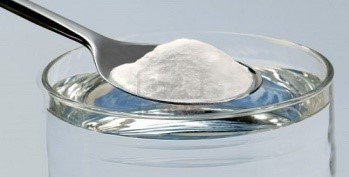
In this mixture, which of the following will be the solute?
a)
The water in the glass
b)
The glass that holds the final mixture
c)
The solution containing both powder and water
d)
The powder on the spoon
10.
The pH scale is a range from:
a)
1-7
b)
0-14
c)
1-14
d)
1-20
11.
A(n) ______ is a substance with a pH less than 7
a)
Acid
b)
Alkaline
c)
Base
d)
Buffer
12.

According to the pH range which substance is more acidic than lemon juice
a)
Hydrochloric acid
b)
cabbage
c)
milk
13.
Proteins are made of monomers called ___________
a)
Nucleotides
b)
Monosaccharides
c)
Amino Acids
d)
Glycerol and fatty acids
14.
Monosaccharides are monomers of
a)
Carbohydrates
b)
Lipids
c)
Proteins
d)
Nucleic Acids
15.
Glycerol and fatty acids are the monomers of
a)
Carbohydrates
b)
Lipids
c)
Proteins
d)
Nucleic Acids
16.

Which macromolecule is shown?
View Figure 1 (if not visible)
View Figure 1 (if not visible)
a)
lipid
b)
protein
c)
nucleic acid
d)
carbohydrate
17.
Which of the following organic compounds is the main source of short term energy for living things?
a)
carbohydrates
b)
lipids
c)
nucleic acids
d)
proteins
18.
Lipids are made of...
a)
C H O
b)
C H O N
c)
C H O N P
d)
C H O N S
19.
Which macromolecule stores energy, insulates us, and makes up the cell membrane?
a)
lipids
b)
proteins
c)
carbohydrates
d)
nucleic acids
20.
What property of water molecules causes surface tension and cohesion?
a)
Covalent bonds
b)
Bent shape
c)
All non-metal atoms
d)
Polarity
21.
What word refers to "like" particles sticking together.
a)
Cohesion
b)
Covalent
c)
Cooperation
d)
Surface tension
22.
What word refers to "different" particles sticking together
a)
cohesion
b)
adhesion
c)
hydrogen
d)
vanderwalls
23.
Which of the following organic compounds is the main source of long term energy for living things?
a)
carbohydrates
b)
lipids
c)
nucleic acids
d)
proteins
24.
What is NOT an example of a lipid?
a)
fats
b)
waxes
c)
phospholipid
d)
starch
25.
Which of the following is a source of carbohydrates?
a)
rice
b)
chicken
c)
peas
d)
oranges
100 %

