
 Worksheets
Bio-U3 Post
Total questions: 20
Worksheet time: 10mins
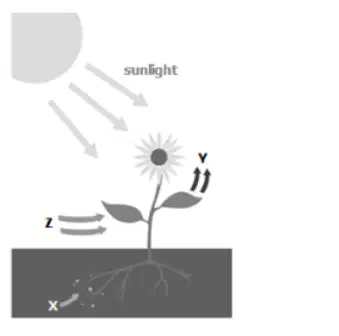
Examine the life process that requires sunlight. What molecule is represented by the letter X?
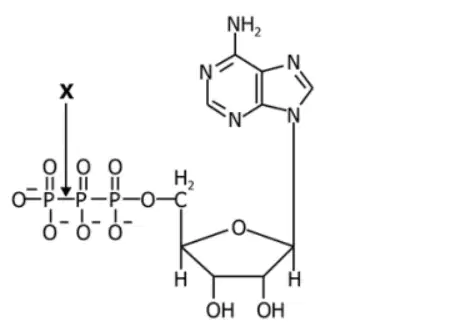
Examine the diagram of a molecule of ATP. What is the significance of breaking the bond at point X?
It forms the carbohydrates needed by cells for energy.
It creates the molecules that are the basic units of nucleic acids
It releases energy for cells to use in carrying out life activities.

Examine the chemical equation. What chemical reaction is represented?
aerobic respiration
anaerobic respiration
fermentaTION
Which product is common to both aerobic and anaerobic processes of cellular respiration?
ATP
alcohol
lactic acid
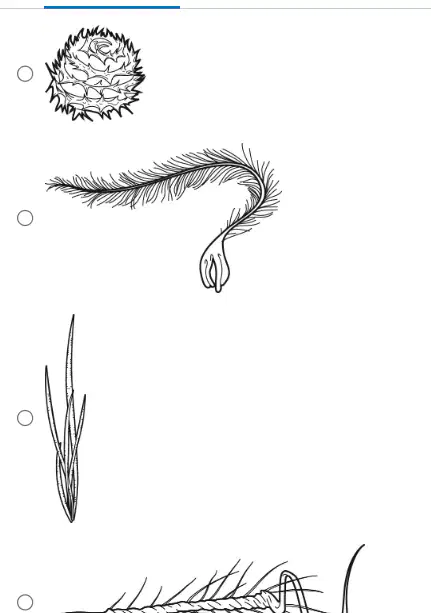
Which seed is least likely to be carried in the fur of animals?
A
B
C
D
Which of these is a response to an internal stimulus?
A sunflower turns to face the rising sun
A pine tree knocked sideways in a landslide grows upward in a bend.
Guard cells of a tomato plant leaf close when there is little water in the roots.
If the climate in an area were to become much drier, which plant variation would be most advantageous to the survival of the species?
bigger branches
thicker leaves
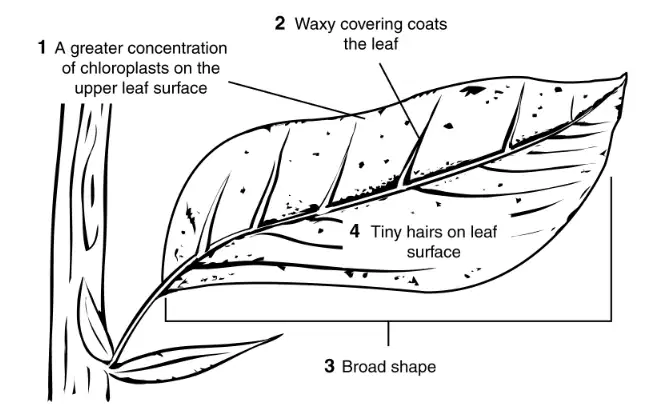
The diagram shows some leaf adaptations. Which adaptation would be most helpful for reducing water loss from the plant?
1
2
3
Which organisms undergo photosynthesis to meet their nutritional needs?
angiosperms
annelids
fungi
paramecia
After a period of heavy rainfall, how would plants remove excess water?
open their stomata
make more food
produce more seeds
drop their leaves
A runner in a cross country tournament experiences muscle cramps toward the end of the race. After completing the race and resting, the runner’s cramps eventually go away. Which statement best explains what has occurred?
The runner did not sufficiently warm up before the race and experienced cramping as the muscles were forced to convert fat into a useable energy source.
As the runner reached the end of the race, fatigued muscle cells began to die at a rate faster than they could be replicated, which resulted in an increased amount of muscle cramping.
As the runner became more fatigued, the muscles did not receive enough oxygen and were forced to perform anaerobic respiration, resulting in cramping.
The runner did not consume sufficient levels of glucose before the race and experienced cramping because the muscles were forced to increase glucose production.
As light intensity slowly decreases in a forest, what will most likely happen to the rate of photosynthesis?
It will slow down with decreasing light intensity.
It will continue to happen at a normal pace.
It will speed up with decreasing light intensity.
It will stop with decreasing light intensity.
The reactants for a biochemical reaction are 6CO + 6HO. What will be the products for this reaction, and where does the reaction take place?
C6H12O6 + 6O2; chloroplast
CHO+ 6O; mitochondria
CHO + 6CO; chloroplast
Which statement best describes photosynthesis and respiration?
Autotrophs carry out photosynthesis, while autotrophs and heterotrophs carry out respiration.
Autotrophs and heterotrophs both carry out photosynthesis and then respiration.
In autotrophs, photosynthesis requires oxygen, and respiration requires carbon dioxide.
Only autotrophs carry out photosynthesis, while only heterotrophs carry out respiration.
How are the reactions of photosynthesis and cellular respiration interconnected?
The reactions are opposites of one another, each using the products of the other as reactants.
Both reactions require ATP as the energy source, but photosynthesis only happens in plants.
Every organism carries out both processes at the same time but in different parts of the organism.
Animals rely on photosynthesis in plants, and plants rely on respiration as the source for their ATP.
Which statement best describes cellular respiration?
It is the metabolism of water into oxygen and hydrogen.
It is the intake of oxygen and release of carbon dioxide.
It is the creation of energy from oxygen and water.
It is the conversion of food energy into a more usable form.
An ocotillo shrub is a desert plant that is characterized by small leaves and a wax-coated stem. How do these structures most likely provide a survival benefit for this plant?
by conserving water
by reflecting sunlight
by deflecting desert sand
by protecting it from predators
Which factor would have the greatest effect on the cellular respiration rate of an animal?
the intensity of sunlight
the number of chloroplasts
the amount of oxygen available
the amount of water available
6CO + 6HO → CHO + 6O What other requirements are necessary for this reaction to occur?
chlorophyll and nitrogen
chlorophyll and sunlight
sunlight and ethanol
sunlight and nitrogen
When athletes run long distances, their muscles become fatigued due to a lack of oxygen. Which process helps athletes generate more energy to continue running?
aerobic respiration
anaerobic respiration
chemosynthesis
photosynthesis

