wayground logo

Free Printable Worksheets

NEW

Font size

S
M
L
XL
Worksheets

anatomy

Total questions: 49

Worksheet time: 32mins

Name
Class
Date
1.
What body system consists of the heart?
a)
Excretory
b)
Digestive
c)
Circulatory
d)
Respiratory
2.
This system allows the body to take in oxygen and excrete, or get rid of waste gases.
a)
Nervous System
b)
Muscular System
c)
Respiratory System
3.
What is the body system that sends and recieves electrical signals from the brain?
a)
Skeletal System
b)
Nervous System
c)
Muscular System
d)
Digestive System
4.
What system allows motion in the body?
a)
Digestive System
b)
Stomach
c)
Musuclar System
d)
Veins 
5.
What system breaks food down into energy for the body?
a)
Stomach
b)
Digestive System
c)
Respiratory system
d)
Lungs
6.
Which of the following is in the correct order from smallest to largest?
a)
tissue-organ-system-cell
b)
cell-organ-tissue-system
c)
System-tissue-cell-organ
d)
cell-tissue-organ-system
7.

What system produces and secretes hormones to regulate body processes.

a)

Excretory

b)

Endocrine

c)

Circulatory

d)

Digestive

8.

Study of the process of living organisms, why and how they work.

a)

Anatomy

b)

Biology

c)

Physiology

d)

Physical Science

9.

Protects and supports body organs, creates frame work, provides a site for muscle attachments

a)

Digestive System

b)

Lymphatic System

c)

Muscular System

d)

Skeletal System

10.
The forehead is ______________ to the nose
a)
Inferior
b)
Superior
11.
The breastbone is _______________ to the spine
a)
Anterior
b)
Posterior
12.
The arms are ___________ to the chest
a)
Lateral 
b)
Medial
13.
The heart is ____________ to the arms
a)
Lateral
b)
Medial
14.

This system works with the circulatory system to provide oxygen to the body's cells and to remove carbon dioxide, your lungs are in this system.

a)

The respiratory system

b)

The nervous system

c)

The digestive system

d)

The muscular system

15.
Group of cells with the same specialized purpose
a)
organ
b)
transitional
c)
tissue
d)
cells
16.
Tissue that transmits and integrates messages
a)
Epithelial
b)
Connective
c)
Nervous
d)
Muscular
17.
Which of the following planes divides the body into front and back sections?
a)
transverse
b)
frontal
c)
mid-sagittal
d)
sagittal
18.
Another name for the plane that divides the body into upper and lower sections is?
a)
frontal
b)
mid-sagittal
c)
sagittal
d)
transverse
19.
Which of the following planes divides the body into EQUAL right and left parts?
a)
sagittal
b)
frontal
c)
mid-sagittal
d)
transverse
20.
Relating to the back, posterior
a)
Dorsal
b)
Anterior
21.
Inferior 
a)
Above
b)
Left
c)
Below
d)
Right
22.

Behind, in back

a)

Superior

b)

Inferior

c)

Posterior

d)

Anterior

23.
Superior 
a)
above 
b)
Inferior 
c)
below 
d)
left 
24.
Center of the body
a)
Superior
b)
Inferior
c)
Medial
d)
Lateral
25.
What is the name of the plane shown in the left picture?
a)
Midsaggital
b)
Transverse
c)
Coronal/Frontal
26.
What is the name of the plane shown in the middle picture?
a)
Midsaggital
b)
Transverse
c)
Coronal/Frontal
27.
What is the name of the plane shown in the right picture?
a)
Midsaggital
b)
Transverse
c)
Coronal/Frontal
28.
The front of the body is known as _______.
a)
anterior (ventral)
b)
posterior (dorsal)
c)
medial
d)
lateral
29.
The back of the body is known as _______.
a)
anterior (ventral)
b)
posterior (dorsal)
c)
medial
d)
lateral
30.
The term superior means?
a)
towards the midline of the body
b)
away from the midline of the body
c)
towards the head
d)
towards the feet
31.
The term medial means?
a)
towards the midline of the body
b)
away from the midline of the body
c)
towards the head
d)
towards the feet
32.
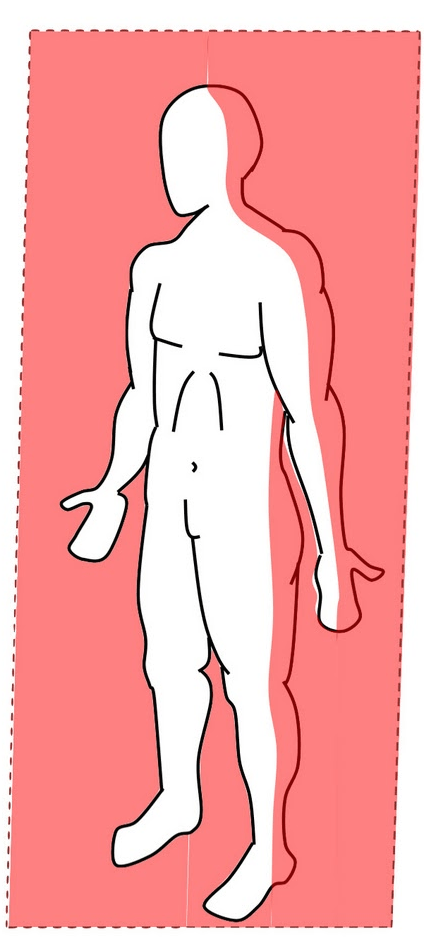
Which body plane is pictured?
a)
sagittal
b)
frontal (coronal)
c)
transverse
33.
This function of this organelle is to break down glucose to make cell energy.
a)
Chloroplasts
b)
Mitochondria
c)
Nucleus
d)
ATP
34.

A sexual reproduction; divides into 2 identical cells.

a)

mitosis

b)

cancer

c)

spindle

d)

centromere

35.

Sex cells divide into 4 new cells and the number of chromosomes is reduced from 46 to 23.

a)

meiosis

b)

mitosis

36.
The cells produced via meiosis are called:
a)
sex cells
b)
somatic cells
c)
body cells
d)
skin cells
37.
The testicles are part of the _____ system
a)
Integumnetary
b)
Skeletal
c)
Nervous
d)
Reproductive
38.
The brain is the major organ of the ___ system.
a)
Urinary
b)
Muscular
c)
Nervous
d)
Digestive
39.
The heart is a major organ of the __________ system
a)
Cardiovascular
b)
Endocrine/Glandular
c)
Skeletal
d)
Nervous
40.
The spleen is a part of the _______ system.
a)
reproductive
b)
respiratory
c)
urinary
d)
lymphatic
41.
Kidneys are major organs in the  ___________ system.
a)
Urinary
b)
Digestive
c)
Lymphatic
d)
Reproductive
42.
The spinal cord is a major structure of the ______ system.
a)
Respiratory
b)
Reproductive
c)
Nervous
d)
Digestive
43.
Hair and nails are both a part of the ________ system.
a)
Nervous
b)
Muscular
c)
Integumentary
d)
Endocrine/Glandular
44.
The respiratory system includes which structure?
a)
Pituitary
b)
Trachea
c)
Femur
d)
Veins
45.
The system that helps exchange oxygen for carbon dioxide is the __________ system.
a)
Urinary
b)
Respiratory
c)
Digestive
d)
reproductive
46.
This system is responsible for keeping our species going from one generation to the next.
a)
Respiratory
b)
Endocrine/Glandular
c)
Reproductive
d)
Integumentary
47.
This system helps fight infections and toxins that work their way into our bodies.
a)
Nervous
b)
Lymphatic
c)
Endocrine
d)
Urinary
48.
Lungs are major organs in the __________ system.
a)
Respiratory
b)
Lymphatic
c)
Digestive
d)
nervous
49.
Lymph nodes are tiny filters in the ____________ system.
a)
Endocrine/glandular
b)
Skeletal
c)
cardiovascular
d)
lymphatic