
 Worksheets
Earthquake & Volcano Review
Total questions: 47
Worksheet time: 39mins
Name
Class
Date
1.
A low silica volcano makes what type of explosion
a)
quiet eruption
b)
explosive eruption
2.
Beneath a volcano, magma collects in a:
a)
magma chamber
b)
magma pocket
c)
vent
d)
hole
3.
Which of the following is an opening through which molten rock and gas leave a volcano
a)
pipe
b)
magma chamber
c)
crater
d)
vent
4.
Composite Volcano
a)
High viscosity
b)
Low Viscosity
5.
Shield Volcano
a)
Low Viscosity
b)
High Viscosity
6.

What is G?
a)
Magma chamber
b)
caldera
c)
fumarole
d)
conduit
7.

A huge hole left behind when a volcano collapses is a __________.
a)
caldera
b)
volcanic neck
c)
sill
d)
vent
8.
Tall, cone-shaped mountains in which layers of lava alternate with layers of ash are called
a)
shield volcanoes
b)
cinder cone volcanoes
c)
composite volcanoes
d)
lava plateaus
9.
Which volcano is a wide, gently sloping mountains made of layers of lava and is formed by quiet eruptions?
a)
Composite
b)
Cinder-Cone
c)
Shield
d)
Stratovolcano
10.

This volcano is most likely which type of volcano?
a)
Felsic
b)
Composite
c)
Shield
d)
Cinder cone
11.
Highly explosive volcanoes tend to have what type of magma?
a)
magma with high silica, high viscosity, and higher gas content
b)
magma with low silica, low viscosity, and lower gas content
c)
magma with low silica, high viscosity, and lower gas content
d)
magma with no silica, high viscosity, and no gas content
12.
TRUE OR FALSE: A substance that flows quickly has high viscosity...
a)
True
b)
False
13.

What is this boundary?
a)
convergent
b)
divergent
c)
transform
d)
neutral
14.

What is this boundary?
a)
convergent
b)
transform
c)
subduction
d)
divergent
15.

These are the secondary, or second waves to be released. They cannot travel through the liquid outer core
a)
S waves
b)
Surface Waves
c)
P waves
16.

The cat is standing on the...
a)
foot wall
b)
hanging wall
c)
left
d)
weirdest elevator ever
17.
Which fault doesn't move up or down?
a)
Strike-slip
b)
Convergent
c)
Transform
d)
Shearing
18.

What type of fault is this?
a)
normal fault
b)
reverse fault
c)
strike-slip fault
d)
Tenson
19.

Stress that squeezes rock!
a)
tension
b)
compression
c)
shear
d)
boa constriction
20.
A scale that rates earthquakes by estimating the total energy released by an earthquake?
a)
Richter scale
b)
moment magnitude scale
c)
Mercalli scale
d)
ph scale
21.

A type of fault where the hanging wall slides upward...caused by compression.
a)
hanging wall
b)
strike-slip fault
strike-slip fault
strike-slip fault
c)
normal fault
d)
reverse fault
22.
A scale that rates Earthquake's magnitude based on the size of it's seismic waves?
a)
Richter Scale
b)
moment magnitude scale
c)
Mercalli scale
d)
Kelvin scale
23.
The measurement of an Earthquake's strength based on seismic waves and movement along faults?
a)
focus
b)
magnitude
c)
stress
d)
liquefatcion
24.
A scale that rates Earthquakes according to their intensity and how much damage they cause at a particular place!
a)
Mercalli scale
b)
Richter scale
c)
moment magnitude scale
d)
decibel scale
25.
The point of Earth's surface directly above an Earthquake?
a)
epicenter
b)
focus
c)
ground zero
d)
syncline
26.
The point beneath Earth's surface where rock breaks under stress causing an Earthquake?
a)
loci
b)
syncline
c)
epicenter
d)
focus
27.

A downward fold in rock formed by compression in Earth's crust?
a)
anticline
b)
syncline
c)
fracture
d)
strike-slip fault
28.

What part of a fold is pictured here?
a)
upfold
b)
downfold
c)
anticline
d)
syncline
29.
What type of boundary experiences shearing stress?
a)
Transform
b)
Convergent
c)
Divergent
d)
Strike-slip
30.

What is viscosity?
a)
A liquid's resistance to flow.
b)
a liquids flow.
c)
a liquid
d)
gas to solid.
31.
These cause the most damage and are the slowest waves caused by an Earthquake
a)
seismic
b)
meteorite
c)
primary
d)
surface
32.

Which city is closest to the epicenter?
a)
A
b)
B
c)
C
33.
Which type of wave arrives to a point first?
a)
Primary Waves (P-Waves)
b)
Secondary Waves (S-Waves)
c)
Rayleigh Waves
d)
Love Waves
34.
Which classification of wave does the most damage?
a)
Body Waves
b)
Mega Waves
c)
Surface Waves
d)
Love Waves
35.
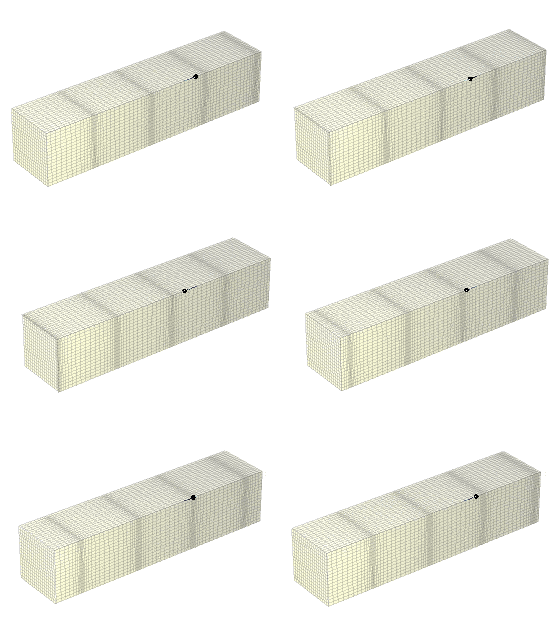
Which body wave is pictured?
a)
P-Wave
b)
S-Wave
c)
Rayleigh Wave
d)
Love Wave
36.
These produce volcanoes in the middle of a plate..
a)
Calderas
b)
Depressions
c)
Craters
d)
Hot Spots
37.
Where do most volcanoes form?
a)
in the center of ocean plates
b)
in the middle of continents
c)
at plate boundaries
38.
What is a dent or depression called on a volcano?
a)
side vent
b)
bump
c)
dent
d)
crater
39.
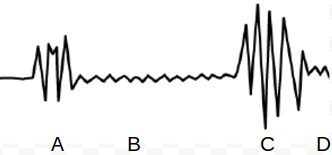
Where are the surface waves located on this seismogram?
a)
A
b)
B
c)
C
d)
D
40.

What is image A?
a)
S waves
b)
P waves
c)
Surface waves
d)
All of these
41.

What does letter B represent ?
a)
S waves
b)
P waves
c)
Surface waves
d)
All of these
42.

Stress that stretches rock so that it becomes thinner in the middle!
a)
tension
b)
compression
c)
shear
d)
rubber-binder
43.

Stress that pushes masses of rock in opposite directions, in a sideways movement?
a)
shear
b)
compression
c)
tension
d)
constriction
44.
Which of the following factors helps determine whether a volcanic eruption will be violent or relatively quiet?
a)
amount of dissolved gases
b)
temperature of magma
c)
composition of magma
d)
all of the above
45.
As the temperature of lava increases, ________
a)
its viscosity decrease
b)
it begins to harden
c)
its viscosity increases
d)
it can flow a much short distance
46.

Examine the diagram and correctly match the letters on the diagram the features named below. Feature B is
a)
Sill
b)
Pyroclastic sediment
c)
Batholith
d)
Lava flow
47.
How does a reverse fault form?
a)
The hanging wall moves upward relative to the footwall.
b)
Compression thrusts the fault into reverse.
c)
Blocks slide past each other.
d)
The hanging wall moves downward relative to the footwall.
100 %

