
 Worksheets
Unit 2: Ecology Review
Total questions: 40
Worksheet time: 32mins
Name
Class
Date
1.

All of the living and nonliving things in an area that interact with each other are called a/an ______.
a)
community
b)
habitat
c)
population
d)
ecosystem
2.

An area where an organism finds food, shelter and water in a specific arrangement
a)
niche
b)
biosphere
c)
biome
d)
habitat
3.

The study of how living things interact with one another and with their environment.
a)
Biology
b)
Lithology
c)
Ecology
d)
Farmacology
4.

Organisms that look similar and can produce fertile offspring
a)
Species
b)
Fish
c)
Community
d)
Trees
5.
Two or more members of a particular species living and interacting in the same area
a)
Community
b)
Population
c)
Organisms
d)
Biosphere
6.

The area between the highest mountain and the deepest ocean where life can be found
a)
Biosphere
b)
Biome
c)
Farm
d)
Ecosystem
7.

Which symbiosis is pictured?
a)
parasitism
b)
mutualism
c)
commensalism
d)
nonalism
8.

The symbiotic relationship in which both organisms benefit is called ____________.
a)
competition
b)
mutualism
c)
nitrogen fixation
d)
energy pyramid
9.

What does a food web represent?
a)
All connections of energy flow throughout all organisms in a habitat.
b)
The specific ways that mutualism is carried out.
c)
A single pathway or energy flow between organisms.
d)
How carnivores get their food.
10.

The image provided is an example of a(n):
a)
Carnivore
b)
Herbivore
c)
Producer
d)
Autotroph
11.

The image provided is an example of a(n):
a)
Producer
b)
Autotroph
c)
Consumer
d)
Insect
12.

The amount of energy that usually transfers from one trophic level to the next is __________.
a)
10%
b)
20%
c)
80%
d)
50%
13.

A pig is an example of an organism that eats both living producers and other consumers. It is called a _________..
a)
Carnivores
b)
Omnivores
c)
Herbivores
d)
Detritivores
14.

What are the Abiotic factors in this image?
a)
water, sunlight, dirt, air
b)
birds and plants
c)
birds, water, dirt
d)
plants, water
15.

What does every food chain start with? (Even if it's not drawn or written there!)
a)
producers
b)
sun
c)
consumer
d)
decomposers
16.

Consumer that eats plants
a)
heterotroph
b)
herbivore
c)
producer
d)
community
17.
Which one is not a consumer?
a)
anemone
b)
bear
c)
shark
d)
vulture
18.
As you move upward, from level to level, in an energy pyramid, energy _____.
a)
increases
b)
decreases
c)
stays the same
d)
increases exponentially
19.
As you move upward, from level to level, in an energy pyramid, energy _____.
a)
increases
b)
decreases
c)
stays the same
d)
increases exponentially
20.
The portion of the planet where life exists is termed the
a)
ecology
b)
biomes
c)
ecosystem
d)
biosphere
21.
How is the majority of energy within an ecosystem lost?
a)
heat loss
b)
energy used to grow biomass
c)
cellular respiration
d)
cellular metabolism
22.

Which of the organisms illustrated above would be the top predator?
a)
zebra
b)
hyena
c)
lion
d)
cheetah
23.

Cattle egrets are birds that forage in fields among cattle. The egrets get easy access to food and the cattle don't care if they are there or not.
a)
mutualism
b)
commensalism
c)
competition
d)
parasitism
24.

Red-billed oxpeckers are birds that feed on parasites found on an impala. The impala gets rid of parasites and the red-billed oxpeckers get a yummy dinner. This is an example of _______.
a)
commensalism
b)
mutualism
c)
neutralism
d)
competition
25.

When the African eye worm infects a host, it crawls under the skin until it finds the eye. This causes the host to have itchy eyes and to have a feeling that something is wiggling on the eyes.
a)
Mutualsim
b)
Parasitism
c)
Commensalism
26.

Is fungus abiotic or biotic?
a)
biotic
b)
abiotic
27.

Is sunlight abiotic or biotic?
a)
biotic
b)
abiotic
28.

A collection of organisms that belong to different populations but all live in the same area and interact with one another.
a)
population
b)
ecosystem
c)
community
d)
biosphere
29.
Which of the following is the correct order in a food chain?
a)
Sun --> producer --> herbivores --> carnivores --> scavengers --> carnivores
b)
Sun --> producer --> scavengers --> carnivores
c)
Sun --> consumers --> predators --> parasites --> hosts
d)
Sun --> producer --> herbivores --> carnivores --> scavengers
30.

What term identifies the role an animal fills including how it lives, what abiotic factors it needs, how it reproduces, what it eats, and how it obtains food in an ecosystem?
a)
territory
b)
niche
c)
habitat
d)
species
31.

Starfish are probably the most important predator in the shallow ecosystem because they eat basically anything that they can come across. Their feeding activities control the whole ecosystem. This is an example of the starfish ___.
a)
habitat
b)
biotic factors
c)
tolerance level
d)
niche
32.

Leeches can be found among the leaf litter on the ground in the rainforest. As an animal walks by they can attach themselves to it to feed off the animal's blood. This is an example of
a)
mutualism
b)
parasitism
c)
commensalism
d)
predator-prey
33.

What is the order of succession shown in this figure?
a)
A, B, C, D
b)
B, A, D, C
c)
C, D, A, B
d)
D, A, B, C
34.

What is the goal of the pioneer species in primary succession?
a)
To kill the dead materials after a disaster
b)
To rebuild soil
c)
To feed Johnny
d)
To put fresh oxygen into the air
35.
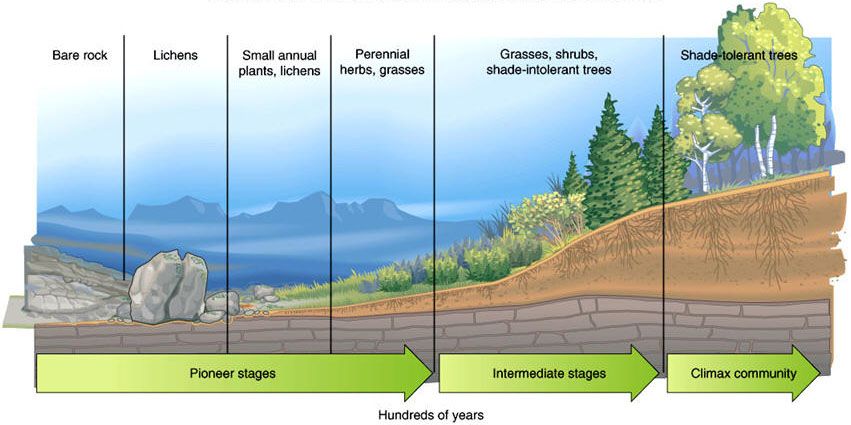
The picture shows what type of succession?
a)
primary
b)
secondary
c)
tertiary
d)
quadanary
36.
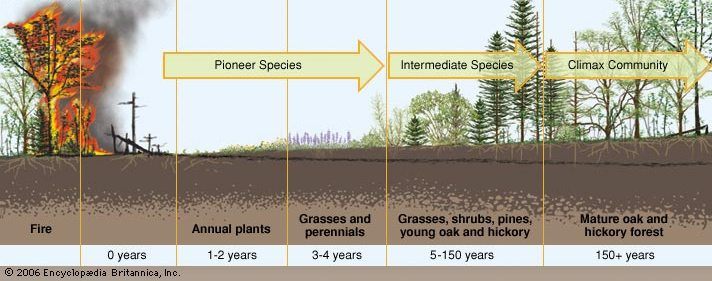
This picture shows what type of succession?
a)
primary
b)
secondary
c)
tertiary
d)
quadanary
37.
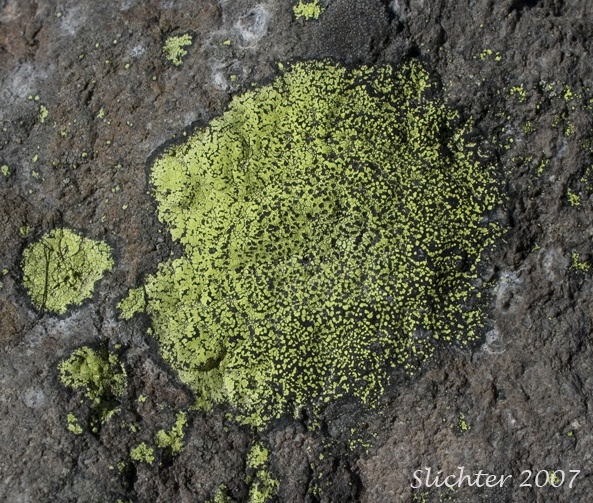
What is the name given to lichen or algae after a primary succession?
a)
pioneer species
b)
volunteer species
c)
founder species
d)
conqueror species
38.
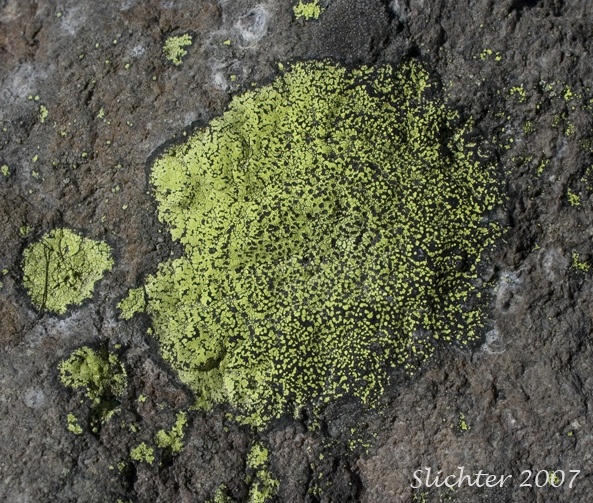
What is the first species you will see in primary succession? (in picture)
a)
lichens
b)
grasses
c)
small plants
d)
pine trees
39.

A pioneer species is...
a)
a large organism
b)
the first organisms to adapt to a new environment
c)
The best organism
d)
Abiotic organisms
40.
Succession that occurs in an area with NO SOIL
a)
ecological succession
b)
primary succession
c)
secondary succession
d)
pioneer speciles
100 %

