
 Worksheets
Nature of Science
Total questions: 110
Worksheet time: 3hrs 44mins
Name
Class
Date
1.
A possible explanation to a problem that has not yet been tested.
a)
data
b)
theory
c)
hypothesis
d)
fact
2.
This variable in an experiment is the one being deliberately changed by the scientist.
a)
dependent variable
b)
independent variable
c)
data
d)
control group
3.
Should experiments be repeated over and over to see if the results are the same each time?
a)
yes
b)
no
4.
There are two types of data. Which type of data involves numbers that are obtained by counting or measuring?
a)
quantitative
b)
qualitative
5.
The summary at the end of an experiment that explains the results.
a)
conclusion
b)
procedures
c)
materials
d)
responding variable
6.
There are two types of data. Which type of data involves descriptions/photographs/illustrations that cannot be counted or measured?
a)
qualitative
b)
quantitative
7.
A series of steps used by scientists to solve a problem or answer a question.
a)
scientific method
b)
recipe
c)
data collection
d)
metric system
8.
In a controlled experiment, how many independent variables can be worked with at a time?
a)
one
b)
none
c)
two or more
d)
how ever many makes sense.
9.
A list of the steps anyone could follow to conduct an experiment.
a)
obervations
b)
question/problem
c)
materials
d)
procedures
10.

Which statement is an inference about this picture?
a)
The van is tan.
b)
The van ran into KFC.
c)
The driver was hungry.
d)
Red and white are part of the KFC building.
11.
Two types of data scientists collect are...
a)
hypothesis and theory
b)
qualitative and quantitative
c)
myths and fables
d)
metric and standard measurements
12.
Mr. S. sets up an experiment to see how the mass of a ball affects the distance it rolls off a ramp. Identify the independent variable.
a)
distance traveled by the ball
b)
height of the ramp
c)
mass of the ball
d)
weight of the ball
13.
Mr. S. sets up an experiment to see how the mass of a ball affects the distance it rolls off a ramp. Identify the dependent variable.
a)
height of the ramp
b)
distance traveled by the ball
c)
mass of the ball
d)
weight of the ball
14.
A student is planning an experiment to find out how the height from which he drops a ball affects how high the ball bounces. The dependent variable is the _____.
a)
Diameter of the ball
b)
Force acting on the ball
c)
Height that the ball bounces
d)
Height from which the ball is dropped
15.
When experimenting with the growth of a plant, a scientist uses three (of the same type of) plants, two different fertilizers, equal light, and equal water. What type of variable is the fertilizer?
a)
Dependent
b)
Independent
c)
Control
d)
Compound
16.
An experiment is performed on plants to see how different liquids affect plant growth. Each plant in the experiment is given a different liquid; water, apple juice, or milk. Each plant has the same amount of soil, sunlight, and listens to the same music. In this investigation, what is the dependent variable?
a)
Type of plant
b)
Water, apple juice, milk
c)
Plant growth
d)
Color of the plant's leaves
17.
Science is a continually ongoing process.
a)
True
b)
False
18.
If I study for my scientific method quiz, then I will have a better test score. What is the dependent variable?
a)
Scientific Method
b)
Studying
c)
Independent variable
d)
Test score
19.
What is a hypothesis?
a)
A hypothesis is the right answer to an experiment.
b)
A hypothesis is the wrong answer to an experiment.
c)
A hypothesis is an educated guess.
d)
I don't know.
20.
Which is NOT a step in the scientific method?
a)
Make observation
b)
Form a theory
c)
Collect data
d)
Form a hypothesis
21.
What step does every scientific experiment begin with?
a)
hypothesis
b)
question/problem
c)
procedures
d)
conclusion
22.
This part of the experiment serves as a basis of comparison; the one variable being tested has been omitted.
a)
experimental group
b)
control group
c)
data
d)
variables
23.
Which of these contains steps in the right order?
a)
Ask a question, state your hypothesis, research, experiment, analyze, make a conclusion
b)
State your hypothesis, ask a question, research, experiment, analyze, make a conclusion
c)
Ask a question, research, state your hypothesis, experiment, analyze, make a conclusion
d)
State your hypothesis, ask a question, research, make a conclusion, experiment, analyze
24.
Why do we want to test only one independent variable at a time?
a)
Because it is hard to setup a data table with more than one variable
b)
To better identify what is causing the changes
c)
It is what has always been done
d)
It's easier to perform the experiment
25.
True or False: Your hypothesis can never be wrong.
a)
True
b)
False
26.
Should experiments be repeated over and over to see if the results are the same each time?
a)
yes
b)
no
27.
The summary at the end of an experiment that explains the results.
a)
conclusion
b)
procedures
c)
materials
d)
responding variable
28.
A possible explanation to a problem that has not yet been tested.
a)
data
b)
theory
c)
hypothesis
d)
fact
29.
This variable in an experiment is the one being deliberately changed by the scientist.
a)
dependent variable
b)
independent variable
c)
data
d)
control group
30.
A series of steps used by scientists to solve a problem or answer a question.
a)
scientific method
b)
recipe
c)
data collection
d)
metric system
31.
The part of the experiment that remains the same for the control and experimental group.
a)
constants
b)
control
c)
independent
d)
dependent
32.
A list of the steps anyone could follow to conduct an experiment.
a)
obervations
b)
question/problem
c)
materials
d)
procedures
33.
Will a construction paper air plane fly faster than an airplane made from notebook paper? Choose the best hypothesis.
a)
If I make a paper airplane from notebook paper, then it will fly faster than construction paper.
b)
Yes.
c)
No.
d)
I think the construction paper air plane will fly faster.
34.
What is the first step in the scientific method?
a)
Ask a question
b)
Conclusion
c)
No Horse Play
d)
Observe
35.
If you increase the amount of spinach you eat, then you will increase the iron in your blood.
What's the dependent variable?
What's the dependent variable?
a)
increase the amount of iron in your blood
b)
spinach you eat
36.
Dependent variable means
a)
the scientist controls what to test
b)
educated guess
c)
ask a question
d)
what is being measured
37.
An experiment is performed on plants to see how different liquids affect plant growth. Each plant in the experiment is given a different liquid; water, apple juice, or milk. Each plant has the same amount of soil, sunlight, and listens to the same music. In this investigation, the independent variable is ...
a)
The type of plant
b)
The amount of sunlight
c)
The type of music
d)
The type of liquid
38.
The name of the information that you get from your experiment (you organize it into charts and graphs).
a)
observations
conclusion
conclusion
b)
data
c)
variables
d)
hypothesis
39.
The summary at the end of an experiment that explains the results.
a)
conclusion
b)
procedures
c)
materials
d)
responding variable
40.
What is a hypothesis?
a)
A hypothesis is the right answer to an experiment.
b)
A hypothesis is the wrong answer to an experiment.
c)
A hypothesis is an educated guess.
d)
I don't know.
41.
Testing a hypothesis often involves a(n):
a)
answer
b)
experiment
c)
problem
d)
safety check
42.
This variable in an experiment is the one being changed by the scientist.
a)
dependent variable
b)
independent variable
c)
data
d)
control group
43.
A testable explanation to a problem that has not yet been tested.
a)
data
b)
theory
c)
hypothesis
d)
fact
44.
Which is NOT a step in the scientific method?
a)
Make observation
b)
Form a theory
c)
Collect data
d)
Form a hypothesis
45.
A series of steps used by scientists to solve a problem or answer a question.
a)
scientific method
b)
recipe
c)
data collection
d)
metric system
46.

Which of the following is a scientific observation?
a)
The potato is brown in color.
b)
The potato tastes the best.
c)
The potato may cause allergies.
d)
The potato smells funny.
47.
What is another word for hypothesis?
a)
evidence
b)
graph
c)
investigation
d)
prediction
48.

A scientist is collecting data on the number of times a cricket chips per minute. What sense is the scientist most likely using to make observations?
a)
hearing
b)
smell
c)
sight
d)
touch
49.

Justin blows his nose, but mucus seems to leak through the tissue. He decides to test which tissue holds up the best while sneezing. What is the independent variable?
a)
sneezing
b)
Justin
c)
amount of tissue
d)
type of tissue
50.
Mr. McNeice wanted to know if different types of music affected people's heart rates, so he played different music and checked their pulses. What is the dependent variable?
a)
type of music
b)
heart rate
c)
how long they listend to music
d)
Mr. McNeice
51.
Which question can best be investigated by a scientist?
a)
Should I buy a red shirt or a green shirt?
b)
Does chocolate milk or plain milk taste better?
c)
Does a plant need sunlight to grow?
d)
Which feels softer, cat fur or dog fur?
52.
The container is filled to the 350 mL mark with water.
a)
observation
b)
inference
c)
problem
d)
hypothesis
53.
Why should an experiment be repeated?
a)
to form a hypothesis
b)
to reduce the chance of error
c)
to change controls
d)
to identify the problem
54.
This is the outcome of the experiment. We get data and results from this.
a)
Independent Variable
b)
Dependent Variable
c)
Control
d)
Constant
55.
How many independent variables should be tested at a time in a scientific investigation?
a)
none
b)
one
c)
two
d)
three
56.

Which is the dependent variable in Amelia's experiment?
a)
the number of bean plants in each group
b)
the amount of water given daily to each plant
c)
the height of each bean plant
d)
the amount of fertilizer given to each group of bean plants
57.
To get data from systematic observations, you must:
a)
Create a model of what you are studying
b)
Collect animals to study and bring inside
c)
Design an entire experiment
d)
Use 5 senses or take pictures to study
58.
The variable that is changed on purpose is:
a)
Control
b)
Dependent
c)
Independent
d)
Outcome
59.
The variable in the experiment that is the outcome that you measure is called:
a)
Control
b)
Dependent
c)
Independent
d)
Hypothesis
60.
When experimenting with the growth of a plant, a scientist uses three plants, two different fertilizers, equal light, and equal water. What type of variable is the water?
a)
Dependent
b)
Independent
c)
Control
d)
Outcome
61.

In the paper airplane experiment, changing the size of the airplane would be which variable?
a)
Dependent
b)
Independent
c)
Control
d)
Conclusion
62.

Squidward found new reeds to tryout for his clarinet. He used an APPLAUSOMETER to measure clapping/applause after playing Under the Sea with each reed. The results were put in the table.
What was the dependent variable?
What was the dependent variable?
a)
The Song
b)
The Reed
c)
The Applause
d)
The clarinet
63.
An experiment is performed on plants to see how different liquids affect plant growth. Each plant in the experiment is given a different liquid; water, apple juice, or milk. Each plant has the same amount of soil, sunlight, and listens to the same music. In this investigation, the independent variable is ...
a)
The type of plant
b)
The amount of sunlight
c)
The type of music
d)
The type of liquid
64.
An experiment is performed on plants to see how different liquids affect plant growth. Each plant in the experiment is given a different liquid; water, apple juice, or milk. Each plant has the same amount of soil, sunlight, and listens to the same music. In this investigation, what are the controlled variables?
a)
Type of plant, amount of music, and sunlight
b)
Water, apple juice, milk
c)
Plant growth
65.
An experiment is performed on plants to see how different liquids affect plant growth. Each plant in the experiment is given a different liquid; water, apple juice, or milk. Each plant has the same amount of soil, sunlight, and listens to the same music. In this investigation, what is the dependent variable?
a)
Type of plant
b)
Water, apple juice, milk
c)
Plant growth
66.
A student is planning an experiment to find out how the height from which he drops a ball affects how high the ball bounces. The dependent variable is the _____.
a)
Diameter of the ball
b)
Force acting on the ball
c)
Height that the ball bounces
d)
Height from which the ball is dropped
67.
A student is planning an experiment to find out how the height from which he drops a ball affects how high the ball bounces. What is the control variable?
a)
The ball used
b)
The height the ball bounces
c)
Height of the ball being dropped
68.
Mr. S set up an experiment to see how the mass of a ball affects the distance it rolls off a ramp. Identify the independent variable.
a)
Distance traveled by the ball
b)
Height of the ramp
c)
Mass of the ball
69.
Mr. S set up an experiment to see how the mass of a ball affects the distance it rolls off a ramp. What is the dependent variable?
a)
Distance traveled by the ball
b)
Height of the ramp
c)
Mass of the ball
70.
Mr. S set up an experiment to see how the mass of a ball affects the distance it rolls off a ramp. What is the controlled variable?
a)
Distance traveled by the ball
b)
Height of the ramp
c)
Mass of the ball
71.

How many children like green?
a)
100
b)
10
c)
2
d)
5
72.

What type of graph is this?
a)
Bar Graph
b)
Line Plot
c)
Pictograph
d)
Tally Chart
73.

How many more people have purple for a favorite color than red?
a)
3
b)
5
c)
7
d)
9
74.

What is the title of the graph?
a)
Number of people
b)
Character
c)
Favorite Cartoon Characters
d)
Sponge Bob
75.

Which sport is the least favorite?
a)
baseball
b)
football
c)
hockey
d)
basketball
76.

How many fewer people liked hockey than football?
a)
3
b)
5
c)
8
d)
11
77.

How many total votes were collected?
a)
5
b)
10
c)
15
d)
20
78.

Who had the most candy?
a)
Rachel
b)
Vanessa
c)
Megan
d)
Olivia
79.

What letter is at the ordered pair (0, 3)?
a)
A
b)
M
c)
R
d)
L
80.

On the coordinate plane, which line is the x-axis?
a)
Horizontal Line (Side to Side)
b)
Vertical Line (Up and Down)
81.

Which ordered pair forms point A?
a)
( 2, 0)
b)
( 0 , 2)
c)
(0, -2)
d)
(-2,0)
82.
In the ordered pair, (7, -7), first I would move ____ then ____.
a)
Left, Down
b)
Left, Up
c)
Right , Up
d)
Right , Down
83.
Which variable represents the second number in an ordered pair?
a)
X
b)
Y
c)
T
d)
G
84.
How do you write an ordered pair?
a)
(X,X)
b)
(Y,X)
c)
(X,Y)
d)
(Y,Y)
85.
Which number in the ordered pair, (-4, 5) represents the x-value?
a)
-4
b)
5
86.

People buy more drinks on ____ than any other day.
a)
Monday
b)
Tuesday
c)
Thursday
d)
Friday
87.

What pattern is evident on this line graph?
a)
Ability to do situps had no change as the days continued
b)
Ability to do situps decreased as the days continued
c)
Ability to do situps increased as the days continued
d)
Ability to do situps does not pertain to the graph
88.

This double line graph for rainfall in two cities shows what pattern?
a)
Rain is steady all year.
b)
It is rainier in the summer months than in winter.
c)
It is the rainiest in winter months.
d)
There is no rain. Both cities are dry year round.
89.

At 60 seconds, how far had this object traveled?
a)
0 m
b)
10 m
c)
20 m
d)
40 m
90.

How long did it take this object to travel back to its reference/starting point?
a)
20 s
b)
30 s
c)
60 s
d)
100 s
91.

How long did it take this object to travel 10 m?
a)
0 s
b)
10 s
c)
15 s
d)
20 s
92.

What is happening in this graph from point B to C?
a)
The object is going down a hill.
b)
The object is returning to its starting location.
c)
The object is slowing down.
d)
The object is staying still.
93.

Look at the graph.
From Tuesday to Wednesday:
From Tuesday to Wednesday:
a)
Food and Drink Sales Increase
b)
Food Sells Increase/ Drink Sells Decrease
c)
Both Food and Drink Sales Decrease
d)
Both Food and Drink Sales Increase
94.

What is happening in the graph from point O to A?
a)
The object is moving SLOWLY
b)
The object is moving FAST
c)
The object is NOT moving
d)
The object is accelerating
95.

What is happening in this graph from point A to B?
a)
The object is accelerating.
b)
The object is not moving.
c)
The object is decelerating.
d)
The object is moving at a constant speed.
96.
A graph is a ___________ of your data
a)
description
b)
variable
c)
answer
d)
picture
97.
Line graphs display data that shows how the __________ variable , changes in response to another variable the __________ variable.
a)
dependent, independent
b)
independent, dependent
c)
constant, independent
d)
mean, mode
98.
Scientists control changes in the ____________ variable.
a)
dependent
b)
control
c)
constant
d)
independent
99.
A line graph is used when. which of the following is true?
a)
An independent variable is continuous
b)
An independent variable is not continuous
c)
A dependent variable is not continuous
d)
No variable is continuous
100.
The X axis
a)
runs up and down
b)
runs left to right
c)
runs on a diagonal
101.
The Y axis runs
a)
up and down
b)
right to left
c)
on a diagonal
102.
The Y axis is labeled with the
a)
control variable
b)
independent variable
c)
sample variable
d)
dependent variable
103.
The X axis is labeled with,
a)
the control variable
b)
the independent variable
c)
the sample variable
d)
dependent variable
104.

During an experiment, the setup shown in the diagram is maintained for 72 hours. Which of the following is the most likely outcome?
a)
Beaker A will hold less water than beaker B will.
b)
The amount of water in beaker A and beaker B will stay the same.
c)
The amount of water in beaker A and beaker B will change by about the same amount.
d)
Beaker B will hold less water than beaker A will.
105.

Which factor is the variable in this experiment?
a)
the type of bee
b)
the time of day
c)
the type of plant
d)
the color of the flowers
106.

Which of the following is the BEST reason why the Portland rose plant is included in all of the groups to be studied?
a)
The type of plant is a control factor.
b)
The experiment will test whether bees prefer Portland rose over other roses.
c)
An experiment should have more than one variable.
d)
The Portland rose is a very common plant.
107.

Which of the following statements describes how temperature changes in the mesosphere?
a)
Temperature increases as altitude increases.
b)
Temperature decreases as altitude increases.
c)
Temperature decreases as pressure increases.
d)
Temperature does not change as pressure increases.
108.

Look at the line graph. Which statement is consistent with the line graph?
a)
The ability of air to hold moisture increases as temperature increases.
b)
The ability of air to hold moisture decreases as temperature increases.
c)
The ability of air to hold moisture decreases and then increases as temperature increases.
d)
The ability of air to hold moisture stays the same regardless of temperature.
109.

On which day was hair length 23 cm?
a)
day 60
b)
day 90
c)
day 120
d)
day 150
110.
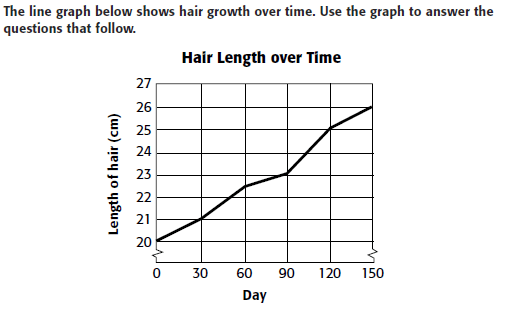
How long was the hair on day 60?
a)
20.0 cm
b)
21.0 cm
c)
22.5 cm
d)
23.0 cm
100 %

