
 Worksheets
APHG Ch. 2
Total questions: 44
Worksheet time: 24mins
Name
Class
Date
1.
The study of population is called
a)
demography
b)
demographics
c)
population geography
d)
distribution
2.
On what types of maps are population distributions usually drawn
a)
dot maps
b)
cartograms
c)
physical
d)
topographic
3.
Why does Egypt have a very high physiological density?
a)
very little land is arable
b)
it is a small country
c)
it does not have many people
d)
it has a low carrying capacity
4.
The number of people an area can support on a sustained basis is known as
a)
population
b)
carrying capacity
c)
physiological density
d)
overpopulation
5.
Which of the following is NOT one of the regions where population is concentrated?
a)
East Asia
b)
South Asia
c)
North America
d)
Europe
6.
Europe's population is concentrated in
a)
urban areas
b)
rural areas
c)
mountainous regions
d)
inland areas
7.
What happened in the 1750s that led population growth?
a)
Industrial Revolution
b)
Agricultural Revolution
c)
Neolithic Revolution
d)
2nd Agricultural Revolution
8.
The number of births in a given year for every 1000 people is
a)
crude birth rate
b)
crude death rate
c)
total fertility rate
d)
natural increase rate
9.
What was the theory of Malthus?
a)
Food grows faster than population
b)
Population grows faster than food
c)
Food grows exponentially, population grows linearly
d)
We should all eat less
10.
What is population density?
a)
the amount of immigrants in an area of land
b)
the amount of citizens in an area of land
c)
amount of emigrants in an area of land
d)
the amount of people per area of land
11.
the number of deaths each year per 1,000 people
a)
fertility rate
b)
rate of natural increase
c)
migration
d)
death rate
12.
the average number of children per woman
a)
birth rate
b)
fertility rate
c)
family rate
d)
census
13.
Physiological Density is
a)
the total measure of a population relative to land size
b)
Number of people per unit area of agriculturally productive land.
c)
The arrangement of people on the Earth's surface.
d)
Huge urban conglomerates
14.
This is calculated by subtracting the total number of deaths from the total number of births...
a)
Total Fertility Rate
b)
Child Mortality Rate
c)
Natural Increase
d)
Population Density
15.
This model is based on the changes in population growth exhibited by countries undergoing industrialization. High birth rates and death rates are followed by plunging death rates, producing a huge net population gain; this followed by the convergence of birth rates and death rates at a low overall level.
a)
Population Pyramid
b)
Demographic Transition Model
c)
Crude Birth Rate
d)
Total Fertility Rate
16.
This is used to display percentages of each age group in a total population (normally in five-year increments) by a horizontal bar whose length represents its share. Males in the group are tot he left of the center line and females to the right...
a)
Population Pyramid
b)
Demographic Transition Model
c)
Crude Birth Rate
d)
Crude Death Rate
17.

A pyramid looks like an upside down triangle, what stage does this represent?
a)
2
b)
3
c)
4
d)
5
18.

There are NO countries in which stage?
a)
Stage 3
b)
Stage 2
c)
Stage 4
d)
Stage 1
19.

In what stage are most European countries?
a)
1
1
1
b)
2
c)
3
d)
4
20.

Which area is the most habitable?
a)
high areas
b)
cold areas
c)
warm areas
d)
dry areas
21.

The world's most populated country is
a)
India
b)
Nigeria
c)
China
d)
Indonesia
22.

Explain the possible stage 5 epidemiological transition.
a)
delayed degenerative diseases
b)
reemergence of infectious and parasitic diseases
c)
degenerative and human-created diseases
d)
pestilence and famine
23.

How are Stages 1 and 4 of the demographic transition model similar?
a)
both have low growth rates
b)
both have low life expectancies
c)
both have low dependency ratios
d)
both have low death rates
24.

What are the four major population clusters/concentrations?
a)
Eastern North America, West Africa, Latin America, Russia
b)
West Asia, South Asia, Central Asia, South Africa
c)
East Asia, Europe, South Asia, Southeast Asia
d)
Latin America, North America, Middle East, Central Africa
25.

What is the definition of ecumene?
a)
land that is suitable for growing crops
b)
portion of Earth's surface occupied by permanent human settlement (inhabited areas)
c)
number or people supported by a unit area of arable land
d)
the ratio of the number of farmers to the amount of arable land
26.
What is the definition of arithmetic density?
a)
a greater pressure placed on land to produce enough food
b)
the number of people supported by a unit of arable land
c)
the total number of people in a region or country divided by the total land area
d)
the ratio of farmers to the amount of arable land
27.
What is the definition of physiological density?
a)
land that is inhabited permanently by human settlement
b)
the ratio of people in a region divided by the amount of food in a region
c)
the ratio of the number of farmers to the amount of arable land
d)
the number of people supported by a unit area of arable land
28.
What is the definition of agricultural density?
a)
the number of crops harvested in a single year
b)
the ratio of the number of farmers to the amount of arable land
c)
the number of animals in a region
d)
the amount of children in the labor force
29.
What is the natural increase rate (NIR)?
a)
the % by which a population grows in a year (subtract the CBR from the CDR after converting to decimals)
b)
the number of people who get jobs in an urban area
c)
the percent by which a region grows in land area
d)
the % by which a population grows in a year (subtract the CDR from the CBR after converting to %)
30.
What is the NIR today?
a)
2.2 %
b)
2.6 %
c)
1.2 %
d)
1.6 %
31.
Overpopulation of a species occurs when...
a)
there are more organisms than resources in an area
b)
there are more males than females in an area
c)
there are more females than males in an area
d)
there is too much competition between species
32.

According the population pyramid Canada's population is _______________
a)
growing
b)
getting smaller
33.
What is the projected population of world in 2050?
a)
7.4 billion
b)
40 billion
c)
25 million
d)
10 billion
34.
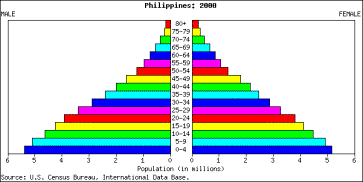
According to the population pyramid of this country, its population is most likely...
a)
growing slowly.
b)
growing rapidly.
c)
decreasing.
d)
not changing.
35.
Sex Ratio:
a)
a decline of the total fertility rate to the point where the natural increase rate equals zero
b)
The number of males per 100 females in the population
c)
The average number of years an individual can be expected to live
d)
Total number of deaths in a year among infants for every 1,000 live births
36.
The highest crude death rates are found in countries in which stage of the demographic transition?
a)
Stage 1
b)
Stage 2
c)
Stage 3
d)
Stage 4
37.
The highest natural increase rates are found in countries in which stage of the demographic transition?
a)
Stage 1
b)
Stage 2
c)
Stage 3
d)
Stage 4
38.
Dr. John Snow found that cholera cases in London were
a)
spatially associated with certain public wells.
b)
being punished for their sins.
c)
being transmitted almost exclusively by French and Irish immigrants.
d)
transmitted through the air in contagious diffusion.
39.
A possible stage five epidemiological transition is the stage of
a)
pestilence and famine.
b)
receding pandemics, including possible zombie pandemics.
c)
emergence of computer viruses that spread to humans
d)
reemergence of infectious and parasitic diseases.
40.
The stages of the epidemiologic transition are based on
a)
causes of death at varying stages of the demographic transition.
b)
the means through which disease is transmitted spatially.
c)
non-contagious diseases such as heart disease, obesity, or diabetes.
d)
new food sources which produced population explosions.
41.
The term ________ refers to the control of diseases.
a)
transition
b)
medicology
c)
pandemiology
d)
epidemiology
42.
The most lethal epidemic in recent years has been
a)
avian flu.
b)
AIDS
c)
malaria
d)
cholera
43.
The ________ that reached Europe from Central Asia in the 1300s was spread by fleas infecting rats, which were carried from port to port on most ships.
a)
Black Blight, or bubonic flu,
b)
Flea Plague, or bubonic pestilence,
c)
Rat plague
d)
Black Plague, or bubonic plague,
44.
__________ is a map which distorts the size of land area or distance to convey information, relationships or data
a)
Cartogram
b)
Economic
c)
Choropleth
d)
Political
100 %

