
 Worksheets
Madison Lesson 1-4 Life Science
Total questions: 133
Worksheet time: 2hrs 6mins
Name
Class
Date
1.
A possible explanation to a problem that has not yet been tested.
a)
data
b)
theory
c)
hypothesis
d)
fact
2.
This part of the experiment serves as a basis of comparison; the one variable being tested has been omitted.
a)
experimental group
b)
control group
c)
data
d)
variables
3.
This part of the experiment shows the effect of the one variable being tested.
a)
control group
b)
experimental group
c)
quantitative data
d)
hypothesis
4.
This variable in an experiment is the one being deliberately changed by the scientist.
a)
dependent variable
b)
independent variable
c)
data
d)
control group
5.
This variable is the actual data collected during the experiment.
a)
independent variable
b)
dependent variable
c)
control group
d)
data group
6.
A broad and comprehensive statement of what is thought to be true; it is supported by much evidence.
a)
hypothesis
b)
theory
c)
guess
d)
fact
7.
There are two types of data. Which type of data involves numbers that are obtained by counting or measuring?
a)
quantitative
b)
qualitative
8.
A series of steps used by scientists to solve a problem or answer a question.
a)
scientific method
b)
recipe
c)
data collection
d)
metric system
9.
Making a forecast of what will happen in the future based on past experience or evidence is called
a)
observing
b)
classifying
c)
predicting
d)
inferring
10.
During an experiment, if you purposely change the temperature to test a hypothesis, the temp is called the
a)
independent variable
b)
operational variable
c)
dependent variable
d)
responding variable
11.
Observations that deal with a number or amount are called
a)
manipulated observations
b)
operational observations
c)
qualitative observations
d)
quantitative observations
12.
An explanation that ties together many hypotheses and explanations is called a(n)
a)
model
b)
concept
c)
theory
d)
investigation
13.
Explaining or interpreting the things you observe based on reasoning from what you already know is called
a)
observing.
b)
inferring.
c)
predicting.
d)
classifying.
14.

All mixtures are defined as "heterogeneous."
a)
TRUE
b)
FALSE
15.

What are the two types of mixtures?
a)
element and sub-atomic
b)
atoms and compounds
c)
homogeneous and heterogeneous
d)
element
16.

A glass of Kool Aid/ Tang juice can be classified as
a)
element
b)
homogeneous
c)
heterogeneous
d)
suspension
17.

What is the similarities between Homogeneous & Heterogeneous Mixtures?
a)
both are element
b)
both are compound
c)
both are mixtures
d)
both are solvent
18.

Is coffee a Homogeneous Mixture?
a)
YES
b)
NO
19.

Soup is a Heterogeneous Mixtures?
a)
TRUE
b)
FALSE
20.
Which type(s) of substances are considered pure substances?
a)
Elements only
b)
Compounds only
c)
Mixtures only
d)
Elements and compounds
21.
This type of substance is made up of one type of atom.
a)
Element
b)
Compound
c)
Mixture
22.
Which of the following requires a physical change to separate?
a)
Element
b)
Compound
c)
Mixture
23.
What type of substance is being represented: O2?
a)
Element
b)
Compound
c)
Mixture
24.
This type of substance is formed through a chemical change.
a)
Element
b)
Compound
c)
Mixture
25.
Which option shows only elements?
a)
NaCl, MgO, OH
b)
O, He, H,
c)
OH, He, Al
d)
O+H, He+Al
26.
What type of substance is the atmosphere?
a)
Element
b)
Compound
c)
Mixture
27.
Which of the following lists only elements?
a)
H2O + OH, MgCl2
b)
H2O, KF, Ne
c)
KCl, Ag, Au
d)
K, Cl, N
28.
Which of the following makes up air, water, and gold?
a)
Protons
b)
Neutrons
c)
Electrons
d)
Atoms
29.

17. potting soil
a)
A. MIXTURE
b)
B. COMPOUND
c)
C. ELEMENT
30.

15. gold
a)
A. MIXTURE
b)
B. COMPOUND
c)
C. ELEMENT
31.

14. a milk shake
a)
A. MIXTURE
b)
B. COMPOUND
c)
C. ELEMENT
32.
A _____________________ is a combination of many different elements not chemically combined.
a)
Pure Substance
b)
Mixture
c)
Compound
d)
Element
33.
A combination of two or more substances where each keeps its own properties and both can be easily separated.
a)
mixture
b)
solution
c)
substance
d)
physical change
34.
Make different without changing what the material is made of, such as cutting, folding, or melting.
a)
physical change
b)
mixture
c)
solution
d)
mass
35.
Pepperoni Pizza
a)
Element
b)
Compound
c)
Homogeneous
d)
Heterogenous
36.
Properties of matter that can be observed, measured, or changed without changing the matter itself
a)
Characteristics
b)
Physical properties
c)
Mass
d)
Volume
37.
The amount of matter in something; usually measured in grams.
a)
Mass
b)
Volume
38.
The amount of space an object takes up; usually measured in liters or milliliters.
a)
Mass
b)
Volume
c)
Matter
d)
Grams
39.
Anything that has mass and takes up space
a)
density
b)
matter
c)
water vapor
d)
mass
40.
A combination of two or more substances that can be easily separated in some physical way
a)
Solubility
b)
Mixture
c)
Solution
d)
Liquid
41.
An _________________ cannot be broken down into any other substance.
a)
Formula
b)
Compounds
c)
Element
d)
Mixture
42.
sodium and potassium react violently with water
a)
physical change
b)
chemical change
43.
pancakes cook on a griddle
a)
physical change
b)
chemical change
44.
food digested in the stomach
a)
physical change
b)
chemical change
45.
grass grows on a lawn
a)
physical change
b)
chemical change
46.
tire inflated with air
a)
physical change
b)
chemical change
47.
Is mixing lemonade powder with water a physical or chemical change?
a)
physical
b)
chemical
48.

The smell your dog makes after eating to much people food.
a)
Chemical Change
b)
Physical Change
49.

Baking a cake by mixing flour, sugar, chocolate powder, eggs, and milk, and then heating them in the oven.
a)
Chemical Change
b)
Physical Change
50.
Is making salt water to gargle with a physical or chemical change?
a)
physical
b)
chemical
51.

a copper penny turning greenish after a few years.
a)
Chemical Change
b)
Physical Change
52.

Green bananas turning yellow on their own as they ripen.
a)
Chemical Change
b)
Physical Change
53.
The smell your dog makes after eating to much people food.
a)
Chemical Change
b)
Physical Change
54.
Which of the following is NOT an example of a physical change?
a)
crumpled paper
b)
pencil sharpening
c)
shrunken clothing
d)
sour milk
55.
A change in which NEW substances are formed.
a)
Chemical change
b)
Physical change
c)
Casual change
d)
Formal change
56.
Which of the following IS a chemical change
a)
using chalk
b)
water freezing
c)
slicing cheese
d)
digestion
57.
Which of the following IS a physical change?
a)
Getting a haircut
b)
Rusty metal
c)
sour milk
d)
A compound
58.
Which of the following is NOT an example of chemical change?
a)
sour milk
b)
burning wood
c)
breaking a pencil
d)
rust
59.
A change in which NEW substances are formed.
a)
Chemical change
b)
Physical change
c)
Casual change
d)
Formal change
60.
Exothermic reactions...
a)
Absorb energy
b)
Release energy
c)
Release Color
d)
Absorb Color
61.
In the equation, 2Mg + O2 ---> 2MgO, which are the reactants?
a)
Mg and O
b)
MgO
c)
Mg and MgO
d)
O and MgO
62.
Is bleaching your hair a physical or chemical change?
a)
physical
b)
chemical
63.
A change in the size, shape, or state of matter.
a)
chemical change
b)
physical change
c)
chemical reaction
d)
electron change
64.
Is hammering wood together to build a house a chemical or physical change?
a)
chemical
b)
physical
65.
Water freezing
a)
Chemical Change
b)
Physical Change
66.
Shredding a piece of paper
a)
Chemical Change
b)
Physical Change
67.
Boiling water
a)
Chemical Change
b)
Physical Change
68.
Odor
a)
Physical property
b)
Chemical property
69.
Luster
a)
Physical property
b)
Chemical property
70.
Red color
a)
Physical property
b)
Chemical property
71.
Bitter taste
a)
Physical property
b)
Chemical property
72.
Flammability
a)
Physical property
b)
Chemical property
73.
In an exothermic reaction, heat is ...
a)
taken in
b)
given out
74.
In an endothermic reaction, heat is ,,,
a)
taken in
b)
given out
75.
Is glass breaking a chemical or phyiscal change?
a)
chemical
b)
physical
76.
Is burning wood a chemical or physical change?
a)
chemical
b)
physical
77.
Is frying an egg a physical or chemical change?
a)
chemical
b)
physical
78.
What type of reaction occurs in a hand warmer
a)
exothermic
b)
endothermic
79.

What happens in an Exothermic reaction?
a)
More energy is released
b)
Less energy is released
c)
The substance's temperature stays the same
d)
The substance gets colder
80.
Which one is correct?
a)
Atoms
Elements
Compounds Molecules
Elements
Compounds Molecules
b)
Atoms
Compounds
Molecules
Elements
Compounds
Molecules
Elements
c)
Molecules
Compounds
Elements
Atoms
Compounds
Elements
Atoms
d)
Atoms
Molecules
Compounds
Elements
Atoms
Molecules
Compounds
Elements
Atoms
81.
Molecules are
a)
2 atoms bound together
b)
2 elements bound together
c)
2 or more atoms mixed together
d)
2 or more atoms bound together
82.
Matter is
a)
everything that has density
b)
everything made of atoms
c)
elements
d)
anything that has mass and takes up space
83.
Atoms make up
a)
Elements
b)
Molecules
c)
Compounds
d)
Protons Neutrons and Electrons
84.
Elements are made of
a)
Many types of atoms
b)
the Periodic Table
c)
One type of Atom
d)
Molecules
85.
What are the basic building blocks for all matter?
a)
atoms
b)
elements
c)
compounds
d)
chemicals
86.
The smallest unbreakable unit of a compound is called
a)
subscript
b)
proton
c)
formula
d)
molecule
87.
What is the formula for density?
a)
density = mass x volume
b)
density = mass / volume
c)
density = mass + volume
d)
density = mass - volume
88.
Jack has a rock. The rock has a mass of 14g and a volume of 2cm3. What is the density of the rock?
a)
7 mL
b)
7 g/cm3
c)
28 g/cm3
d)
1/7 g/cm3
89.
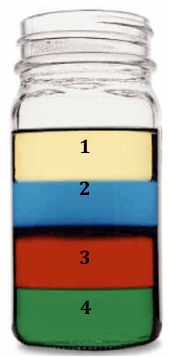
Put the liquids in order from most dense to least dense?
a)
4, 3, 2, 1
b)
1, 2, 3, 4
c)
3, 4, 2, 1,
d)
4, 3, 1, 2
90.
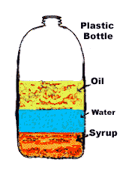
Which liquid is the least dense?
a)
oil
b)
water
c)
syrup
d)
plastic bottle
91.
Frank has an eraser. It has a mass of 4g, and a volume of 2cm3. What is its density?
a)
8 g/cm3
b)
2 g/cm3
c)
1/2 g/cm3
d)
24 g/cm3
92.
In general what is the most dense form of matter?
a)
solid
b)
liquid
c)
gas
d)
plasmas
93.
An object with which of the following densities will float on water?
a)
0.7 g/cm3
b)
1.2 g/cm3
c)
3.5 g/cm3
d)
11.4 g/cm3
94.
Veal finds a gold colored rock in a river. It has a mass of 9.65 grams and a volume of 0.5 cm3. What is the density of the rock?
a)
10.15 g/cm3
b)
19.3 g/cm3
c)
9.15 g/cm3
d)
4.825 g/cm3
95.
Which property of matter is determined by dividing its mass by its volume?
a)
elasticity
b)
buoyancy
c)
density
d)
viscosity
96.
The following liquids are poured together in a beaker: alcohol (density=0.79), corn syrup (density=1.38), water (density=1.0), and cooking oil (density=0.93). Which of these liquids will sink to the bottom of the beaker?
a)
alcohol
b)
corn syrup
c)
water
d)
cooking oil
97.
Veal finds a gold colored rock in a river. It has a mass of 9.65 grams and a volume of 0.5 cm3. What is the density of the rock?
a)
10.15 g/cm3
b)
19.3 g/cm3
c)
9.15 g/cm3
d)
4.825 g/cm3
98.
Will an object with a density of 1.01 g/cm3 float or sink?
a)
float
b)
sink
99.
Veal finds a gold colored rock in a river. It has a mass of 9.65 grams and a volume of 0.5 cm3. What is the density of the rock?
a)
10.15 g/cm3
b)
19.3 g/cm3
c)
9.15 g/cm3
d)
4.825 g/cm3
100.
A brick sinks in water while a wooden block of the same size floats. This is because the brick has a
a)
lower volume than the wooden block
b)
lower density than the wooden block
c)
higher volume than the wooden block
d)
higher density than the wooden block
101.
What is the density of a liquid that has a mass of 27g and a volume of 30ml?
a)
0.9 g/ml
b)
3 g/ml
c)
57 g/ml
d)
810 g/ml
102.
Which of these would be correct to put at the end of a density answer?
a)
g/cm
b)
cm3
c)
g/ml
d)
g/lb
103.

Put the liquids in order from most dense to least dense?
a)
4, 3, 2, 1
b)
1, 2, 3, 4
c)
3, 4, 2, 1,
d)
4, 3, 1, 2
104.

What do we know about the density of lamp oil, rubbing alcohol, and vegetable oil?
a)
The density is greater than 1.0 g/mL
b)
The density is less than 1.0 g/mL
c)
The density is equal to 1.0 g/mL
d)
The density can not be determined
105.
The amount of space an object takes up is its
a)
mass
b)
volume
c)
density
d)
weight
106.
How much mass is in a certain amount of volume is its
a)
mass
b)
volume
c)
density
d)
weight
107.
The amount that gravity pulls on you is called
a)
mass
b)
volume
c)
density
d)
weight
108.
Density is measured with what units?
a)
grams (g)
b)
centimeters (cm)
c)
g/mL
d)
pounds (lbs)
109.
How do you calculate the density of an object?
a)
length x width x height
b)
mass x volume
c)
volume ÷ mass
d)
mass ÷ volume
110.
You have a box that has a volume of 10 cm3 and a mass of 20 g. What is its density?
a)
0.5 g/cm3
b)
200 g/cm3
c)
30 g/cm3
d)
2 g/cm3
111.
An irregular object with a mass of 100 g displaces 25 mL of water. What is its density?
a)
0.25 g/mL
b)
4 g/mL
c)
2500 g/mL
d)
125 g/mL
112.

The first object in the data table has a density of 17 g/cm3, and is in a fluid with a density of 17.4 g/cm3. Will it sink, float, or neither?
a)
sink
b)
float
c)
neither
d)
How am I supposed to know?!
113.
The first object in the data table has a density of 17 g/cm3, and is in a fluid with a density of 17.4 g/cm3. Will it sink, float, or neither?
a)
sink
b)
float
c)
neither
d)
How am I supposed to know?!
114.
How many elements are in C6H12O6?
a)
1
b)
2
c)
3
d)
4
115.
How many atoms of carbon (C) are in C6H12O6?
a)
3
b)
6
c)
12
d)
24
116.
Element or compound?
H2O
H2O
a)
element
b)
compound
117.
How many elements are in H2O?
a)
1
b)
2
c)
3
d)
4
118.
A way to show the number and type of elements (atoms) in a molecule or compound with a combination of symbols and numbers.
a)
Molecule
b)
Chemical formula
c)
Physical change
d)
Coefficient
119.
How many Sodium (Na) are in 6NaCl?
a)
1
b)
12
c)
6
120.
How many atoms are there TOTAL in:
H2SO4
H2SO4
a)
6
b)
5
c)
7
d)
3
121.
A chemical change is?
a)
a shoe lace cut in half
b)
doesn't change anything
c)
changes the look of an object
d)
change that results in the formation of new chemical substances
122.
How many elements are in C6H12O6?
a)
1
b)
2
c)
3
d)
4
123.
Which is the correct formula for:
one carbon (C)
two oxygen (O)
one carbon (C)
two oxygen (O)
a)
CO2
b)
CO
c)
C2O
d)
2CO
124.
How many elements are in H2O?
a)
1
b)
2
c)
3
d)
4
125.
The smallest unit of matter is ________.
a)
the cell
b)
an atom
c)
a compound
d)
an element
126.
Physical properties are
a)
properties that can be observed without changing the identity of the substance
b)
properties that describe how a substance changes into a completely different substance
127.

Ability to rust is this type of property:
a)
Physical property
b)
Chemical property
128.
which one is the definition of chemical property?
a)
a property or characteristic of a substance that is observed during a reaction where the chemical composition of a substance is changed
b)
any change that results in the formation of new chemical substances
c)
combustibility
129.
which one is the definition of chemical property?
a)
a property or characteristic of a substance that is observed during a reaction where the chemical composition of a substance is changed
b)
any change that results in the formation of new chemical substances
c)
combustibility
130.
what is the definition of physical change?
a)
any change that results in the formation of new chemical substances.
b)
rusting
c)
changes affecting the form of a chemical substance, but not its chemical composition.
d)
any property that is measurable, whose value describes a state of a physical system
131.
Odor: Chemical or Physical Property
a)
Chemical Property
b)
Physical Property
132.
Luster: Chemical or Physical Property
a)
Chemical Property
b)
Physical Property
133.
which one is the definition of chemical property?
a)
a property or characteristic of a substance that is observed during a reaction where the chemical composition of a substance is changed
b)
any change that results in the formation of new chemical substances
c)
combustibility
100 %

