wayground logo

Free Printable Worksheets

NEW

Font size

S
M
L
XL
Worksheets

Cell parts and functions

Total questions: 63

Worksheet time: 1hrs 20mins

Name
Class
Date
1.

What unit would most likely be used to view a eukaryotic cell? (hint- think of your microscope lab)

a)

millimeters (mm)

b)

micrometer (um)

c)

nanometer (nm)

d)

meter (m)

2.
The part of the cell that makes protein.
a)
Vacuoles
b)
Ribosomes
c)
Golgi Apparatus
d)
Cytoplasm
3.
Protects the cell from the outside environment. (Only Plants)
a)
Cell Membrane
b)
Chloroplasts
c)
Cell Wall
d)
Vacuoles
4.

Acts like a subway system, carrying protein through the cell, often modifying it along the way

a)

Golgi Apparatus

b)

Nuclear Membrane

c)

Ribosomes

d)

rough Endoplasmic Reticulum

5.
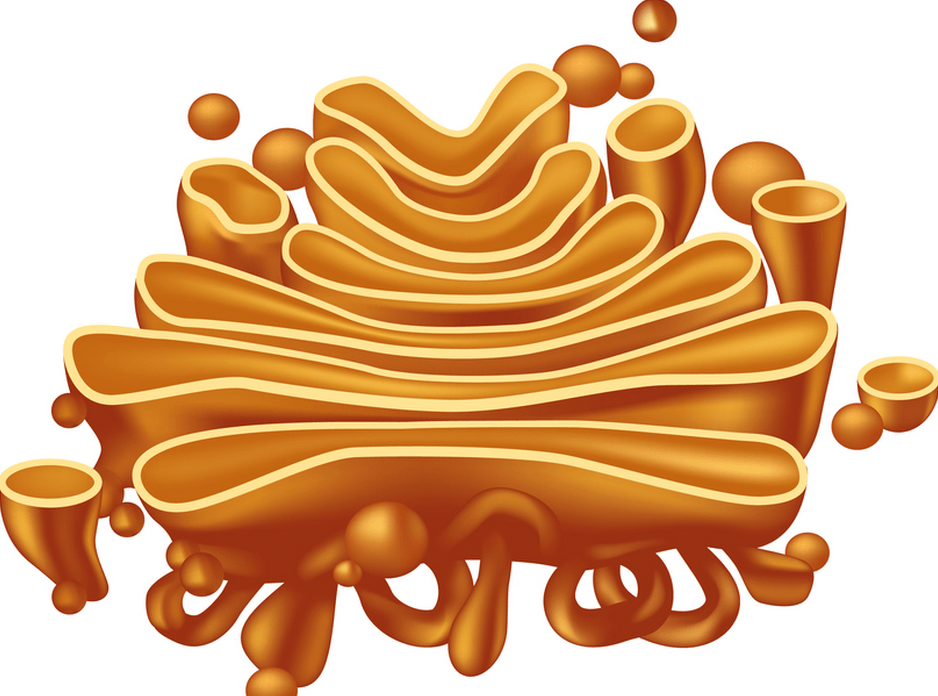
Packages proteins into vesicles and ships them out.
a)
Endoplasmic Reticulum
b)
Ribosomes
c)
Golgi Apparatus
d)
Nucleus
6.
Provides support and protection for the cell while also controlling the movement of materials in and out of the cell.
a)
Cellular Membrane
b)
Nucleus
c)
Ribosomes
d)
Vacuole
7.
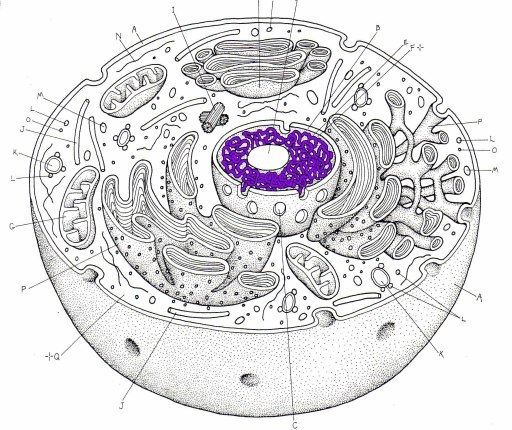
Identify letter G.
a)
Golgi complex
b)
ribosome
c)
cell wall
8.

Which is an accurate difference between plant cells and animals cells?

a)

Animal cells contain Golgi but plant cells do not

b)

Plant cells contain chloroplasts but animal cells do not.

9.
Identify letter K.
a)
nucleus
b)
mitochondria
c)
endoplasmic reticulum
10.
Which organelle aids with the detoxification of the cell as well as makes lipids for cell membranes?
a)
Smooth Endoplasmic Reticulum
b)
Rough Endoplasmic Reticulum
c)
Mitochondria
d)
Golgi Body
11.

Which of the following macromolecules are NOT found in cell membranes

a)

Proteins

b)

Carbohydrates

c)

Lipids

d)

DNA

12.
This contains digestive enzymes. These enzymes can digest materials and cleans the cell
a)
ribosomes
b)
cilia
c)
flagella
d)
lysosomes
13.
I am a protein packaging and shipping machine! Who am I?
a)
vacuole
b)
ribosome
c)
mitochondrion
d)
golgi apparatus
14.
Which structure helps plants stand up?
a)
cell membrane
b)
lysosome
c)
Golgi apparatus
d)
cell wall
15.
Eukaryotes include animal cells and plant cells. True or False?
a)
True
b)
False
16.
What kind of cell is this?
a)
Eukaryotic
b)
Prokaryotic
17.
What type of cell has a nucleus? 
a)
eukaryotic
b)
prokaryotic 
18.
What type of cell does not have a nucleus?
a)
eukaryotic 
b)
prokaryotic 
19.
Ribosome function:
a)
makes protein
b)
contains genetic material
c)
in animal cell only
d)
makes sugar
20.

What organelles transfer energy from organic molecules such as glucose to ATP?

a)

Ribosomes

b)

Vesicles

c)

Cytoskeleton

d)

Mitochondria

21.
Lysosome function:
a)
Stores water
b)
Gets rid of waste
c)
Transports materials
d)
Hold genetic material
22.
True or False:  Mitochondria are found in both plant and animal cells 
a)
True 
b)
False 
23.
I am a protein packaging and shipping machine! Who am I?
a)
vacuole
b)
ribosome
c)
endoplasmic reticulum
d)
golgi apparatus
24.
What makes the endoplasmic reticulum rough?
a)
Vessicles
b)
Vacuoles
c)
Ribosomes
d)
Chromosomes
25.
Main producer of ATP in all eukaryotes
a)
chloroplast
b)
mitochondria
c)
lysosome
d)
smooth er
26.
Produces hormones and lipid molecules for cells
a)
smooth endoplasmic reticulum
b)
rough endoplasmic reticulum
c)
nucleus
d)
ribosome
27.
In the diagram below, which section represents a cells that has been placed in a hypertonic solution?
a)
A
b)
B
c)
C
28.
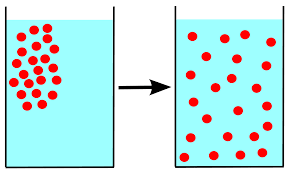
The picture below is an example of _________________.
a)
osmosis
b)
isotonic
c)
diffusion
d)
active transport
29.
The diffusion of water through a semi-permeable membrane is called?
a)
Osmosis
b)
Cell wall
c)
Diffusion
d)
Respiration
30.
What is the definition of  Selective Permeability?
a)
The movement of materials across the cell membrane that requires NO ENERGY from the cell.
b)
The movement of materials through (or across) the cell membrane
c)
The ability of the cell membrane to allow some things to pass through while preventing other things from passing through.
d)
The movement of molecules from an area of high concentration to a area of low concentration 
31.
What type of transport requires energy? 
a)
Active Transport
b)
Facilitated Diffusion
c)
Simple Diffusion
d)
Passive Transport
32.
The cell below is in a _________ solution.
a)
Hypotonic
b)
Hypertonic
c)
Isotonic
33.
The cell below is in a _____________ solution.
a)
Hypertonic
b)
Hypotonic
c)
Isotonic
34.
What type of solution allows water to enter the plant cell?
a)
hypotonic solution
b)
hypertonic solution
c)
isotonic solution
d)
active transport
35.
What type of solution is this cell in?
a)
Isotonic
b)
Hypertonic
c)
Hypotonic
d)
diffused
36.
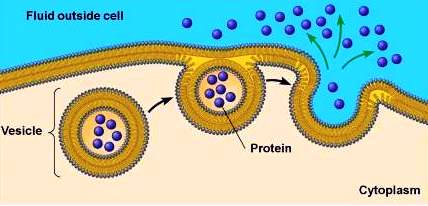
Which form of active transport is being shown?
a)
Pinocytosis
b)
Endocytosis
c)
Exocytosis
d)
Osmosis
37.
Allows large/polar molecules to pass through the cell membrane via facilitated diffusion
a)
Phospholipid bilayer
b)
Transport Protein
c)
Cholesterol
d)
Carbohydrate Chains
38.
Which of the following can pass directly through the phospholipid cell membrane?
a)
Charged particles (Na+)
b)
Large molecules (glucose)
c)
Polar Molecules (H2O)
d)
Small, nonpolar molecules (CO2)
39.
Which cell is in an isotonic environment?
a)
A
b)
B
c)
C
40.
Which cell is in a hypertonic environment?
a)
A
b)
B
c)
C
41.
Active Transport moves molecules from ________ to _________ concentration; it ___________ energy.
a)
high, low; does not require
b)
low, high; does not require
c)
high, low; requires
d)
low, high; requires
42.

This cell part is responsible to assembling ribosomes

a)

Rough ER

b)

Golgi body

c)

nucleolus

d)

nuclear envelope

43.

What important genetic material is also called chromatin?

a)

proteins

b)

DNA

c)

carbohydrates

d)

lipids

44.

Which of the following places the protein manufacturing organelles into the correct order? from start to finish

a)

mitochondria, Nucleus, ribosomes, Golgi, Rough ER

b)

Rough ER, Golgi, Nucleus, ribosomes, smooth ER

c)

nucleus, ribosomes, rough ER, Golgi, transport vesicle

d)

lysosome, ribosome, Golgi, mitochondria

45.
What type of transport is this?
a)
facilitated diffusion
b)
active transport
c)
diffusion
d)
osmosis
46.
A phospholipid has 2 parts. What are they called? 
a)
Hydrophilic Head, Hydrophobic Tail 
b)
Hydrophobic Head, Hydrophilic Tail 
47.
"Water Loving"
a)
Hydrophobic
b)
Hydrophilic 
c)
Hydroelectric 
d)
Hydroloric
48.
"Water Fearing" 
a)
Hydrophobic
b)
Hydrophilic 
c)
Hydroelectric 
d)
Hydroloric
49.
Describes the arrangement of the cell membrane as bendable and made of many parts. 
a)
The Fluid Mosaic Model 
b)
The Major Mobility Model 
c)
The Crazy Cell Model
d)
The Maze Model
50.
Hydrophobic region of the cell membrane?
a)
E
b)
B
c)
C
d)
51.
Hydrophilic portion of cell membrane?
a)
A
b)
C
c)
D
d)
52.
Which of the following scientists concluded that all animals are made of cells?
a)
Rudolf Virchow
b)
Matthais Schleiden
c)
Robert Hooke
d)
Theodor Schwann
53.
Which of the following statements is not part of the cell theory?
a)
Cells are the basic unit of structure and function in all living things.
b)
All cells are produced from other cells.
c)
Only animal cells are composed of cells.
d)
All living things are composed of cells.
54.

When cells are damaged, new cells are created by cell a process called cell division. How does the cell theory support this fact?

a)

It states that all cells have a nucleus which divides.

b)

It states that all living things are made up of one or more cells.

c)

It states that cells come from previously existing cells.

d)

It states that the basic units of structure and function are cells.

55.
The ___ is the basic unit of sturucture and function of organisms
a)
atom
b)
cell
c)
matter
d)
all other answers are correct
56.
Which statement is a part of the cell theory?
a)
all cells come from preexisting cells
b)
bacteria are prokaryotic cells
c)
eukaryotic cells are complex
d)
humans are multicellular
57.
Which scientist did NOT contribute to the cell theory?
a)
Anton Van Leeuwenhoek
b)

Robert Hooke
c)
Albert Einstein 
d)

Matthias Schleiden
58.
Who looked at cork and named the cell?
a)
Robert Hooke
b)
Van Leeuwenhoek
c)
Robert Brown
d)
Francesco Redi
59.
What was Schleiden convinced of? 
a)
All plants are made of cells
b)
All animals are made of cells
c)
All cells form spontaneously
d)
None of the above
60.
Who noted that animals are made of cells and concluded that all living things are made of cells and cell products? 
a)
Rudolf Virchow
b)
Anton van Leeuwenhoek
c)
Theodor Schwann
d)
Robert Hooke
61.
Who discovered that cells come from preexisting cells and whose research lead to the major principles of cell theory?
a)
Matthias Schleiden
b)
Robert Hooke
c)
Zacharias Janssen
d)
Rudolf Virchow
62.
Which of the following is responsible for getting large or charged (polar) molecules across the cell membrane?
a)
E
b)
B
c)
C
d)
D
63.
Look at the cross section of a cell membrane of a eukaryotic cell. H+ ions are being pumped from a low concentration to a high concentration. 
How do you describe this type of transport across the cell membrane?

a)
active transport
b)
passive transport
c)
facilitated diffusion
d)
co-transport