
 Worksheets
test review PT
Total questions: 88
Worksheet time: 4hrs 29mins
Name
Class
Date
1.
A ___________ is an arrangement of elements in columns
a)
columns
b)
rows
c)
periodic table
d)
electron shell
2.
In the modern periodic table elements are arranged by:
a)
atomic mass
b)
atomic number
c)
valence electrons
d)
number of isotopes
3.
Each column in the periodic table is called a
a)
period
b)
group
c)
cluster
d)
unit
4.
The atomic number tells you what?
a)
number of electrons
b)
number of protons
c)
number of neutrons
d)
both electrons and protons in an atom.
5.
Elements which are shiny, conduct electricity and heat are called
a)
metal
b)
nonmetal
c)
metalloid
d)
nonexistent
6.
Which element is not a metal?
a)
H
b)
Re
c)
Al
d)
B
7.

The atoms along the staircase are called
a)
metals
b)
nonmetals
c)
metalloids
d)
noble gases
8.
Which is an alkali metal?
a)
Magnesium
b)
Iron
c)
Sodium
d)
Europium
9.
In the modern periodic table elements are arranged by:
a)
atomic mass
b)
atomic number
c)
valence electrons
d)
number of isotopes
10.
Calcium is most like which of the following?
a)
Barium
b)
Potassium
c)
Cesium
d)
Nitrogen
11.
The alkali metals have how many valence electrons?
a)
1
b)
2
c)
7
d)
8
12.
The noble gases have how many valence electrons?
a)
1
b)
2
c)
7
d)
8
13.
Membership in a family is based on the number of
a)
electrons
b)
valence electrons
c)
protons
d)
neutrons
14.
Elements which are shiny, conduct electricity and heat are called
a)
metal
b)
nonmetal
c)
metalloid
d)
nonexistent
15.

The blue atoms are called
a)
metals
b)
nonmetals
c)
metalloids
d)
noble gases
16.

The atoms along the staircase are called
a)
metals
b)
nonmetals
c)
metalloids
d)
noble gases
17.
Which of the following is not a property of metals?
a)
brittle
b)
malleable
c)
lustrous
d)
conductive
18.
Good conductor of heat
a)
Metal
b)
Nonmetal
19.
If a material can easily be drawn into the shape of a wire, it is
a)
Ductile
b)
Magnetic
c)
Malleable
d)
Reactive
20.
All the elements on the right side of the periodic table are called..
a)
Metals
b)
Metalloid
c)
Nonmetals
21.
Which element is not in the Alkali metal family?
a)
Li
b)
H
c)
Fr
d)
Cs
22.

Beryllium is in group number______.
a)
Group 2
b)
Group 3
c)
Group 4
d)
Group 7
23.

The period for Bromine is ___________.
a)
3
b)
2
c)
4
24.
How many Valance electrons does Iodine Have?
a)
6
b)
16
c)
7
d)
17
25.
What is the name of the group that never reacts--ever ever they are stable with a full outermost ring!!!
a)
noble gases
b)
transition
c)
halogens
d)
borons
26.

Which two families on the periodic table react aggressively?
a)
noble gases and alkali metals
b)
alkali metals and halogens
c)
noble gases and halogens
d)
metals and halogens
27.

What section is the least reactive?
a)
yellow
b)
red
c)
dark blue
d)
orange
28.

What are the first two elements on the periodic table?
a)
hydrogen and helium
b)
hydrogen and lithium
c)
hydrogen and carbon
d)
nitrogen and helium
29.

Which elements have the most similar chemical properties?
a)
K and Na
b)
K and Ca
c)
K and Cl
d)
K and S
30.

Nonmetals are located in what section of this periodic table?
a)
Blue
b)
Yellow
c)
Pink
31.
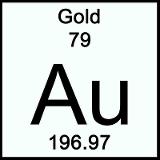
Which number is the atomic mass?
a)
79
b)
196.97
32.
Which of the following will have a larger radius than Zinc?
a)
Gallium
b)
Aluminum
c)
Magnesium
d)
Strontium
33.
Which of the following will have a higher electronegativity than arsenic (As)?
a)
Carbon (C)
b)
Neon (Ne)
c)
Antimony (Sb)
d)
Germanium (Ge)
34.
Which of the following will have a lower ionization energy than Scandium (Sc)?
a)
Helium (He)
b)
Titanium (Ti)
c)
Calcium (Ca)
d)
Magnesium (Mg)
35.
As atoms of elements in group 16 are considered in order from top to bottom, the electronegativity of each successive element....
a)
decreases
b)
increases
c)
remains the same
d)
none of the above
36.
As you move down the periodic table atoms get bigger. This is because ____________.
a)
The atoms have more mass.
b)
The atoms have more protons.
c)
The atoms have more energy levels
d)
The atoms have more neutrons
37.
As you move across the periodic table atoms tend to get smaller because, ______________.
a)
the atoms have more mass.
b)
the atoms have less mass
c)
the atoms have more protons.
d)
the atoms have less electrons.
38.
Electronegativity is...
a)
the ability of an atom to attract/ accept electrons
b)
the ability of an atom to lose electrons
c)
the energy required to remove an electron from a specific atom
d)
how easy it is to make friends.
39.
Ionization energy is...
a)
the energy required to add an electron to a specific atom
b)
how much energy it takes to remove an electron from an atom
c)
the energy required to shield the outer electrons from the nucleus
d)
a measure of the ability of an atom to attract electrons
40.
The atom with the largest atomic radius in Group 18 is -
a)
Ar
b)
He
c)
Kr
d)
Rn
41.
Metals have the largest -
a)
atomic radius and electronegativity
b)
electronegativity and ionization energy
c)
atomic radius only
d)
ionization energy and atomic radius
42.
Which statement correctly and completely identifies a trend?
a)
Atomic radius decreases across a period and increases down a group.
b)
Electronegativity decreases across a period and decreases down a group.
c)
Ionization energy increases across a period and increases down a group.
d)
Ionic radius increases across a period and increases down a group.
43.
Atomic radius generally increases as we move __________.
a)
down a group and from right to left across a period
b)
up a group and from left to right across a period
c)
down a group and from left to right across a period
d)
up a group and from right to left across a period
44.
A negatively charged subatomic particle that exists in various energy levels outside the nucleus of an atom
a)
neutron
b)
electron
c)
proton
d)
subatomic particle
45.
The chart scientists use to organize and classify all the known elements
a)
elements chart
b)
the chart
c)
Periodic Table of the Elements
d)
Period table
46.
The tendency of an atom to attract electrons and acquire a negative charge
a)
electronegativity
b)
charge
c)
bonding ability
d)
electron configuration
47.
Vertical columns of elements (families) on the periodic table with similar properties
a)
groups
b)
periods
c)
quadrants
d)
rows
48.
An isotope is the same element with a different number of...? (4.3)
a)
Protons
b)
Neutrons
c)
Electrons
49.
Which of the following will have a larger radius than Zinc?
a)
Gallium
b)
Aluminum
c)
Magnesium
d)
Strontium
50.
As you move down the periodic table atoms get bigger. This is because ____________.
a)
The atoms have more mass.
b)
The atoms have more protons.
c)
The atoms have more energy levels
d)
The atoms have more neutrons
51.
Which of the following will have a higher electronegativity than arsenic (As)?
a)
Carbon (C)
b)
Neon (Ne)
c)
Antimony (Sb)
d)
Germanium (Ge)
52.
As atoms of elements in group 16 are considered in order from top to bottom, the electronegativity of each successive element....
a)
decreases
b)
increases
c)
remains the same
d)
none of the above
53.
Electronegativity is...
a)
the ability of an atom to attract/ accept electrons
b)
the ability of an atom to lose electrons
c)
the energy required to remove an electron from a specific atom
d)
how easy it is to make friends.
54.
Ionization energy is...
a)
the energy required to add an electron to a specific atom
b)
how much energy it takes to remove an electron from an atom
c)
the energy required to shield the outer electrons from the nucleus
d)
a measure of the ability of an atom to attract electrons
55.
Electronegativity __________ from left to right within a period and __________ from top to bottom within a group.
a)
decreases, increases
b)
increases, increases
c)
increases, decreases
d)
stays the same, increases
56.
One metal that is liquid at room temperature is
a)
magnesium
b)
manganese
c)
mercury
d)
sodium
57.
How do you determine the number of valence electrons an element has?
a)
Look at its period
b)
Look at its group
c)
Look at its atomic number
d)
Look at its atomic mass
58.
Which is a chemical property of metals
a)
malleable
b)
ductile
c)
reactivity
d)
luster
59.
Insulators, brittle, dull, crumbly, tends to gain electrons, mostly gasses at room temperature, located on the right.
a)
Metals
b)
Non-Metals
c)
Metalloids
d)
Periods
60.
Francium (Fr) has the lowest ionization energy in Group 1 because -
a)
it has the smallest number of valence electrons
b)
it has the greatest atomic mass
c)
it has the greatest number of protons, so it attracts its electrons the strongest
d)
its 1 valence electron is very far from the nucleus, so little energy is needed to remove it
61.
As the atoms in period 3 of the periodic table are considered from left to right, the atoms generally show...
a)
an increase in radius and an increase in ionization energy
b)
an increase in radius and a decrease in ionization energy
c)
a decrease in radius and an increase in ionization energy
d)
a decrease in radius and a decrease in ionization energy
62.
What is Left of the zig zag line on the periodic table
a)
Non-Metals
b)
Metals
c)
Metalloids
d)
anions
63.
Which element is not a metal?
a)
H
b)
Re
c)
Al
d)
B
64.
Why are elements in groups 1 and 17 highly reactive?
a)
Because they don't bond with other elements
b)
Because they have 8 valence electrons and are stable
c)
Because they loose/gain 1 valence electron
d)
None of the above
65.
Which of the following has a full valence shell?
a)
Oxygen
b)
Neon
c)
Barium
d)
Carbon
66.
How many electrons do atoms need to be stable?
a)
1
b)
2
c)
6
d)
8
67.
Chlorine, bromine, and iodine were grouped together in the earliest forms of the periodic table, including the table developed by Mendeleev. What was an organizing principle in this grouping at that time?
a)
Atoms of the three elements had approximately the same mass.
b)
The three elements react the same way with other elements.
c)
The elements have the same number of valence electrons.
d)
These three elements are all gases at room temperature
68.
The early periodic table organized the elements in periods of increasing atomic mass. What information is currently used to organize the elements on the periodic table?
a)
number of valence electrons
b)
number of energy levels
c)
atomic number
d)
ionic radius
69.
All elements found on the left side of the Periodic Table of the Elements have what properties in common?
a)
They conduct heat and electricity
b)
They are all gases
c)
They are brittle and dull
d)
They are radioactive
70.

Which of these elements has an electron structure most similar to that of element X?
a)
1
b)
2
c)
3
d)
4
71.
The number of valence electrons in an element affects the reactivity of that element. Which element listed has the fewest valence electrons?
a)
beryllium (Be)
b)
sodium (Na)
c)
oxygen (O)
d)
neon (Ne)
72.
According to the Periodic Table of the Elements, which set of elements has similar properties?
a)
H, C, I
b)
He, H, Al
c)
He, Ne, Ar
d)
Na, Ca, Al
73.
The Periodic Table of the Elements is useful for revealing patterns and trends in the elements. Which statement accurately describes a pattern in the size of atomic radii in the Periodic Table of the Elements?
a)
Atomic radii decrease from left to right across a period and decrease from top to bottom in a group.
b)
Atomic radii increase from left to right across a period and increase from top to bottom in a group.
c)
Atomic radii decrease from left to right across a period and increase from top to bottom in a group.
d)
Atomic radii increase from left to right across a period and decrease from top to bottom in a group.
74.

The symbols W, X, Y, and Z represent four elements shown on the outline of a periodic table.
Which element has the highest electronegativity?
Which element has the highest electronegativity?
a)
W
b)
X
c)
Y
d)
Z
75.
Electron affinity increases from bottom to top in a family of nonmetal elements on the periodic table. What other pattern occurs from bottom to top of a nonmetal family based on this change in electron affinity?
a)
atomic radii
b)
ionization energy
c)
ionic radii
d)
none of these
76.
The elements chromium (Cr) and zinc (Zn) are in period four of the periodic table. Which characteristic of zinc and chromium is correct based on their positions?
a)
Zinc has a greater atomic radius than chromium
b)
Zinc loses electrons more easily than chromium
c)
Chromium has more valence electrons than zinc
d)
Chromium has lower ionization energy than zinc
77.
Which element on the periodic table most likely has physical properties similar to magnesium?
a)
calcium (Ca)
b)
neon (Ne)
c)
phosphorus (P)
d)
potassium (K)
78.
What are the only two elements that are liquids on the Periodic Table at 20o C (room temperature)?
a)
Hg and Br (Mercury and Bromine)
b)
Cl and Hg (Chlorine and Mercury)
c)
Mg and Hg (Magnesium and Mercury)
d)
Mn and Mg (Manganese and Mercury)
79.
Where are the metals on the Periodic Table?
a)
To the left
b)
In the upper right hand corner
c)
On the zigzag line
d)
At the bottom
80.
Where are the nonmetals on the Periodic Table?
a)
To the left
b)
In the upper right hand corner
c)
On the zigzag line
d)
At the bottom
81.
How would you describe reactivity on the periodic table?
a)
Elements in the same group are most likely to react.
b)
Elements in the same Periodic are most likely to react.
c)
Elements on opposite sides of the Periodic Table are most likely to react.
d)
There is no trend of reactivity.
82.
Which of the following is NOT a trend on the Periodic Table?
a)
Elements are arranged in increasing atomic number
b)
Reactivity is high in Groups 1, 2, 16, and 17.
c)
The number of shells increases with each periodic.
d)
Periods are also called families.
83.
In which state of matter are most elements on the Periodic Table at 20o C (room temperature)?
a)
Solid
b)
Liquid
c)
Gas
d)
Plamsa
84.

The yellow atoms are called
a)
metals
b)
nonmetals
c)
metalloids
d)
noble gases
85.
Each column in the periodic table is called a
a)
period
b)
group
c)
cluster
d)
unit
86.
How many Valance electrons does Iodine Have?
a)
6
b)
16
c)
7
d)
17
87.
Electronegativity is...
a)
how good an atom is at attracting electrons
b)
the ability of an atom to lose electrons
c)
the energy required to remove an electron from a specific atom
d)
how easy it is to make friends.
88.
Which atom has the largest atomic radius?
a)
potassium (K)
b)
rubidium (Rb)
c)
francium(Fr)
d)
cesium(Cs)
100 %

