
 Worksheets
Plate Tectonics, EQ, and Volcanoes Review
Total questions: 87
Worksheet time: 1hrs 23mins


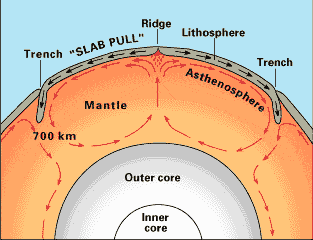
What is the source of energy that drives plate movement?
the subducton of the sea floor
the different densities of the oceanic and crustal plates
convection currents in the asthenosphere
the friction force between the plates that move past each other
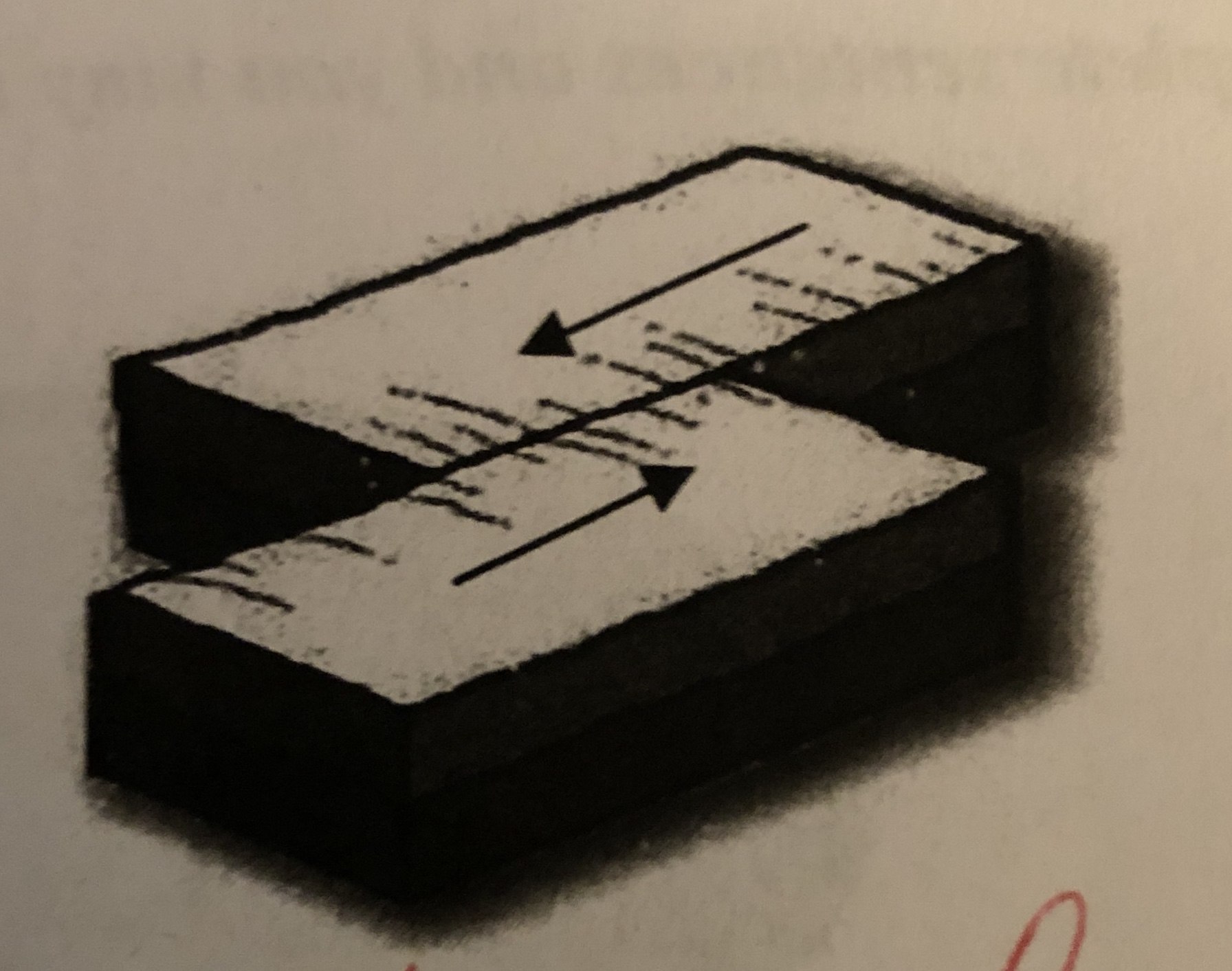
What type of boundary is this?
convergent
divergent
transform

Which type of crust is more dense?
Oceanic Crust
Continental Crust
Neither, they are the same
Pizza Crust
What is created at a Convergent Continental Continental Plate Boundary?
Volcano
Rift Valley
Mountains
Deep Ocean Trench
What happens in a Convection Current?
Cold Magma moves left, hot magma moves right
Hot magma moves left, and cold magma moves right
Hot magma rises, cold magma lowers
Hot Magma lowers, cold magma rises
What forms at a transform plate boundary?
Volcanic Island Arc
Mountains
Fault Line
Trench

Hypothesis that states that the continents once formed a single landmass then broke apart:
continental drift
seafloor spreading
plate tectonics
convection currents
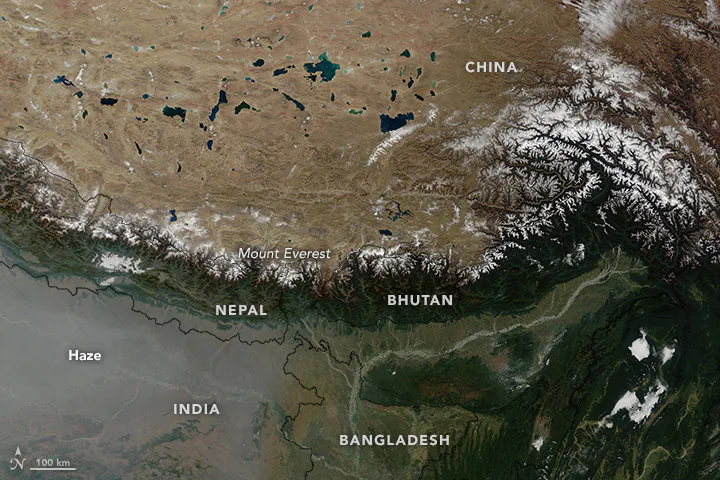
The Himalayan mountains formed at which type of boundary?
Convergent boundary
Divergent boundary
Transform boundary
Heated magma moves upwards, cools, and then sinks. This is called a...
Heat Zone
Convection Current
Seafloor Spreading Event
Continental Drift Motor

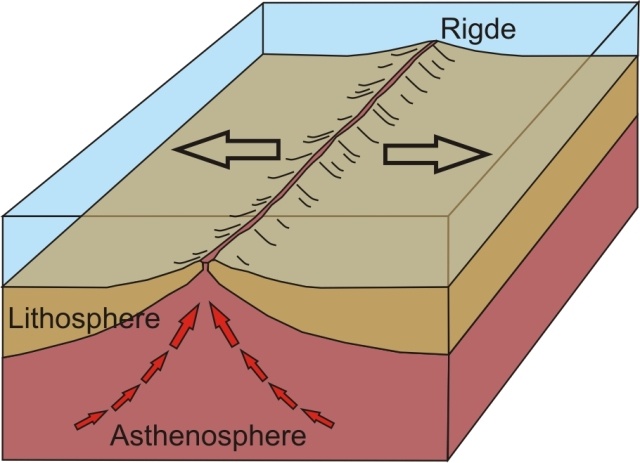
The diagram shows a rift valley formed by the movement of tectonic plates
Which movement of tectonic plates caused the rift valley to form?
Two tectonic plates separated from each other.
Two tectonic plates collided with each other.
One tectonic plate slid under another.
One tectonic plate slid past another.
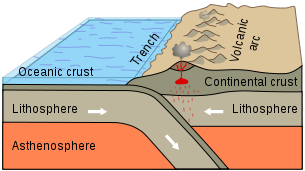
The movement of the tectonic plates is caused by
the rotation of the Earth.
convection currents in the Asthenosphere
the gravity of the iron-nickel core.
the Moho discontinuity.

Which type of crust is older?
Continental Crust
Oceanic Crust
They are the same age
The crust isn't alive so they don't have an age
What two factors identify what type of crust we have?
Density and location
Buoyancy and Type of material
Density and Buoyancy
Type of material and density
Why does the continental crust float more than the oceanic crust?
The hypothesis that a single large landmass broke up into smaller land masses to form the continents.
continental drift
Sea floor spreading
Asthenosphere
pangea
The process by which new oceanic lithosphere(sea floor) forms when magma rises to Earth’s surface at mid ocean ridges and solidifies
continental drift
Sea floor spreading
Asthenosphere
pangea
The theory that explains how large pieces of the lithosphere called plates move and change shape
Rifting
Fault
Plate tectonics
Divergent Boundary
The solid, outer layer of Earth that consists of the crust, and the ridged upper part of the mantle
asthenosphere
lithosphere
pangea
sea floor spreading
The boundary between tectonic plates that are sliding past each other horizontally
convergent boundary
transform boundary
divergent boundary
fault
The magnetic pattern of ocean-floor rocks on one side of an ocean ridge is _____.
a mirror image of that of the other side
younger than on the other side
much different from the magnetic pattern found in rocks on land
at right angles to the ocean ridge
Compared to ocean crust near deep-sea trenches, crust near ocean ridges is _____.
younger
older
the same age
magnetically reversed

True or False: The plates are currently moving
What is the difference between magma and lava?
lava is magma but it is on the surface of the Earth
lava is the chamber that magma flows
lava is the Earth's crust
lava has a different chemical composition than magma

Many earthquakes happen along the borders of...
Countries
Tectonic Plates
Climate Zones
Mountains

The surface of Earth is called
crust
core
nucleus
magma

B on the diagram is
Mantle
Inner Core
Outer Core
Crust

The center of Earth is called
Core
Mantle
Crust
San Andreas Fault

What is under the crust?
Magma
Solid Metal
Liquid Metal
Solid Rock

Tectonic Plates move because
Plates float on moving magma.
Plates float on the ocean.
Earthquakes cause plates to move.
The rotation of EArth moves plates.

India colliding with Asia creates the
Himalayan Mountains
Mid Atlantic Ridge
Pacific Ring of Fire
Volcanoes

250 million years ago the continents were
together.
under the ocean.
contracting.
between the oceans.

The place where an earthquake originates inside the Earth's surface is called...
Epicenter
Focus
Underground
Crust

The place on the Earth's surface, above the origin of the earthquake.
Epicenter
Focus
Surface
Crust

Which city is closest to the epicenter?
A
B
C

Which seismogram represents a city that is far from the epicenter of an earthquake?
New York, NY
Nome, Alaska
Guadalajara, Mexico
This is created by earthquakes that occur on the ocean floor.
longshore current
gulf stream
tsunamis
high tide
S-waves can move through which of the following?
Gas
Liquid
Solid
All of these
What is the minimum number of seismograph stations needed to locate an earthquake epicenter?
1
2
3
5
Which wave can travel through all materials?
P - primary
S - secondary
L - Long
Earthquakes generate compressional waves [P-waves] and shear waves [S-waves]. Compared to the speed of shear waves in a given earth material, the speed of compressional waves is
always faster
always slower
always the same
sometimes faster and sometimes slower
The distance between an epicenter and seismograph’s location can be calculated by using the
arrival time of the first P-wave
difference in arrival times between P- and S- waves
amplitude of the p-wave
energy released by an earthquake

Only P-waves were recorded at seismic station C because P-waves travel
only through Earth’s interior, and S-waves travel only on Earth’s surface
fast enough to penetrate the core, and S-waves travel too slowly
through iron and nickel, while S-waves cannot
through liquids, while S-waves cannot


Many earthquakes happen along the borders of...
Countries
Tectonic Plates
Climate Zones
None of the above.

What type of boundary is shown in the diagram?
Divergent
Convergent
Transform

What type of boundary is shown in the diagram?
Divergent
Convergent
Transform


A flat, wide volcano is called a...
Cinder cone volcano
Stratovolcano
Composite Volcano
Shield Volcano
A short, mountain volcano with steep sides is called a...
Cinder cone volcano
Stratovolcano
Composite Volcano
Shield Volcano
A very tall mountain volcano with steep sides is called a...
Cinder cone volcano
Stratovolcano OR Composite Volcano
Shield Volcano
Eruptions at subduction zones are more likely to be...
Non-explosive
Mostly mafic lava
Explosive and violent
From shield volcanoes
Having more silica or feldspar in lava makes it...
Thicker and felsic
Very thin and runny
Mafic
Thinner and felsic
When molten rock cools and becomes solid it is called:
sedimentary rock
igneous rock
metamorphic rock
Depending on its silica content, lava can be "runny" and flow quickly downslope or "thick" and flow more slowly. This property is called:
density
viscosity
flow rate

