
 Worksheets
Digestion, Water, & Macromolecules (PreIB Biology)
Total questions: 87
Worksheet time: 1hrs 7mins
Molecular Biology is the study of
Biological molecules
Chemical processes in living organisms
Organic chemistry
DNA
Select all that apply. Urea can be produced by:
Aerobic respiration in living organisms.
The urea cycle in the liver.
From carbon dioxide and ammonia in a laboratory.
Anaerobic respiration in living organisms.
Typically, in carbon compounds, how many bonds does carbon make?
3
4
5
none of the above
Common types of carbon compounds in living organisms are:
DNA, enzymes, nitrogenous bases, and amylose.
Nucleic acids, amino acids, carbohydrates, and lipids.
Urea, amino acids, nucleic acids, and carbohydrates
Carbon dioxide, Lipids, carbohydrates, and proteins.
Nucleic acids, proteins, carbohydrates, and lipids.

This molecule is a
Carbohydrate
Lipid
Protein
Nucleic acid
Cholesterol
What is a -COOH group called?
Amine group
Hydroxyl
Carboxyl
Methyl
Which is not true about carbohydrates?
They contain oxygen and hydrogen in a 1:2 ratio.
They contain carbon, oxygen, and hydrogen.
They have hydroxyl groups.
They have carboxyl groups.
Which statement is true about amino acids?
All amino acids have
C=C double bondsAll amino acids have amine groups.
Some amino acids contain phosphorus.
No amino acid contains sulfur.
Which statement is true about catabolism?
Catabolism occurs during protein synthesis.
Catabolic reactions release energy that can be captured in the form of ATP
An example of a catabolic process is DNA replication.
Catabolism is the synthesis of complex molecules from simpler molecules through hydrolysis.
Metabolism is best defined as:
A chemical reaction.
The web of all enzyme-catalyzed reactions in a cell or organism.
The web of all chemical reactions in a cell or organism.
The web of all endergonic reactions in a cell or organism.
Water molecules consist of two types of atoms
Oxygen and Oxygen
Oxygen and Helium
Oxygen and Hydrogen
Oxygen and Hafnium
Where one part of water molecules is partially negative and the other is partially positive is called
Bonding
Polarity
Charged
Neutral
When water molecules are near each other, what forms between them?
nothing
a tiny rope
Attractive forces
Hydrogen Bonds
Hydrophillic means
water-loving
water-fearing
Which substance is more likely to dissolve in water?
Hydrophillic
Hydrophobic
In the Phospholipid bilayer, there is a __________ head and a ___________ tail.
polar; nonpolar
nonpolar; polar
Which property of water would allow bugs to float on water?
Cohesion
Adhesion
Thermal
Solvent
Which property of water allows plants to transport water?
Cohesion
Adhesion
Thermal
Solvent
When energy is added to water
water stays the same
water warms up
water freezes
The energy required to increase 1g of a substance 1 degree Celcius is
Boiling
Increase in energy
Freezing
Specific Heat
Water's high specific heat allows it to be a __________ environment for marine organisms.
Heated
Good
Stable
Harsh
The energy required for water to evaporate is called
Specific Heat
Latent Heat of Vaporization
Boiling
Evaporation
Because of its hydrogen bonds, water has a high ___________
Boiling Point
Freezing Point
Latent Heat of Vaporization
Specific Heat
Water's high latent heat of vaporization allows organisms to use it as a ______________
Coolant
Dietary Supplement
way to stay hydrated
Compared to water, methane is
Polar
Non-Polar
Compared to water, methane has a lower ________________
Specific Heat
Latent Heat of Vaporization
Melting Point
Boiling Point
Because water is polar, it makes an effective
Solute
Solvent
Which term describes the synthesis of complex molecules fromsimpler molecules?
adhesion
catabolism
metabolism
anabolism
Which can be explained by the solvent properties of water?
Sodium chloride is transported as Na+ and Cl– in blood.
Movement of water occurs under tension in the xylem.
Water is the coolant in sweat.
Ice floats on liquid water.
Which type of reaction is the breakdown of starch into sugars?
Denaturation
Reducation
Catabolic
Condensation
Which molecule is a polysaccharide?
Glucagon
Glucose
Glycerol
Glycogen
Which type of chemical reaction is an example of anabolism?
Phytolysis
Combustion
Hydrolysis
Condensation
What feature of carbon makes it most suitable as a basis for life?
Its abundance in nature
Its bonding properties
Its teativity to light
Its presence in the early atmosphere of the Earth
Which of the following is the main reason that humans need to include carbohydrates in their diet?
Carbohydrates are broken down in cells for energy.
Carbohydrates combine to form many different proteins.
Carbohydrates act as catalyst to speed up chemical reactions.
Carbohydrates are the building blocks for cell growth and repair.

What characteristic shows that this steroid molecule is a lipid?
it is made of carbon rings
it has a very low proportion of oxygen to carbon
it contains OH groups as do fatty acids
it is made only of nitrogen, oxygen, and hydrogen

The diagram shows the structure of palmitic acid. What type of fatty acid is palmitic acid?
it is monosaturated
it is polyunsaturated
it is saturated
it is a trans-fatty acid
What is a role of cholesterol in animal cells?
it increases body fat
it controls membrane fluidity
it lines the inner wall of capillaries
it is a constituent of bile
Which molecule diagram corresponds to the name?


Which molecule is a sugar?


Condensation between two amino acids results in a _________, joined by a _________ bond.
dipeptide, peptide
dipeptide, ester
disaccharide, peptide
disaccharide, ester
Water is _______ in a condensation reaction.
produced
consumed
When forming a dipeptide, condensation occurs between the ______ from a carboxyl group on one amino acid and ______ from an amine group of another amino acid.
OH, H
H, OH
Which is NOT a key idea that explains the huge range of possible polypeptides?
They could be any length.
There are 20 amino acid possibilities.
The amino acids could be in any order or combination.
Prokaryotes only use 10 amino acids.
Select the properties that R groups of amino acids can possess that they affect how the protein folds into its three dimensional shape (multiple answers possible).
Some are polar (hydrophilic).
Some are non-polar (hydrophobic).
Some are positively or negatively charged.
Some contain sulfur.
The sequence of amino acids forming a polypeptide is known as the _____ structure of a protein.
primary
secondary
tertiary
quaternary
The chains of amino acids folding or turning on themselves is known as the _____ structure of a protein.
primary
secondary
tertiary
quaternary
The folding and coiling into a three dimensional structure based on interactions between R-groups is known as the _____ structure of a protein.
primary
secondary
tertiary
quaternary
The interaction between multiple polypeptides or prosthetic groups is known as the _____ structure of a protein.
primary
secondary
tertiary
quaternary
The level of structure most important to enzyme function is the _____ structure.
primary
secondary
tertiary
quaternary
Fibrous proteins are generally ______ in water, while globular proteins are generally ______ in water.
insoluble; soluble
soluble; insoluble
The breaking of bonds between R-groups results in a conformational change in a protein called
denaturation.
insolubility.
a genome.
a peptide bond.
T/F: Denaturation is normally permanent.
true
false
The sum total of all chemical reactions that occur within an organism is it's
metabolism.
enzyme-driven reaction.
glycolysis.
activation energy.
Activation energy is the ________ input of energy required to trigger a chemical reaction.
initial
final
An enzyme is a
carbohydrate.
protein.
lipid.
nucleic acid.
The region on the surface of the enzyme that the substrate binds to is the
active site.
activation energy.
lock-and-key model.
catalysis.
What suffix is commonly applied to enzymes?
-ase
-ose
-ter
-ice
Enzymes act as catalysts to __________ the rate of a biochemical reaction by ___________ the activation energy needed for the reaction to occur.
increase, lowering
decrease, lowering
increase, raising
decrease, raising
After an enzyme is denatured, the substrate can ______ to the active site.
bind
no longer bind
As temperature increases toward the optimal level, the kinetic energy of the enzyme and substrate ________, resulting in ________ collisions.
increases, more frequent
increases, less frequent
decreases, more frequent
decreases, less frequent
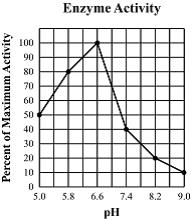
T/F: All enzymes have the same optimum pH range.
true
false

The graph for substrate concentration vs enzyme activity plateaus because
all active sites are full and the enzymes are working at their maximum efficiency.
the enzymes are used up and there aren't any left.
Enzymes used in industry are commonly
immobilized.
replaced after every catalysis reaction.
unstable.
unconcentrated.
_______ is the enzyme that hydrolyzes _______ into glucose and galactose.
Lactase, lactose
Lactose, lactase
Which organ in the human body secretes lipase, amylase and protease?
Liver
Small intestine
Stomach
Pancreas
Where does the digestion of polypeptides start in humans?
Mouth
Esophagus
Stomach
Small intestine

What are functions of the stomach, small intestine and large intestine?
A
B
C
D

The diagram below shows parts of the human digestive system.
Which points are linked by the small intestine?
I and III
II and III
II and IV
III and IV
What is the main function of the large intestine?
absorption of water
absorption of vitamins
absorption of monosaccharides
digestion of vitamins
Important elements in living organisms EXCEPT
Hydrogen
Carbon
Mercury
Nitrogen
Example of a monomer
Triglycerides
Starch
DNA
Glycine

Involuntary muscle contractions that move food.
Chemical breakdown
Flexion
Swallowing
Peristalsis

Where does MOST of the digestion process occur?
Small intestine
Mouth
Stomach
Large Intestine
Colon

The physical & chemical breakdown of food is called?
Digestion
Absorption
Swallowing
Excretion

Pick the correct order of digestion
Mouth,stomach,esophagus,large intestine,small intestine
Mouth,esophagus,stomach,small intestine, large intestine
Mouth, esophagus, stomach, large intestine, small intestine, colon
Mouth, stomach, esophagus, small intestine, large intestine

Where is Bile produced?
Liver
Stomach
Pancreas
Colon

