
 Worksheets
Unit 4 Bio Test Review
Total questions: 90
Worksheet time: 2hrs 21mins
In which stage of the cell cycle does the cell grow in size?
G1
S
G2
Mitosis
In which stage of the cell cycle does the DNA replicate?
G1
S
G2
Mitosis

Where does DNA reproduce?
Mitosis
Synthesis
G2

Nuclear membrane disappears
Chromosomes can now be seen
Centrioles move to opposite sides
Metaphase
Interphase
Telophase
Prophase

Chromosomes line up at the equator of the cell
Spindle fibers extend from the centrioles to the middle of the chromosomes
Prophase
Metaphase
Anaphase
Interphase

Chromatids separate
Anaphase
Metaphase
Prophase
Telophase

Nuclear membrane reforms around the new daughter cells.
Cytoplasm begins to "pinch" in.
Anaphase
Metaphase
Telophase
Interphase

Two replicated cells split from each other and are able to move on their own.
Metaphase
Prophase
Cytokinesis
Telophase
Identical copies of chromosomes
Chromosome
Chromatid
Centriole
Centromere
The middle of a chromosome
Centriole
Cytokinesis
Centromere
Chromatid
The goal of mitosis is to
make a new parent cell
make two new daughter cells with the same DNA
make two new daughter cells with different DNA
to grow a larger toe
A good way to remember the stages of cell division is:
AMPT
ATMP
PMAT
PMA
How many chromosomes are in each human cell?
1
146
46
1,000,000

What stage of mitosis is this?
Interphase
Anaphase
Cytokinesis
Prophase

What stage of mitosis is this?
metrophase
middlephase
centraphase
metaphase
In what stage do the chromosomes line up along the equator of the cell?
interphase
prophase
metaphase
anaphae
If there are 20 chromosomes in the nucleus before mitosis how many will there be in each new daughter cell after cytokinesis?
20
10
40
200

Which picture illustrates telophase?


Which picture illustrates anaphase phase?


Sex cells are called ______________ and body cells are called ___________.
gametes; somatic
somatic; gametes
daughters; parents
parents; daughters
If an organism's lung cells contain 28 chromosomes, its gametes have ____ chromosomes.
28
14
56
7
_________________ creates genetic diversity in gametes.
Crossing over
Prophase
Mitosis
Interphase
Crossing over occurs during _________________.
prophase II
telophase II
prophase I
anaphase I

What phase is this?
Metaphase I
Prophase II
Telophase I
Anaphase II

What phase is this?
Metaphase II
Prophase II
Telophase I
Anaphase I

What phase is this?
Metaphase II
Prophase I
Telophase I
Anaphase II

What phase is this?
Metaphase II
Prophase I
Telophase I
Anaphase I

What phase is this?
Anaphase II
Telophase I
Telophase II
Anaphase I
MEIOSIS produces ___ cells
diploid
haploid

Meiosis is involved in the production of _____.
Body cells.
Skin and blood cells.
Healing wounds.
Gametes.
Mitosis occurs only in _____.
Reproductive cells.
Skin and bones.
Body cells.
Infants and Children.
A cell containing 20 chromosomes goes through MITOSIS. What is the end result?
2 daughter cells each containing 40 chromosomes
2 daughter cells each containing 20 chromosomes
2 daughter cells each containing 10 chromosomes
4 daughter cells each containing 20 chromosomes
2. A cell containing 20 chromosomes undergoes MEIOSIS. What is the end result?
2 daughter cells each containing 20 chromosomes
2 daughter cells each containing 40 chromosomes
4 daughter cells each containing 10 chromosomes
4 daughter cells each containing 20 chromosomes

Asexual reproduction is associated with what type of cell division?
Mitosis
Meiosis
How many parents are required for sexual reproduction?
0
1
2
3
Which is a disadvantage of asexual reproduction?
populations take a long time to grow
populations lack genetic diversity, making them vulnerable
offspring are slow to reach sexual maturity
offspring are not vulnerable to environmental changes
Sexual reproduction results in genetic variation because sex cells (gametes) go through the process of:
mitosis
meiosis
interphase &
cell growth
cell division
The facts that organisms might die before they find a mate and reproduce is a(n):
disadvantage of sexual reproduction
disadvantage of asexual reproduction
advantage of asexual reproduction
advantage of sexual reproduction
___________ result in species that are more resilient to environmental changes.
Genetically diverse populations
Large population numbers
Genetically identical populations
Environmental pressures
All human have _________ chromosomes
23
46
Diploid
Haploid
A 2n cell of a bat has 44 chromosomes, how many chromosomes will you find in one of his gametes
23
22
44
88
A cell that has a half set of chromosomes is called a______ cell.
haploid
diploid
triploid
hetrolpoid
A cell that has a full set of chromosomes is called a______ cell.
haploid
diploid
triploid
hetrolpoid

Image shows pairing of chromatids called...?
Crossing Over
Segregation
Synapsis
Coupling

Crossing over in organisms is responsible for...?
Dominance of genes
Recombination of genes
Linkage
Segregation of alleles
In pea plants, round seeds (R) are dominant to wrinkled seeds (r). Which of the following represents the genotype of a pea plant that is heterozygous?
RR
round
Rr
wrinkled
rr
In pea plants, round seeds (R) are dominant to wrinkled seeds (r). Which of the following represents the genotype of a pea plant that is homozygous dominant?
RR
round
Rr
wrinkled
rr

In mice, black fur (B) is dominant to white fur (b). According to the Punnett square shown, the offspring in box 4 would:
be white.
be heterozygous.
be gray.
be homozygous.
If black fur is dominant and white fur is recessive, what genotype would an organism with white fur have?
FF
Ff
ff


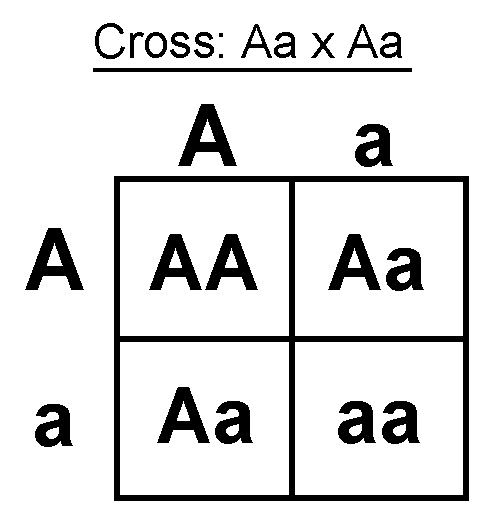
What are the possible phenotype(s) of the offspring? (A-Brown hair; a-blond hair)
50 % Brown Hair and 50% Blond Hair
25 % Brown Hair and 75% Blond Hair
75 % Brown Hair and 25% Blond Hair
0% Brown Hair and 100% Blond Hair

Cody crosses a plant producing wrinkled peas with a plant producing smooth peas. Weeks later, he discovers that all the offspring plants have smooth peas. Cody drew the Punnett square above to show the genotypes of the offspring plants. What were the genotypes of the parent plants?
RR and rr
Rr and Rr
RR and Rr
Rr and rr
In a plant species, long stems (L) are dominant to short stems (l). A heterozygous plant is crossed with a homozygous dominant plant. What will be the ratio of genotypes in the offspring?
1:1
2:2
1:3
0:4
In a species of mammals, gray fur (G) is dominant to white fur (g). Two heterozygous mammals are mated together and produce offspring. What fraction of offspring will have gray fur?
1/4
1/2
3/4
2/4
In cats, long hair (H) is dominant to short hair (h). A cat with long hair (Hh) is mated with a cat that also has long hair (Hh). What will be the ratio of long hair to short hair?
1:1
2:2
3:1
1:3
What would be the gametes for the YyRr plant?
YR, YR, yR, yR
YR, Yr, yR, yr
Yy, Rr, YY, RR
yy, rr, yy, rr

What is the genotype that should be in the blank square?
yyRr
YYRR
yyrr
YrYr

What percent of the parakeets from this cross look like the first parent in P1?
7
8
9
11
What is the genotype that should be in the blank square?
yyRr
YYRR
yyrr
YrYr

Parent 1 is heterozygous for both pea color and shape. Parent 2 is heterozygous for both pea color and shape.
What should the phenotype be for the box with the "?" ?
Yellow & Smooth
Green & Wrinkled
Green & Smooth
Yellow & Wrinkled
Parent 1 is heterozygous for both pea color and shape. Parent 2 is heterozygous for both pea color and shape.
What should the phenotype be for the box with the "?" ?
Yellow & Smooth
Green & Wrinkled
Green & Smooth
Yellow & Wrinkled

Based off this punnett square, what fraction of the offspring will have wrinkled, yellow seeds?
9/16
3/16
1/16
16/16


A man that is homozygous for type A blood (IAIA) has children with a woman that is heterozygous for type B blood (IBi). What percentage of offspring will have type A blood?
25%
50%
75%
100%
A man that is homozygous for type A blood (IAIA) has children with a woman that is heterozygous for type B blood (IBi). What fraction of offspring will have type AB blood?
1/8
1/4
1/2
3/4
A woman with type AB blood marries a man with type O blood and they have several children. What fraction of offspring will have type A blood?
1/4
2/4
1/2
3/4
A woman with type AB blood marries a man with type O blood and they have several children. What percentage of offspring will have type AB blood?
0%
25%
50%
75%
Some flowers are controlled by codominance. Red flowers (RR), blue flowers (BB) and Speckled flowers (RB).
Cross a red flower with a speckled flower. What is the phenotypic ratio?
2 red, 2 speckled
2 red, 2 blue
2 blue, 2 speckled

Incomplete dominance occurs in cats, which allows them to be Black, White, or gray as shown on this Punnett square. What percentage of the offspring will be white?
25
50
0
100

