wayground logo

Free Printable Worksheets

Font size

S
M
L
XL
Worksheets

Spring Exam Review

Total questions: 85

Worksheet time: 43mins

Name
Class
Date
1.
Humans are omnivores.  This means that
a)
humans can only eat plant based foods
b)
humans are at the top of the food chain
c)
humans are only capable of digesting other animal products
d)
humans eat both meat and plants
2.

In which order do organisms occur in the food chain?

a)

carnivore → herbivore → producer

b)

herbivore → carnivore → producer

c)

producer → carnivore → herbivore

d)

producer → herbivore → carnivore

3.
A tick sucking blood from a human... YUMMMY!!
a)
Commensalism
b)
Parasitism
c)
Mutualism
d)
Density-dependent
4.
Minimal parental involvement and lots of offspring
a)
R selection
b)
K selection
5.
A S-shaped curve can be seen when...
a)
A population is growing
b)
A population is declining
c)
A population meets it's carrying capacity
d)
A population is migrating
6.
Carrying capacity of the population...
a)
20
b)
40
c)
80
d)
100
7.
All the different populations interacting with each other in a particular area. 
a)
ecosystem
b)
community
c)
population
d)
biosphere
8.
Which type of interaction would describe the relationship between a barnacle attached to a whale that doesn't harm or hurt the whale, but the barnacle benefits by getting a free ride around the ocean?
a)
parasitism (+, -)
b)
mutualism (+, +)
c)
commensalism (+, 0)
d)
predation (+, -)
9.
An organism that does NOT eat other organisms to obtain energy because it can make its own energy!
a)
plant
b)
producer
c)
autotroph
d)
these are all correct
10.

Which type of trees characterizes our biome, here in Alabama?

a)
deciduous
b)
cacti
c)

mostly conifers

d)
palm
11.

This biome is just south of the tundra. It contains mostly spruce trees and Douglas firs, which are both evergreen. The winters are long and cold and the summers are short and rainy. The soil is very rich. Moose and elk live here.

a)

boreal forest or taiga

b)

chaparral

c)

temperate deciduous forest

d)

temperate rainforest

12.
The biome known for trees with broad leaves that fall off the trees in the winter.
a)
Coniferous Forests
b)
Temperate Deciduous Forests
c)
Deserts
d)
Tundra
13.
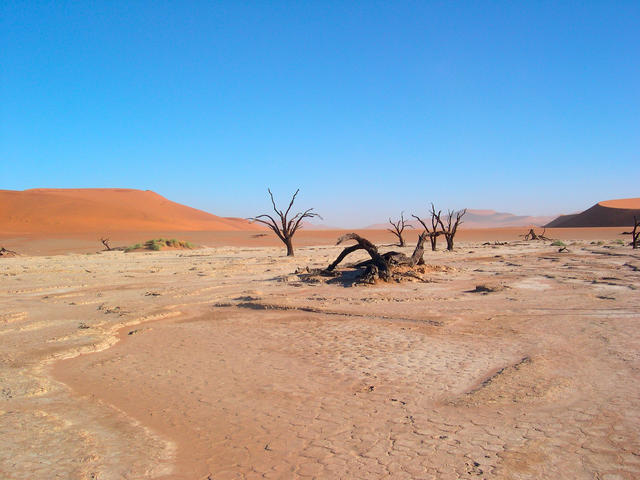
 What type of biome is pictured?
a)
Desert
b)
Tundra
c)
Tropical Rainforest
d)
Grassland
14.
Biotic factors of an ecosystem are:
a)
non-living
b)
plants
c)
living thing
d)
soil
15.
Identify an a example of an abiotic factor?
a)
Panda
b)
Turtle
c)
Butterfly
d)
sunlight
16.
Where does the energy start in this food chain?
a)
Plant
b)
Sun
c)
Deer
d)
Wolf
17.
What is the role of a producer?
a)
Use sunlight to make food
b)
Gain energy from eating other organisms
c)
Keep other species from overpopulating
d)
Breaking down dead stuff 
18.
What is the role of decomposers in a food chain?
a)
Use sunlight to make food
b)
Eat other organisms to gain energy
c)
Make the food for the whole food chain
d)
Break down dead organisms and add nutrients to the soil
19.
The arrows in a food chain or web represents what?
a)
They point to the organism that is being eaten.
b)
It shows how sunlight flows within an ecosystem.
c)
They show what direction the energy is flowing between organisms. 
d)
They represent how water is transferred within a habitat.
20.

Energy flows from the ______ to _______ to ______.

a)

Sun to consumers to producers

b)

Predator to the prey to the sun

c)

Sun to producers to consumers

d)

Predator to the Sun to prey

21.
A relationship between two organisms in which one organism benefits and the other is unharmed...
a)
Mutualism 
b)
Competition
c)
Parasitsm 
d)
Commensalism 
22.
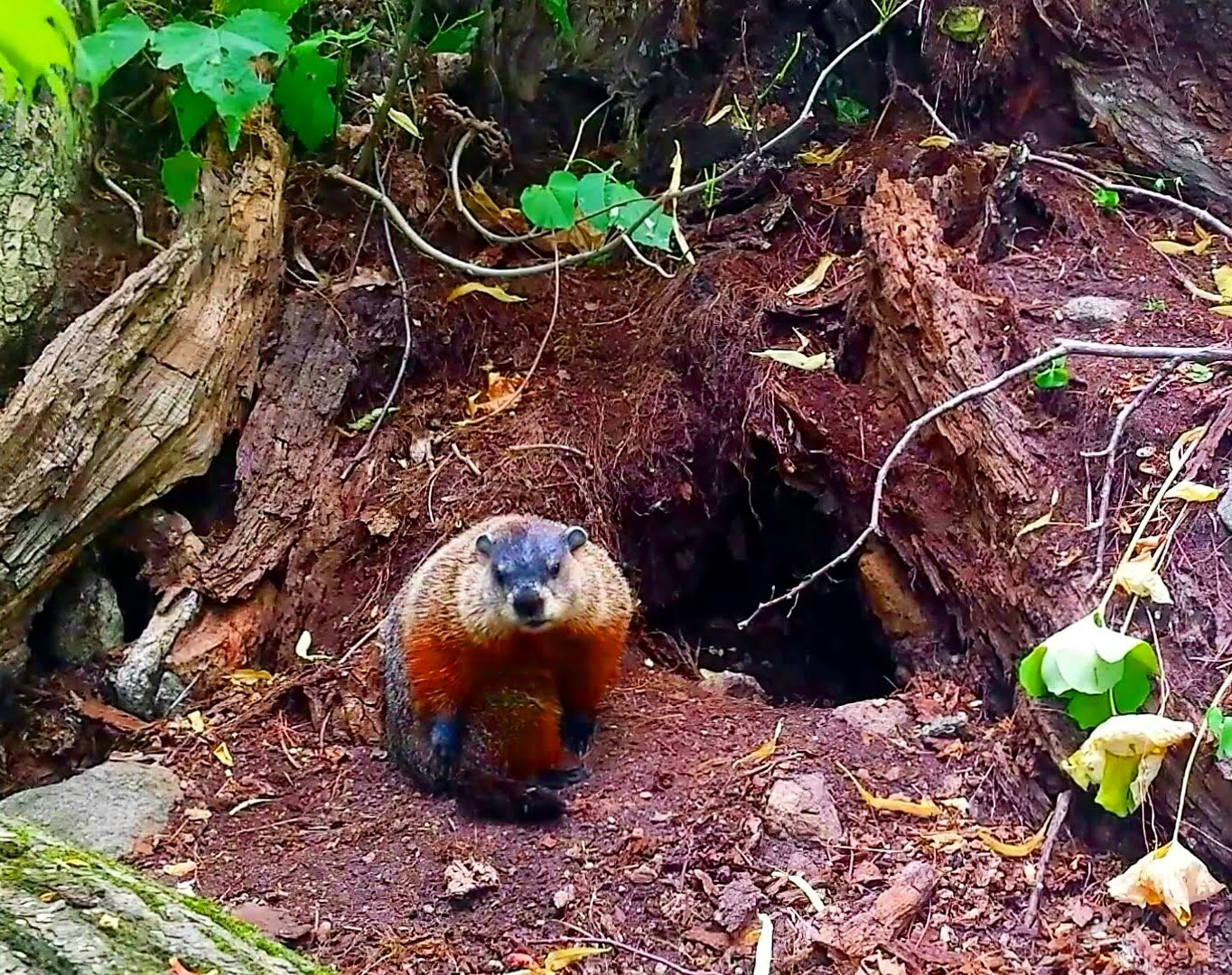
What type of symbiosis?  Skunks often live in burrows that have been dug and abandoned by woodchucks.  
a)
commensalism
b)
mutualism
c)
parasitism
d)
predation
23.
A pioneer species is...
a)
a large organism
b)
the first organisms to adapt to a new environment 
c)
The best organism 
d)
Abiotic organisms 
24.
What is the most important function of pioneer species?
a)
To create rocks
b)
To create soil and add nutrients to the environment 
c)
To look nice
d)
Food for animals 
25.
What is the difference between primary and secondary succession?
a)
Primary succession already has soil.
b)
Primary has soil and secondary does not
c)
soil is present in both
d)
primary has no soil and secondary has soil
26.
How much energy is passed on to each trophic level in an energy pyramid?
a)
10%
b)
90%
c)
50%
d)
80%
27.
Which off the following processes returns water vapor to the atmosphere?
a)
Evaporation and Condensation
b)
Evaporation and Precipitation
c)
Transpiration and Evaporation
d)
Transpiration and Precipitation
28.

Nitrogen fixing bacteria, lives in nodules on the root of a plant called

a)

Broccoli

b)

Legumes

c)

Beets

d)

Turnips

29.

Which of the following is NOT a legume?

a)

soybeans

b)

peas

c)

peanuts

d)

fungi

e)

clover

30.

What are the 3 types of dispersions?

a)

size, density, dispersion

b)

groups, couples, single

c)

near, far, wherever you are

d)

random, clumped, uniform

31.

The most common kind of dispersion in nature is

a)

clumped

b)

uniform

c)

random

d)

unknown

32.

Tracks organisms that tend to live long lives (low death rate and high survivorship rate); toward the end of their life expectancies, however, there is a dramatic increase in the death rate.

a)

Type I

b)

Type II

c)

Type III

d)

Type IV

33.
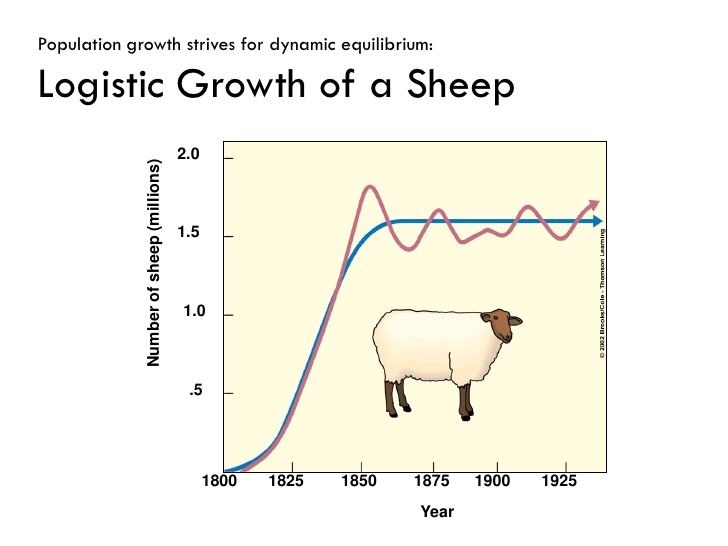
What is the carrying capacity for this sheep population?
a)
1.8 million
b)
1.25 million
c)
1.6 million
d)
1.o million
34.

What point on the graph represents maximum growth?

a)
A
b)
B
c)
C
d)
D
35.
The two strands of a DNA molecule are held together by ________ bonds between their base pairs.
a)
covalent
b)
hydrogen
c)
ionic
d)
peptide
36.
Which of the following is not a base found in DNA?
a)
adenine
b)
thymine
c)
cytosine
d)
uracil
37.
What is the process that copies information from DNA into RNA?
a)
protein synthesis
b)
transcription
c)
translation
d)
DNA Polymerase
38.
The copying of DNA to make two identical strands is called ___
a)
transformation
b)
translation
c)
transcription
d)
replication
39.
What do amino acids form?
a)
RNA
b)
DNA
c)
Proteins
40.

Which of the following is the correct order?

a)

RNA -> DNA-> protein

b)

protein -> DNA -> RNA

c)

DNA -> protein -> RNA

d)

DNA->RNA-> Protein

41.
RNA contains the sugar
a)
ribose
b)
deoxyribose
c)
glucose
d)
lactose
42.
Amino acids are joined together in order to form
a)
DNA
b)
ribosomes
c)
proteins 
d)
RNA
43.
In eukaryotes, DNA is located in the
a)
cytoplasm
b)
nucleus
c)
cell membrane
d)
ribosome
44.
A sugar, a phosphate group, and a nitrogen base form the building blocks of which organic compound?
a)
carbohydrates
b)
nucleic acids
c)
lipids
d)
proteins
45.
What are the backbones (sides) of the DNA structure made up of?
a)
repeating phosphates and sugars
b)
nitrogen bases
c)
nucleotides
d)
adenine and thymine
46.

Who built the first accurate model of DNA?

a)

Chargaff

b)

Franklin and Wilkins

c)

Watson and Crick

d)

Mendel

47.

What scientist used x-rays to study DNA and died early so he/she did not receive a Nobel Prize for their work?

a)

Franklin

b)

Wilkins

c)

Watson

d)

Chargaff

48.

What scientists figured out the base pairing rules?

a)

Watson

b)

Chargaff

c)

Crick

d)

Franklin

49.
What is the shape of DNA?
a)
Double helix
b)
Triple helix
c)
Flat, bilayer
d)
Three-pronged rigid ladder
50.

How do you classify the following genotype : AA

a)

Homozygous Dominant

b)

Homozygous Recessive

c)

Heterozygous

51.

How do you classify the following genotype : Mm

a)

Homozygous Dominant

b)

Homozygous Recessive

c)

Heterozygous

52.

If Purple Flowers (P) are dominant over white flowers (p), what would the phenotype be for a Pp genotype?

a)

Purple flowers

b)

White flowers

c)

Not enough information

53.

If Brown eyes (B) are dominant over blue eyes (b), what would the phenotype be for a bb genotype?

a)

Brown Eyes

b)

Blue Eyes

c)

Green Eyes

54.

When organisms are better adapted to their environment they will survive and reproduce more successfully than organisms less adapted. This process is called what?

a)

Selective breeding

b)

Natural Selection

c)

Cloning

d)

Evolution of all species

55.

Which scientist visited the Galapagos Islands and came up with the theory of natural selection?

a)

Theodor Schwann

b)

Gregor Mendel

c)

Charles Darwin

d)

Rudolf Virchow

56.

Sometimes bones in the front limbs of animals are very similar in structure. What do we call similar bone structures that indicate a link to a common ancestor?

a)

Adaptations

b)

Gradualism

c)

Homologous Structures

d)

Extinction

57.

A physical or behavioral trait that helps an organism survive and reproduce in its environment is called a what?

a)

An adaptation

b)

A response to a stimulus

c)

A mutation

d)

Evolution

58.

What most likely caused the finches on the Galapagos Islands to have beaks that were different from the finches on the mainland?

a)

There were different types of predators on the island.

b)

There were different types of food available on the island.

c)

The finches had no water to drink.

d)

The finches on the mainland could not fly high enough.

59.

What do we call a change in a species over time?

a)

Adaptation

b)

Evolution

c)

Extinction

d)

Environmental influences

60.
Who was the naturalist that traveled the world to study plants and animals?
a)
Albert Einstein
b)
Charles Darwin
c)
Charles Barkley
d)
Isaac Newton
61.
Darwin wrote that organisms with traits that are best suited to the environment will ________________
a)
increase in number
b)
become extinct
62.
A group of similar organisms that can mate with each other and produce fertile offspring is called a species.  
a)
True  
b)
False
63.

The three species pictured share a common ancestor and have adapted so that each lives in a different environment. This is an example of

a)

Law of Superposition

b)

Evolutionary Arms Race

c)

Divergent Evolution

d)

Convergent Evolution

64.

The yucca moth depends on the small soap weed for food, and the small soap weed is only pollinated by the yucca moth. This is an example of

a)

Evolutionary Arms Race

b)

Convergent Evolution

c)

Coevolution

d)

Adaptive Radiation

65.

When unrelated species evolve similar characteristics because they live in similar environments.

a)

Convergent Evolution

b)

Coevolution

c)

Adaptive Radiation

d)

Divergent Evolution

66.
What was Linnaeus the founder of? 
a)
Taxonomy
b)
Genetics
c)
DNA
d)
Structure of a Cell
67.

the smallest, most specific classification category

a)

Genus

b)

Phylum

c)

Order

d)

Species

68.

two-name system of classification

a)

phylum

b)

classification

c)

taxonomy

d)

binomial nomenclature

69.

Which of the following is the correct order from broadest to smallest?

a)

Kingdom, Class, Order, Family, Genus, Species, Phylum

b)

Species, Genus, Family, Order, Class, Phylum, Kingdom

c)

Kingdom, Phylum, Order, Class, Family, Genus, Species

d)

Kingdom, Phylum, Class, Order, Family, Genus, Species

70.
 Genetic Drift is more likely to happen in... 
a)
aquatic populations
b)
small populations
c)
terrestrial populations
d)
older populations
71.

Mechanism of evolution responsible for a random change in a population is known as:

a)

Speciation

b)

Selection

c)

Genetic Drift

d)

Variation

72.

Situation in which allele frequencies change as aresult of the migration of small subgroup of a population is known as:

a)

founder effect

b)

genetic bottleneck

c)

random mating

d)

natural selection

73.
Natural selection states that organisms are best suited for their environment if they ____________ and ____________.
a)
Survive and Reproduce
b)
Survive and Predate
c)
Survive and Parasitize
d)
Survive and Adapt
74.
Which of the following is an example of the bottleneck effect?
a)
Cheetah populations reach their lowest levels with reduced diversity and as they rebound are so genetically similar they appear to be inbred.
b)
Affected individuals with blue skin can trace their ancestry back to one of the first settlers in the region.
c)
The environment of a fox population changes and over time foxes who are white survive and pass on their genes to their offspring.
d)
Humans choose two dogs they like the characteristics of and breed them together.
75.
A flash flood carried a raft of Amazon ants away from their original population. There is enough distance between the two groups, that they will never meet in nature again. What type of reproductive barrier is this?
a)
behavioral isolation
b)
temporal isolation 
c)
gametic isolation
d)
geographic isolation 
76.
Gentoo penguins will present a mate with a pebble that they find to attract a mate. Emperor penguins have a specific call and movement that they make to attract a mate. Which type of isolation do these penguins demonstrate?
a)
temporal isolation 
b)
behavioral isolation
c)
geographical isolation
d)
anatomical isolation
77.

In the Great Lakes region of North America, gray wolves and coyotes are similar species but do not mate because their breeding periods occur at different times of the year.

a)

Geographic isolation

b)

Behavioral isolation

c)

Temporal isolation

78.

The American toad (Anaxyrus americanus) and Fowler's toad (Bufo fowleri) live in the same area. However, The American toad mates in early summer while Fowler’s mates in late summer.

a)

Geographic isolation

b)

Behavioral isolation

c)

Temporal isolation

79.

Albert’s squirrel and the Kaibab squirrel are distinct subspecies that live on opposite sides of the Grand Canyon. They were once one species, but now differ significantly, including fur coloring.

a)

Geographic isolation

b)

Behavioral isolation

c)

Temporal isolation

80.

Starlings produce an average of five eggs. If there are more than five the parents cannot adequately feed the young. Fewer than five and predators may destroy them. As a result, five eggs becomes the most common number.

a)

Stabilizing

b)

Directional

c)

Disruptive

81.

Seed cracker birds have either large beaks or small beaks. They do not have medium sized beaks because medium sized beaks do not allow for adequate cracking of seeds.

a)

Stabilizing

b)

Directional

c)

Disruptive

82.
What type of selection is depicted in the picture? 
a)
stabilizing 
b)
directional 
c)
disruptive 
d)
the answer is not here
83.
What type of selection?
a)
Directional 
b)
Stabilizing
c)
Disruptive
84.

Gregor Mendel studied

a)

corn plants

b)

pea plants

c)

tomato plants

d)

peanut plants

85.

The haploid number in humans is ____ and the diploid number is ___.

a)

46; 23

b)

20;40

c)

23;46

d)

80;160