
 Worksheets
Astronomy Tides and Eclipses Science 8
Total questions: 93
Worksheet time: 3hrs 6mins
Name
Class
Date
1.
How old is the Universe?
a)
4.6 million years old
b)
4.6 billion years old
c)
13.7 million years old
d)
13.7 billion years old
2.
How old is the Solar System?
a)
4.6 million years old
b)
4.6 billion years old
c)
13.7 million years old
d)
13.7 billion years old
3.
A light year is a measure of
a)
distance
b)
speed
4.
Galaxies are classified based on
a)
size
b)
number of stars
c)
shape
d)
angles
5.
Stars are huge balls of gas held together by
a)
glue
b)
gravity
c)
speed
d)
heat
6.
Stars produce tremendous amounts of energy due to
a)
nuclear fusion
b)
gravity
c)
mass
d)
light
7.
The life cycle of a star is determined by its
a)
speed
b)
temperature
c)
velocity
d)
mass
8.
Our Sun currently is considered a
a)
white dwarf star
b)
main sequence star
c)
giant star
d)
super giant star
9.
Our solar system is younger than the universe.
a)
True
b)
False
10.
The Terrestrial planets consist of
a)
Jupiter, Saturn, Neptune, and Uranus
b)
Jupiter, Saturn, Mars, and Earth
c)
Mercury, Venus, Earth and Mars
d)
Mercury, Venus, and Saturn
11.
The Jovian planets consist of
a)
Jupiter, Saturn, Neptune, and Uranus
b)
Jupiter, Saturn, Mars, and Earth
c)
Mercury, Venus, Earth and Mars
d)
Mercury, Venus, and Saturn
12.
This planet is the closest to the Sun and has the shortest period of revolution
a)
Mercury
b)
Venus
c)
Earth
d)
Mars
13.
Why does the Moon have different phases?
a)
It follows the Sun around the Earth.
b)
It moves around the Earth.
c)
It moves around the Sun.
14.
We can see the light shining on the Moon during the New Moon Phase.
a)
True
b)
False
15.
When the Moon is between the Earth and the Sun, it is most likely in what phase?
a)
New
b)
Last Quarter
c)
Full
16.
Is the Moon bigger or small than the Earth?
a)
Bigger
b)
Smaller
c)
The same
17.
The Moon gets its light from the
a)
Earth
b)
Stars
c)
Sun
18.
About how long does it take the Moon to complete it's cycle?
a)
1 week
b)
1 month
c)
1 year
19.

What moon phase is this?
a)
waxing crescent
b)
waxing gibbous
c)
waning crescent
d)
waning gibbous
20.

What moon phase would be seen from Earth when the moon is at position 1?
a)
new moon
b)
first quarter
c)
last quarter
d)
full moon
21.

What moon phase would be seen from Earth when the moon is at position 5?
a)
new moon
b)
first quarter
c)
full moon
d)
last quarter
22.

What moon phase is this?
a)
waxing crescent
b)
waxing gibbous
c)
waning crescent
d)
waning gibbous
23.

What phase of the moon would be visible from Earth when the moon is at position 1?
a)
new moon
b)
first quarter
c)
full moon
d)
last quarter
24.

What phase of the moon would be visible when the moon is at position 3?
a)
new moon
b)
first quarter
c)
full moon
d)
last quarter
25.

What moon phase would be visible from Earth when the moon is at position 5?
a)
first quarter
b)
last quarter
c)
new moon
d)
full moon
26.

What moon phase is this?
a)
first quarter
b)
last quarter
c)
waxing crescent
d)
waning crescent
27.

What moon phase is this?
a)
new moon
b)
full moon
c)
waxing crescent
d)
waning crescent
28.
What does "waxing" mean?
a)
growing
b)
shrinking
c)
lighted
d)
dark
29.
What does "waning" mean?
a)
growing
b)
shrinking
c)
lighted
d)
dark
30.
What side of the moon is the light on when the moon is waning?
a)
left
b)
right
c)
front
d)
back
31.
What side of the moon is the light on when the moon is waxing?
a)
left
b)
right
c)
front
d)
back
32.
The spinning of an object on its axis is called______
a)
orbit
b)
rotation
c)
revolution
d)
tide
33.
Day and night is caused by the _____________ of earth on its axis.
a)
revolution
b)
orbit
c)
rotation
34.
The earth orbits around...
a)
The sun.
b)
the moon
c)
other planets
d)
the Milky Way
35.
It takes the Earth _______ days to travel all the way around the Sun.
a)
28
b)
100
c)
24
d)
365
36.
What is responsible for the moon's illumination?
a)
infrared rays
b)
sunlight reflecting on the surace of the moon
c)
sunlight bouncing off the earth's atmosphere
d)
gamma rays
37.

The Universe is
a)
expanding
b)
contracting
c)
remaining the same size
38.

A light year is used to measure
a)
light
b)
heat
c)
speed
d)
distance
39.

Our Milky Way Galaxy is classified as a __________________ galaxy.
a)
spiral
b)
elliptical
c)
irregular
d)
chocolate/caramel deliciousness!!!!
40.

Our Solar System consists of ______ planets. Not including dwarf planets
a)
8
b)
9
c)
10
d)
11
41.
Stars produce energy through the process of
a)
convection
b)
radiation
c)
nuclear fusion
d)
nuclear fission
42.

The early stage of star development is called
a)
main sequence
b)
white dwarf
c)
giants
d)
super giants
43.

Our Sun will end its life as a
a)
main sequence
b)
white dwarf
c)
giants
d)
super giants
44.

Stars spend most of their lives as a
a)
main sequence
b)
white dwarf
c)
giants
d)
super giants
45.

These stars are highly luminous, low temperature and much more massive than the Sun.
a)
main sequence
b)
white dwarf
c)
giants
d)
super giants
46.

The late stage of star development is called
a)
main sequence
b)
white dwarf
c)
giants
d)
super giants
47.

Stars are classified based on
a)
temperature and size
b)
temperature and color
c)
temperature and luminosity
d)
box office sales
48.
In order to have nuclear fusion you need to have
a)
extreme heat and pressure
b)
extreme cold and pressure
c)
pizza and Doritos
d)
carbon and iron
49.

Currently our Sun is
a)
fusing hydrogen into helium
b)
fusing carbon into iron
c)
fusing helium into carbo
d)
fusing helium into hydrogen
50.
Terrestrial planets consist of
a)
Mercury, Venus, Earth & Mars
b)
Mercury, Venus, Jupiter, & Saturn
c)
Jupiter, Saturn, Uranus, & Neptune
d)
Jupiter, Saturn, Venus & Earth
51.
Jovian planets consist of
a)
Mercury, Venus, Earth & Mars
b)
Mercury, Venus, Jupiter, & Saturn
c)
Jupiter, Saturn, Uranus, & Neptune
d)
Jupiter, Saturn, Venus & Earth
52.
These planets are also called the outer planets and gas giants
a)
Jovian Planets
b)
Terrestrial Planets
53.
These planets are also called the inner planets and rocky planets
a)
Jovian Planets
b)
Terrestrial Planets
54.
These planets have the highest densities
a)
Jovian Planets
b)
Terrestrial Planets
55.

This determines the life cycle of a star
a)
mass
b)
temperature
c)
luminosity
d)
movies
56.

This planet is the most massive in our Solar System
a)
Jupiter
b)
Saturn
c)
Uranus
d)
Neptune
57.

This planet would float in water
a)
Jupiter
b)
Saturn
c)
Uranus
d)
Neptune
58.

This planet is the least dense
a)
Jupiter
b)
Saturn
c)
Uranus
d)
Neptune
59.

This planet has the longest period of revolution.
a)
Jupiter
b)
Saturn
c)
Uranus
d)
Neptune
60.

When our Sun becomes a Red Giant it will become
a)
larger, more luminous and cooler
b)
larger, more luminous and hotter
c)
larger, less luminous and cooler
d)
larger, less luminous and hotter
61.

This planet has the shortest period of revolution
a)
Mercury
b)
Venus
c)
Earth
d)
Jupiter
62.

This planet has the shortest period of rotation
a)
Mercury
b)
Venus
c)
Earth
d)
Jupiter
63.

What planet is closest to the Sun.
a)
Mercury
b)
Venus
c)
Jupiter
d)
Neptune
64.

What planet is furthest from the Sun
a)
Mercury
b)
Venus
c)
Jupiter
d)
Neptune
65.

We measure distances between galaxies in
a)
light years
b)
miles
c)
kilometers
d)
feet
66.

A collection of billions of stars held together by gravity is called a
a)
star
b)
galaxy
c)
solar system
d)
planet
67.

We classify galaxies based on
a)
size
b)
color
c)
shape
68.

Stars produce energy through the process of
a)
nuclear fusion
b)
fire
c)
coal
d)
heat
69.
Currently our Sun is
a)
fusing hydrogen into helium
b)
fusing carbon into iron
c)
fusing helium into carbo
d)
fusing helium into hydrogen
70.
Differences in the moon's and sun's pull on different sides of the Earth cause _________.
a)
gravity
b)
lunar phases
c)
tides
d)
dabbing
71.
The bulge of water on the side of the Earth closest to the moon produces ___________.
a)
high tide
b)
low tide
c)
neap tide
d)
spring tide
72.

Which body has the greater effect on Earth's tides?
a)
Sun
b)
Saturn
c)
Moon
d)
Venus
73.
What causes tides?
a)
gravity
b)
wind
c)
spring
d)
neap
74.
You visited the beach at 12 pm (noon) and it is high tide. If you return 6 hours later what tide will you see?
a)
high
b)
low
c)
none
d)
spring
75.
How many low tides and high tides happen in a day?
a)
1 low tide, 1 high tide
b)
4 low tides, 4 high tides
c)
3 low tides, 3 high tides
d)
2 low tides, 2 high tides
76.
What is the darkest inner part of the shadow cone called, where a total eclipse can be viewed.
a)
Total
b)
Umbra
c)
Penumbra
77.
A lunar eclipse can occur only during the _________________.
a)
Full moon
b)
New moon
c)
Waxing moon
78.
A solar eclipse can occur only during the _________________.
a)
Full moon
b)
New moon
c)
Quarter moon
79.
Which type of eclipse occurs when the Earth comes directly between the Sun and Moon?
a)
Lunar eclipse
b)
Solar eclipse
80.

What does number 1 in the image to the left represent?
a)
Umbra
b)
Penumbra
81.
What does number 2 in the image to the left represent?
a)
Umbra
b)
Penumbra
82.
When the Earth's shadow falls on the moon, the shadow causes what to happen?
a)
Lunar eclipse
b)
Solar eclipse
c)
Partial eclipse
83.
This type of eclipse occurs when the moon blocks the sunlight from reaching Earth?
a)
Solar eclipse
b)
Lunar eclipse
c)
Total eclipse
84.
Tides are caused mainly by what?
a)
Moon’s gravitational pull
b)
Sun’s gravitational pull
c)
Earth’s gravitational pull
85.
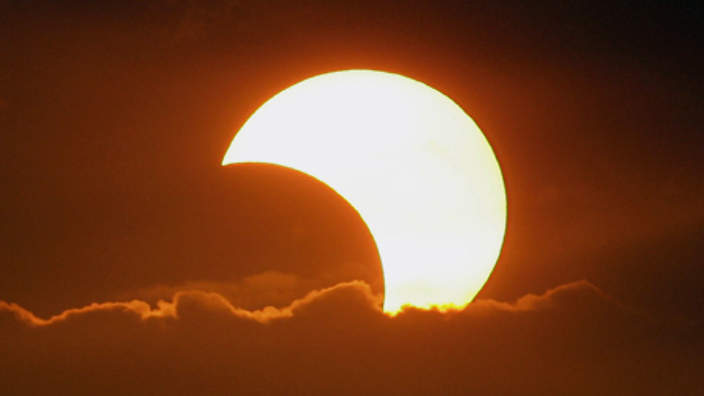
This image is an example of
a)
Lunar Eclipse
b)
Full Moon
c)
New Moon
d)
Solar Eclipse
86.

What happens during a solar eclipse?
a)
The sun blocks the moon from Earth.
b)
The moon blocks the light from the sun from Earth.
c)
The Earth blocks the moon from the sun.
d)
The Earth blocks the light from the sun on the moon.
87.
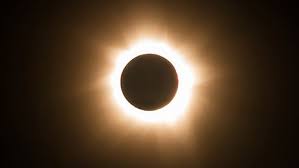
During a solar eclipse...
a)
The sun is blocked by the moon
b)
The Earth is blocked moon
c)
The moon is blocked by the sun
d)
You are blocked
88.
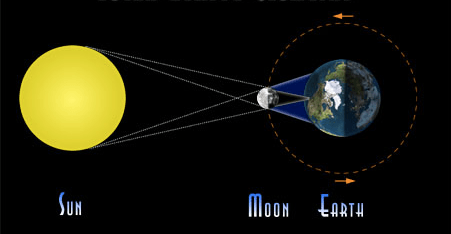
Which type of eclipse is shown in this picture?
a)
Solar Eclipse
b)
Orbit
c)
Lunar Eclipse
d)
Total Eclipse
89.
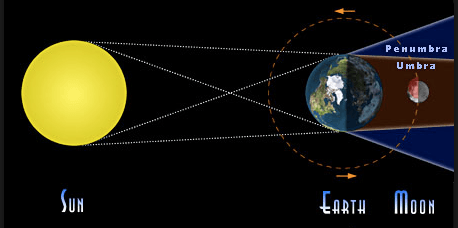
Which type of eclipse is shown in the diagram?
a)
Solar Eclipse
b)
Lunar Eclipse
c)
Total Eclipse
d)
Partial Eclipse
90.

We do NOT have a solar or lunar eclipse each month because...
a)
The tilt of the moon's orbit is at 5 degrees
b)
The moon is too small
c)
The moon's orbital distance changes
d)
All choices
91.
About how many days would it take the Moon to go from position 1 to position 5?
a)
7.5 days
b)
15 days
c)
30 days
d)
one year
92.
About how many days would it take the Moon to go from position 1 back to position 1?
a)
7.5 days
b)
15 days
c)
30 days
d)
one year
93.
We see Moon phases because the Moon
a)
revolves around the Earth.
b)
rotates on its axis.
c)
reflects sunlight.
d)
stands still.
100 %

