
NEW
Font size
S
M
L
XL
 Worksheets
Chemical Reactions Review
Total questions: 31
Worksheet time: 16mins
Name
Class
Date
1.
If the atoms of an object are moving slow, the object's temperature would feel...
a)
Cold
b)
Hot
c)
Unknown
2.
If the atoms of an object are moving fast, the temperature of the object would be...
a)
High
b)
Low
c)
Unknown
3.
Select the correct vocabulary term: Anything that has mass & takes up space.
a)
gravity
b)
force
c)
matter
d)
volume
4.
Select the correct vocabulary term: Substances that form as the result of a chemical reaction.
a)
products
b)
reactants
c)
coefficients
d)
subscripts
5.
Select the correct vocabulary term: Substances present at the start of a chemical reaction.
a)
subscripts
b)
coefficients
c)
reactants
d)
products
6.
What is the Law of Conservation of mass?
a)
Mass is created in a chemical reaction
b)
Mass is created in a physical change
c)
New chemicals formed from a chemical reaction have a larger overall mass than the original reactants
d)
Mass is never created or destroyed
7.
Which of the following is evidence of a chemical reaction?
a)
Phase change
b)
No new substance
c)
Bubbles forming
d)
Shape change
8.
Which of the following is NOT Evidence of a chemical change?
a)
New substances
b)
Heat produced
c)
Phase change
d)
Light produced
9.
In a reaction A + B ----> C, reactant A is 5g and product C is 9g. How many grams is reactant B?
a)
4g
b)
5g
c)
9g
d)
14g
10.
If a chemical reaction starts with 20g of reactants it should produce how many grams?
a)
a total of 40g of products
b)
a total of 10g of products
c)
a total of 80 g of products
d)
a total of 20g of products
11.
Which of these is NOT a chemical reaction?
a)
Burning of wood
b)
Milk going bad
c)
Mixing vinegar and baking soda
d)
Melting of ice
12.
A precipitate is a...
a)
liquid that forms when two solids are reacted
b)
a solid that forms when two liquids are mixed
c)
a gas that forms when vinegar and baking soda react
d)
a change of color in a solution
13.
Jack has a rock. The rock has a mass of 14g and a volume of 2cm3. What is the density of the rock?
a)
7 mL
b)
7 g/cm3
c)
28 g/cm3
d)
1/7 g/cm3
14.

What is the volume of Object X?
a)
10.0 cm3
b)
15.0 cm3
c)
20.0 cm3
d)
25.0 cm3
15.
What is the formula for density?
a)
density = mass x volume
b)
density = mass / volume
c)
density = mass + volume
d)
density = mass - volume
16.
A scientist has four different liquids and pours them all into a bottle. The silver liquid sinks to the bottom, the red liquid settles on top of the silver one, and the pink liquid stays at the surface. Which liquid has the smallest density?
a)
the pink liquid
b)
the silver liquid
c)
the red liquid
d)
the water
17.
The density of water is 1g/ml. Will an object with a density of 0.999g/ml sink or float in water?
a)
sink
b)
float
18.
Why do some substances float on water?
a)
they are warmer than water
b)
they are cooler than water
c)
they are more dense than water
d)
they are less dense than water
19.
Physical or Chemical Change: Dissolving sugar in water.
a)
physical change
b)
chemical change
20.
Select the physical change below.
a)
melting ice
b)
burning wood
c)
rotting food
d)
rusting iron
21.
Select the chemical change.
a)
freezing fruit juice
b)
slicing a potato
c)
boiling water
d)
copper metal turning green
22.
A clear liquid is poured into a beaker that contains a second clear liquid. As the two chemicals meet a yellow solid is formed. What evidence helps you to identify the type of change?
a)
Precipitate and change in color, Physical Change.
b)
Color change, Physical Change
c)
There are two liquids, Chemical change.
d)
New substance (precipitate) and change in color, Chemical Change.
23.
What is the phase change of a solid to a liquid?
a)
freezing
b)
melting
c)
boiling
d)
condensation
24.
Change from Gas to Solid is called........
a)
Sublimation
b)
Deposition
c)
Fusion
d)
condensation
25.

Beaker 1 begins boiling at 100°C. At what temperature will Beaker 3 begin to boil?
a)
300 ˚C
b)
100 ˚C
c)
200 ˚C
d)
50 ˚C
26.
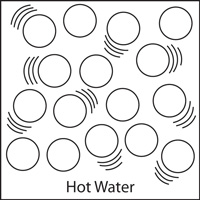
The speed of the molecules of a substance determines the _____ of the substance.
a)
volume
b)
density
c)
pressure
d)
temperature
27.

The molecules in the picture are tightly held together with little movement. They have shape and energy. Therefore, the picture represents _________.
a)
solid
b)
liquid
c)
gas
d)
plasma
28.
All matter is made of...
a)
energy
b)
atoms
c)
electrons
d)
compounds
29.
The central region of an atom that contains neutrons and protons is called the...
a)
nucleus
b)
electron cloud
c)
core
d)
center
30.
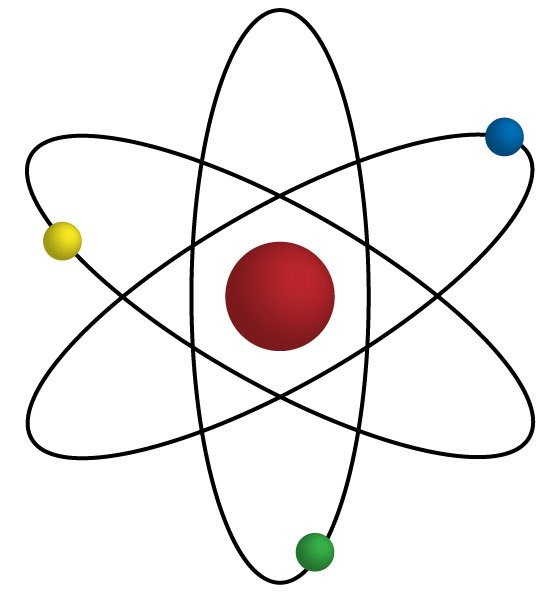
What are the 3 particles that make-up the atom?
a)
protons, neutrons, and isotopes
b)
neutrons, isotopes, and electrons
c)
positives, negatives, and electrons
d)
protons, neutrons, and electrons
31.

What is the volume of the glue?
a)
10 mL
b)
13 mL
c)
8 mL
d)
21 mL
Reset

