
 Worksheets
Cell Theory/Microscope
Total questions: 15
Worksheet time: 11mins
Name
Class
Date
1.
Who noted that animals are made of cells and concluded that all living things are made of cells and cell products?
a)
Rudolf Virchow
b)
Anton van Leeuwenhoek
c)
Theodor Schwann
d)
Robert Hooke
2.
Which is not a part of cell theory?
a)
All organisms are made of cells
b)
All existing cells come from preexisting cells
c)
All matter is composed of living cells
d)
The cell is the most basic unit of life
3.
Which of the following is NOT one of the three parts of Cell Theory?
a)
All living things are made of cells.
b)
The cell is the smallest living thing that can perform all the functions of life.
c)
Cells are too small to see without a microscope.
d)
All cells must come from pre-existing cells.
4.
Who discovered that cells come from preexisting cells and whose research lead to the major principles of cell theory?
a)
Matthias Schleiden
b)
Robert Hooke
c)
Zacharias Janssen
d)
Rudolf Virchow
5.

Number 3
a)
Ocular Lens
b)
Objective Lens
c)
Diaphragm
d)
Base
6.

Number 8
a)
Base
b)
Stage
c)
Tube
d)
Arm
7.
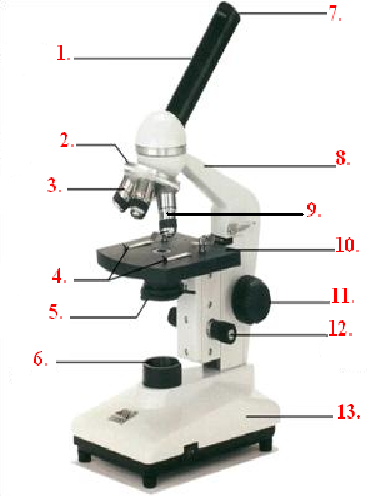
Number 10
a)
Stage
b)
Stage Clips
c)
Diaphragm
d)
Base
8.
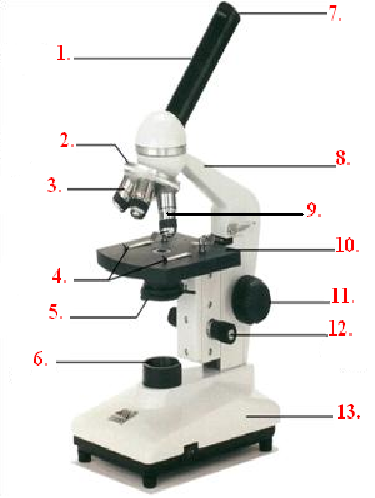
Number 12
a)
Course Adjustment
b)
Fine Adjustment
c)
Small Adjuster
d)
Large Adjuster
9.

Number 11
a)
Course Adjustment
b)
Fine Adjustment
c)
Small Adjuster
d)
Large Adjuster
10.

Number 5
a)
Knob
b)
Ocular Lens
c)
Diaphragm
d)
Objective Lens
11.
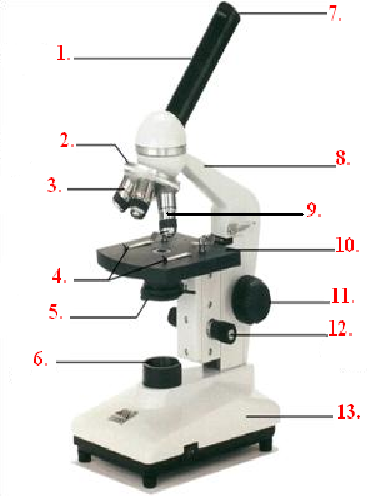
Piece 7
a)
Ocular Lens/Eyepiece
b)
Objective Lens
c)
Base
d)
Arm
12.

If you move the slide left while viewing, in which direction will it appear to move?
a)
right
b)
left
c)
up
d)
down
13.

What is number 15?
a)
light source
b)
base
c)
coarse adjustment
d)
fine adjustment
14.
Find the total magnification:
Eyepiece = 10X
Objective lens = 55X
Eyepiece = 10X
Objective lens = 55X
a)
10x
b)
55x
c)
65x
d)
550x
15.
What year did Robert Hooke identify and name cells?
a)
1665
b)
1839
c)
1838
d)
1675
100 %

