
 Worksheets
2.5 IB Enzymes #1
Total questions: 25
Worksheet time: 2hrs 47mins

What do humans need to digest the lactose in milk?
a substrate
an enzyme
an acid
a product

What is structure labeled E, F, and G?
Substrate
Active site
Enzyme
Products
Enzymes are capable of increasing the rate of a chemical reaction within a living cell. Enzymes accomplish this through which of the following means?
reducing the number of products
reducing the activation energy
increasing the temperature of the cell
increasing the concentration of reactants

What is structure D?
substrate
active site
enzyme
products
Which of the following is NOT true about enzymes?
enzymes speed up chemical reactions
enzymes react best at a specific temperature
enzymes only control ONE type of reaction
enzymes are made of polysaccharides
Which of the following can influence the rate of reaction when an enzyme is involved? (4)
pH
temperature
substrate concentration
enzyme concentration
reaction vessel
What makes an enzyme substrate specific?
size
shape
name
location it is found in
What is the optimum pH of pepsin which is found in the stomach gastric juice of humans?
pH 5
pH 2
pH 7
pH 9
Which of these is NOT true?
Enzymes can denature (change shape) when the temperature gets too high
Enzymes can only be used once in a chemical reaction
Enzymes can denature when the pH changes
Enzymes speed up chemical reactions

What is broken down by the enzyme amylase, which is found in saliva?
sugar
starch
oils
protein
What 3 letters do enzymes typically end in?
-ose
-ase
-ese
-tic
Enzymes are proteins that help increase the rate of chemical reactions inside cells. These proteins are composed of many simpler molecules called amino acids. Which of the following suggests that the shape of an enzyme determines the enzyme’s function?
Enzymes are specific to a substrate
Enzymes can operate in a wide range of conditions
Enzymes are activated by neighboring molecules
Enzymes can be found in all life-forms

Enzymes speed up reaction rates by changing...
activation energy
pH
hydrogen Bonds
kinetic energy

When a molecule can occupy the same active site as the substrate, a situation called __________________ can result
competitive inhibition
allosteric regulation
non-competitive Inhibition
feedback inhibition
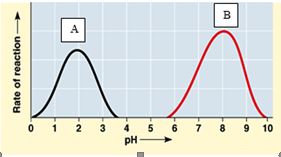
Which enzyme is most efficient in a basic (alkaline) solution?
A
B
both are equally efficeint
neither are efficient in a basic solution

Denaturation is when....
an enzyme loses its shape after it has catalyzed an reaction
an enzyme loses its shape due to it's secondary, tertiary, and possibly quaternary structure bonds being broken
an enzyme loses its shape due to allosteric inhibition
an enzyme loses its shape due to hydrogen bonding
Increasing substrate concentration increases the rate of reaction. This is because....
less substrate molecules will be colliding with enzyme molecules, so less product will be formed
more substrate molecules will be colliding with enzyme molecules, so more product will be formed
the temperature will increase, resulting in faster reactions
the rate of denaturation of enzymes will decrease

At high temperatures enzyme activity declines because of....
denaturation
decreased kinetic motion
increased hydrogen-bonding
dissociation of ionic compounds

Venus flytraps produce chemicals that facilitate in the break down insects into usable compounds. These chemicals are most likely.....
hormones
lipids
enzymes
carbohydrates
The enzyme known as ‘catalase’ is involved in the breakdown of hydrogen peroxide molecules into separate water and oxygen molecules. During this reaction, what happens to the enzyme ‘catalase’?
it would become products: O2 and H2O
it would be fully used up and discarded
it would remain unchanged in any way
it would become a new type of enzyme
By what chemical process are enzymes synthesized?
polymerization of carbohydrates
condensation reaction between fatty acids and glycerol
peptide bonding of amino acids
hydrolysis of polysaccharides
Why does exposure to high temperatures cause an enzyme to lose its biological properties?
The substrate blocks the active site at high temperatures.
The three dimensional structure of the enzyme becomes changed.
Chemical reactions cannot take place at high temperatures.
High temperatures increase the activation energy of reactions.
What is the name given to enzyme driven reactions synthesize complex molecules in living organisms from simpler ones?
Anabolism
Catabolism
What are essential for all metabolic processes?
Enzymes
Carbohydrates
Lipids
All of these

What does the letter A represent?
Activation energy
Substrate energy
Product energy
Reaction time

