
 Worksheets
Matter: Properties & Change Test Review
Total questions: 66
Worksheet time: 2hrs 43mins
Name
Class
Date
1.
A characteristic that is observed by your senses is a
a)
physical property
b)
physical change
c)
chemical property
d)
chemical change
2.
Humidity is an example of a ___ state of matter.
a)
solid
b)
liquid
c)
gas
d)
physical
3.
Which of the following is an example of a chemical property?
a)
the ability to burn
b)
the ability to melt
c)
the ability to evaporate
d)
the ability to freeze
4.
Which of the following can be a characteristic of both a physical and a chemical change?
a)
change is size
b)
change in color
c)
change in density
d)
change in mass
5.
A baked cake is a good example of a
a)
chemical property
b)
physical change
c)
chemical change
d)
physical property
6.

a change of state when a gas becomes a liquid
a)
melting
b)
freezing
c)
condensation
d)
boiling
7.

What happens to particles of a substances when heat energy is taken away?
a)
particles speed up and move closer
b)
particles slow down and move apart
c)
particles slow down and move closer
d)
particles speed up and move apart
8.
What happens in ALL chemical changes?
a)
Change in state of matter
b)
A new substance is formed
c)
Bubbles are produced
d)
An explosion
9.
____________ is defined as anything that has mass and takes up space.
a)
volume
b)
mass
c)
matter
d)
atom
10.

Is Gatorade powder dissolving in water physical or chemical change?
a)
Physical
b)
Chemical
11.

Is mold growing on cheese a physical or chemical change?
a)
Physical
b)
Chemical
12.
Color, smell, and density are examples of what type of property?
a)
chemical
b)
physical
13.

Is wood burning a physical or chemical change?
a)
Physical
b)
Chemical
14.

Is the formation of the Grand Canyon a physical or chemical change?
a)
Physical
b)
Chemical
15.
melting is an example of
a)
chemical change
b)
physical change
16.
A change that only affects the appearance of a substance (its size, shape, or state of matter)
a)
physical change
b)
chemical change
17.
Law of Conservation of Matter states that
a)
the mass of an object will stay the same even if it goes through a change
b)
matter will change mass if it goes through a change
18.
Changes can usually be reversed
a)
chemical change
b)
physical change
19.
The measurement of the pull of gravity on an object
a)
density
b)
mass
c)
volume
d)
weight
20.
Measurement of the amount of matter in an object
a)
mass
b)
density
c)
volume
d)
weight
21.
Rusting nail
a)
Chemical change
b)
physical change
22.
a change in which one kind of matter changes into a different kind of matter with different properties
a)
chemical change
b)
physical change
23.
baked cake
a)
chemical change
b)
physical change
24.
mixing sugar and lemon juice to make lemonade
a)
chemical change
b)
physical change
25.
fireworks
a)
chemical change
b)
physical change
26.
slicing bread
a)
chemical change
b)
physical change
27.
change gives off an odor
a)
chemical change
b)
physical change
28.
change produces light and/or heat
a)
chemical change
b)
physical change
29.
Which statement best explains why fruit salad is classified as a mixture?
a)
The components can be easily separated.
b)
When heated, a new substance is formed.
c)
The ingredients will combine to make new matter.
d)
The physical properties of the components change.
30.
Sam had a piece of chalk that had a mass of 3 grams. He smashed it with a hammer
into smaller pieces. He gathered all the pieces up and used a balance to measure the mass of the chalk.
The mass of the chalk ___________.
into smaller pieces. He gathered all the pieces up and used a balance to measure the mass of the chalk.
The mass of the chalk ___________.
a)
increased
b)
decreased
c)
stayed the same
31.
On a warm, sunny afternoon, ocean water splashed onto a rock. A short time later, the
rock was dry. Which statement best explains what happened to the water on the rock?
rock was dry. Which statement best explains what happened to the water on the rock?
a)
Salt caused the water to become a gas.
b)
Heat caused the water to become a gas.
c)
Salt melted the water and it disappeared.
d)
Heat melted the water and it disappeared.
32.
Taylor put iron filings and sand in a jar. She put a lid on the jar and shook it until the two
materials combined, but the materials did not bond together. What did Taylor make?
materials combined, but the materials did not bond together. What did Taylor make?
a)
mixture
b)
solution
c)
gas
d)
molecule
33.
A balance is used to measure ______.
a)
mass
b)
volume
c)
density
d)
weight
34.
A glass of iced tea is placed on a table. After 10 minutes, there are drops of water on
the outside surface of the glass. Which change in phase caused the drops of water?
the outside surface of the glass. Which change in phase caused the drops of water?
a)
Liquid water in the air evaporated into a gas.
b)
Liquid water in the air condensed into a solid.
c)
Water vapor from the air evaporated into a liquid.
d)
Water vapor from the air condensed into a liquid.
35.
When water changes from solid to liquid to gas, which statement is true?
a)
The mass increases.
b)
The mass stays the same.
c)
The mass decreases.
36.
What two physical properties could best describe a basketball?
a)
color and texture
b)
weight and solubility
c)
size and magnetism
d)
magnetism and hardness
37.
A student used a balance to find the mass of an ice cube. They let the ice cube melt
and found the mass of the melted water. Both the ice cube and the water had a mass of
5 grams. Choose the statement that best explains why this happened with water.
and found the mass of the melted water. Both the ice cube and the water had a mass of
5 grams. Choose the statement that best explains why this happened with water.
a)
Mass stays the same whether the object is together or in parts.
b)
Mass stays the same even when water changes states.
c)
No two objects can occupy the same space at the same time.
38.
What kind of change occurs when wood is chopped into pieces?
a)
physical change
b)
chemical change
39.
The unit used for measuring mass is
a)
cubic centimeters
b)
liters
c)
Newtons
d)
grams
40.
What is made when materials combine and bond together to make a new substance which cannot be easily separated?
a)
love
b)
solution
c)
simple mixture
d)
tacos
41.
Which of the following always occurs during a chemical change?
a)
change in color
b)
formation of a new substance
c)
emission of heat or light
d)
all of the above
42.
A physical change can result in?
a)
a change in size
b)
a change in state
c)
a change in shape
d)
all of the above
43.
I weight a piece of paper and it weighed 12 grams. I performed a change on it and it still weighed 12 grams. What kind of change did I perform on the paper?
a)
change in appearance
b)
chemical change
c)
change is diet
d)
physical change
44.
I weigh an apple and then in went through a change. Before the change the apple weighed 126 grams. After the change the apple weighed 52 grams. What kind of change did the apple go through?
a)
chemical change
b)
change is season
c)
change is color
d)
physical change
45.
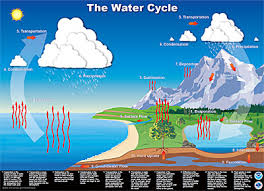
During which stage do clouds form?
a)
condensation
b)
evaporation
c)
precipitation
46.

What is it called when plants give off water vapor as a waste product?
a)
condensation
b)
evaporation
c)
sublimation
d)
transpiration
47.
What is the energy source for the water cycle?
a)
the sun
b)
the earth
c)
water
d)
the moon
48.

What is water that flows in rivers and streams into the oceans and lakes?
a)
evaporating
b)
condensing
c)
precipitating
d)
runoff
49.
Where is most water found on Earth?
a)
glaciers
b)
lakes
c)
rivers
d)
oceans
50.
What type of precipitation forms when raindrops fall through cold air and freeze before they hit the ground?
a)
Rain
b)
Freezing Rain
c)
Sleet
d)
Snow
51.
What is water vapor?
a)
Water on the land (geosphere)
b)
Water in the air (atmosphere)
c)
Water in plants
d)
Water in the water (hydrosphere)
52.
Which is the opposite of condensation?
a)
runoff
b)
evaporation
c)
precipitation
d)
transpiration
53.
Which best explains why runoff is important?
a)
It returns water to other locations on Earth
b)
It increases the chance of flooding
c)
It makes evaporation occur faster
d)
It increases condensation
54.
Snow, sleet, hail, and rain are all examples of ________________.
a)
evaporation
b)
condensation
c)
accumulation
d)
precipitation
55.
When water _________, dew forms.
a)
Melts
b)
Evaporates
c)
Condenses
d)
Precipitates
56.

What does this illustration show?
a)
Sunrise
b)
The Water Cycle
c)
Sunset
d)
the recycling of snow
57.
The sun's energy
a)
changes daily
b)
heats the ocean before evaporation
c)
directly causes evaportation
58.
Heat from the sun's energy most directly affects which part of the water cycle?
a)
evaporation
b)
precipitation
c)
transpiration
d)
condensation
59.
Plants give off excess water by...
a)
precipitation
b)
condensation
c)
transpiration
d)
infiltration
60.

The map shows the location of South Carolina. South Carolina is humid during the summer months. Which of the following is the most likely cause of the humid conditions?
a)
runoff from inland mountains
b)
flooding from rivers and streams
flooding from rivers and streams
c)
groundwater bubbling to the surface
d)
evaporation from the surface of the ocean
61.
Transpiration requires _________.
a)
Cold
b)
Mild Climate
c)
Heat
62.
What is the water cycle?
a)
the 3 forms of water
b)
the movement of water on, above, or below the surface of the Earth
c)
when water melts
d)
when clouds form
63.

The image is a model showing the processes of the water cycle. Water uptake to the atmosphere occurs through the processes of evaporation and transpiration from plants where it condenses to form clouds. Clouds release the water through precipitation. During a summer of extreme drought, what can we expect to happen to the surface ground water stored in ponds and lakes?
a)
water levels will increase because there is more precipitation
b)
animals won't drink as much to save water, so water levels remain the same
c)
water levels will increase because there is more evaporation and transpiration
d)
water levels will decrease because there is more evaporation and transpiration
64.
All our sources of fresh water, like rivers, wells, and aquifers, are dependent on _______________ to replenish and maintain themselves.
a)
the water cycle
b)
sanitation plants
c)
desalination
d)
oxygenation
65.
Which best describes the composition, or make-up, of clouds?
a)
They are made of heated air.
b)
They are made of air pollution.
c)
They are made of tiny droplets of water.
d)
They are made of carbon dioxide and oxygen.
66.
Rivers, springs, and aquifers are all fresh water components of the hydrologic cycle/water cycle. As this water progresses through the cycle, it will eventually ___________ into the atmosphere before ____________ and falling back to the earth as precipitation.
a)
condense; evaporating
b)
evaporate; condensing
c)
dissolve; cloud-forming
d)
condense; precipitating
100 %

